AI Receptionist UK: Your Options Compared for 2026

An AI receptionist answers your phone, handles routine questions, books appointments and passes the call to a person when it should. In the UK you can buy one in four broad forms: a self-serve answering app, a hybrid of AI and human staff, a bundle from your phone provider, or a custom-built agent connected to your own systems. The right one depends less on price than on what happens to the call afterwards: does the enquiry reach your CRM, your diary and the right colleague?
This guide compares the four types on the criteria that matter to an established UK organisation, and is blunt about where an AI receptionist should not be used.
TL;DR
- There are four types of AI receptionist: self-serve apps, AI plus human hybrids, telecom bundles and custom agents built on your own systems.
- Cheap, standalone tools suit simple call capture. Anything involving members, clients or high-value enquiries needs a link to your CRM and calendar.
- UK GDPR still applies: carry out a data protection impact assessment, tell callers they are speaking to AI and keep recording off unless you need it.
- Keep a person in charge of complaints, vulnerable callers, money problems and anything sensitive, with a fast route to reach them.
- Cloud 9 builds the custom option, connecting AI agents to the CRMs, databases and APIs you already run.
Table of Contents
- Why missed calls are worth fixing
- What an AI receptionist actually does
- The four types of AI receptionist compared
- What it costs in the UK
- What UK law and regulators expect
- Where an AI receptionist should not be used
- Examples by sector
- Our perspective: the call is the start of a process
- How to choose: a practical checklist
- How Cloud 9 can help
- FAQ
- Sources
Why missed calls are worth fixing
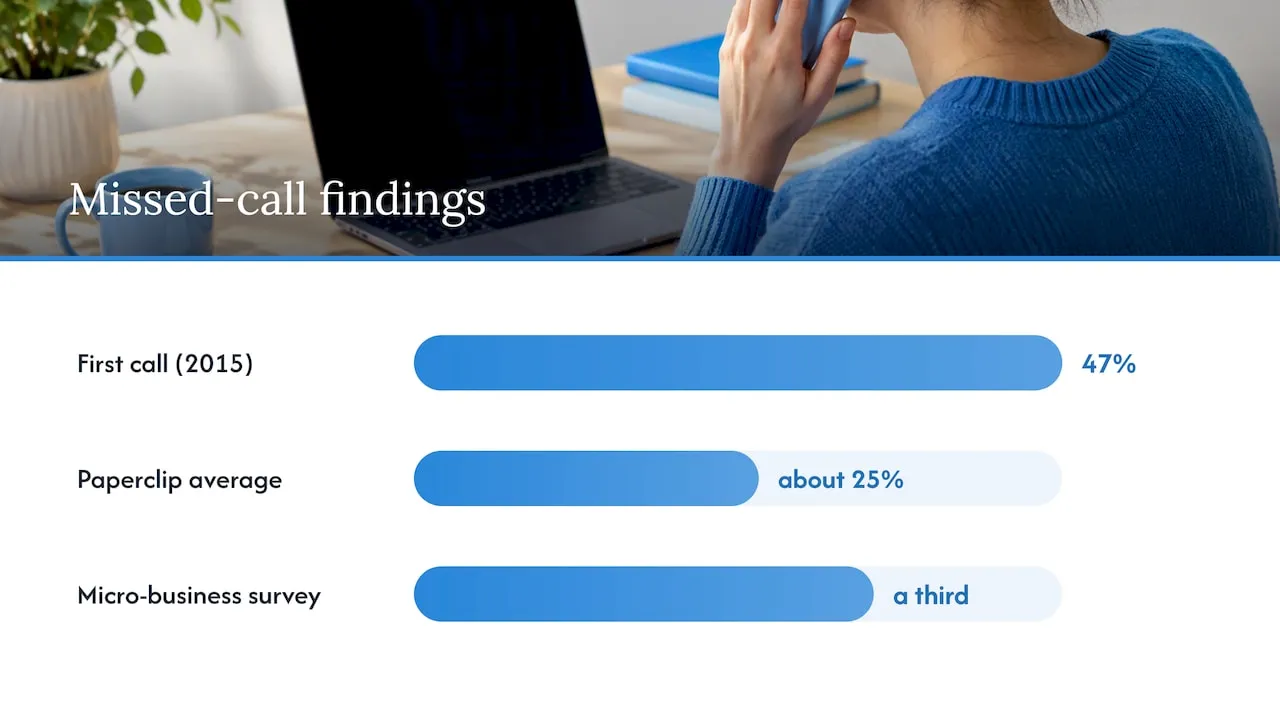
Phone enquiries are often your highest-intent leads, and they disappear quickly. A UK telephone study of 142 small businesses found that 47% missed the first call. It is an older study (2015) and a small sample, so treat it as an indicator, not a benchmark. More recent analysis by Paperclip suggests a reasonable average for missed calls across sectors is about 25%, with big variation between sectors, and a survey of micro-businesses, mainly tradespeople, found a third of calls went unanswered.
The pattern is familiar in the organisations we work with. A recruitment consultancy misses a candidate call while the team is in interviews. A membership body gets a surge of renewal queries in the week invoices go out. A security firm’s out-of-hours enquiries wait until Monday. A professional services firm loses a new-client call because everyone is with clients.
Not every missed call needs AI. If your volume is low and one person can reliably pick up, a good rota may be cheaper and better. AI earns its place when calls are repetitive, spiky or out of hours, and when the answers already exist in your documents and systems.
What an AI receptionist actually does
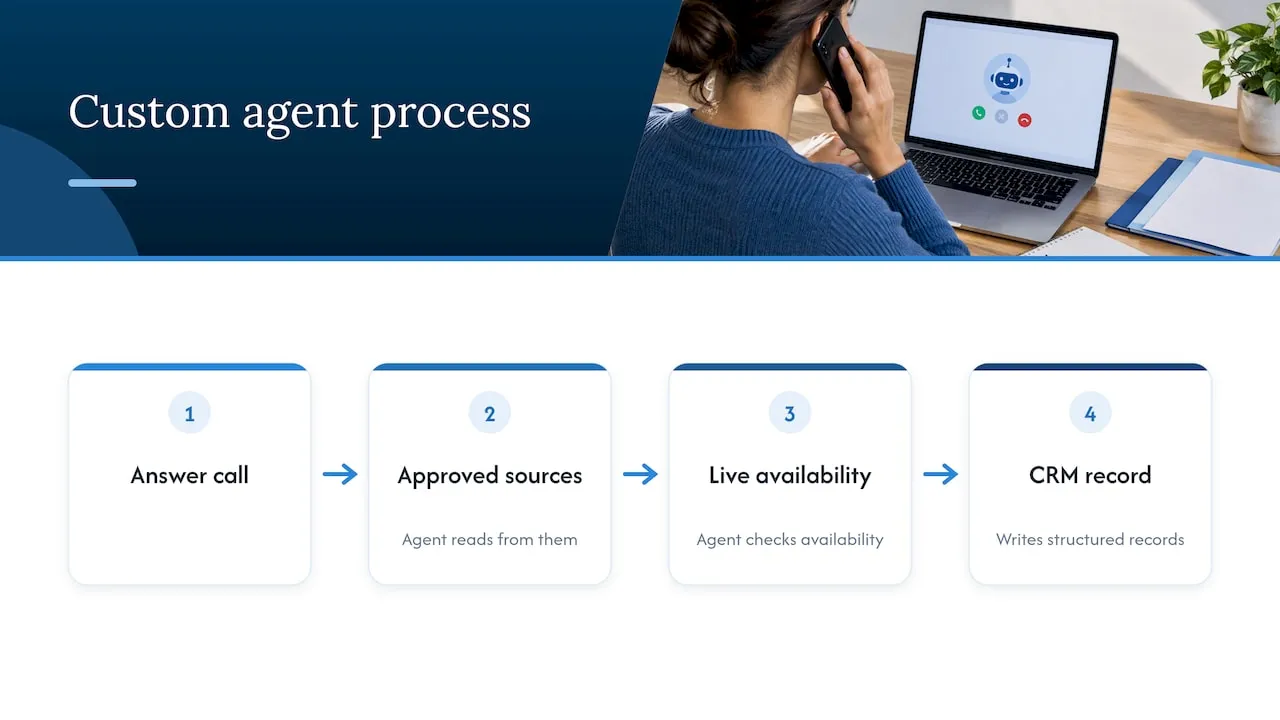
The label covers very different things. At the basic end it is a phone menu with a nicer voice: it follows a script, takes a message and emails you. At the advanced end it is an AI agent that understands what the caller wants, looks up information from approved sources, checks a live diary, books a slot, updates a record and hands the call to a named person with a summary.
When you evaluate any option, ask four things:
- Where does it get its answers? From a fixed script, or from your approved documents that you can update?
- What can it do beyond talking? Book, reschedule, create a CRM record, send a confirmation, trigger a workflow?
- What happens when it cannot help? Is there a warm transfer to a person, or just a voicemail?
- Where does the data go? Who stores transcripts and recordings, for how long, and in which country?
The four types of AI receptionist compared
| Self-serve app | AI plus human hybrid | Telecom bundle | Custom agent on your systems | |
|---|---|---|---|---|
| Typical buyer | Sole traders, small teams | Firms wanting a human fallback | Organisations already using a cloud phone system | Established organisations with a CRM, membership or booking system |
| Set-up effort | Hours | Days to weeks | Days | Weeks, scoped to your processes |
| Answers from | Script or uploaded FAQ | Script plus human PAs | Menu logic and basic FAQs | Your approved documents and live data |
| CRM and diary integration | Often limited to a few common tools | Varies | Usually tied to the phone platform | Designed around your stack |
| Human escalation | Basic transfer or message | Built in, the main selling point | Basic | Defined by your rules, per call type |
| Pricing shape | Low monthly fee, often with usage limits | Higher monthly fee, often per call or per minute | Add-on to line rental | Project plus support retainer |
| Main risk | Becomes an isolated silo | Cost rises with call volume | Limited flexibility | Needs a proper scoping process |
Self-serve apps
These are the cheapest route and the quickest to start. You sign up, upload some information, point a number at the service and it begins answering. They work well for straightforward businesses with a short list of questions and a single diary. The weakness is isolation: if the app captures the lead but your CRM never receives it, someone has to retype it, and the time saved at the front is lost at the back.
AI plus human hybrids
These combine an automated first response with human staff for anything the AI cannot resolve. They suit organisations where the call is sensitive and the volume is moderate. The trade-off is cost per interaction, and the fact that your human fallback is a third party who is not inside your systems or familiar with your members or clients.
Telecom and VoIP bundles
If you already use a cloud phone provider, an AI answering add-on is convenient: one supplier, one bill, call routing in the same place. It tends to handle routing and message-taking well. It is less suited to complex workflows that need to read and write to a membership database or case management system.
Custom agents built on your systems
This is where the receptionist is treated as one front door to a wider process, not a product. The agent is configured around your call types, reads from approved sources, checks live availability and writes structured records into your CRM. It costs more to set up and requires clear decisions about scope, but it is the only route that removes the admin behind the call, not just the call itself.
What it costs in the UK
Published prices move quickly, and most are on supplier pages that also sell the product, so treat any figure as a snapshot. Entry-level self-serve plans are typically a low monthly subscription, hybrid services with human support cost noticeably more, and custom integration adds a one-off set-up fee. One UK price guide puts the usual small-business range at around £30 to £99 a month for basic plans, with set-up fees from nothing to around £1,500 depending on integration. We link it for context only, since the publisher sells such a product.
Three cost traps recur:
- Usage limits. A low headline fee may cap minutes or calls. A busy week can double the bill.
- Integration charges. Connecting to a CRM or booking system is often an extra, or only available on higher tiers.
- Hidden staff time. If someone must reconcile the AI’s messages with your systems, you have moved the cost, not removed it.
We do not publish a price for our AI work, because scope varies too much by organisation: a membership body with a renewals line has very different needs from a recruitment firm with candidate calls. We scope against a clear business case, which is the right way to judge any option here.
What UK law and regulators expect
This is general guidance, not legal advice. Your data protection officer or solicitor should sign off the final design.
There is no UK law that bans AI call handling, but UK GDPR applies to everything the system collects: names, phone numbers, the content of what callers say, and recordings or transcripts if you keep them. The ICO’s guidance on AI and data protection sets out the principles, including fairness, transparency and accountability, that you should work through before going live.
In practice, we recommend:
- Complete a data protection impact assessment before launch, because you are handling personal data in a new way at scale.
- Tell callers at the start that they are speaking to an automated assistant, and say how to reach a person.
- Update your privacy notice to cover call data, the purpose and how long you keep it.
- Switch recording off by default and enable it only where you have a clear reason and lawful basis.
- Check where data is processed and stored, and what your supplier’s contract says about using calls to train their models.
The UK regulator Ofcom has also been gathering views on consumer-facing AI in telecoms. A response from the Communications Consumer Panel’s member network describes AI adoption among its members as growing but still early-stage and uneven, most visible in customer-facing support. That matches what we see: plenty of interest, patchy execution.
Where an AI receptionist should not be used
A receptionist is the first impression of your organisation. Some calls should never be left to a machine alone:
- Complaints and disputes. A frustrated caller who gets a bot may escalate to a formal complaint or leave.
- Vulnerable callers. Charities, advice services and professional firms advising on debt, bereavement or health must have a human route available at once.
- Safeguarding and security incidents. A security firm’s emergency line, or any call that signals risk to a person, goes to a trained human immediately.
- Legal, financial or medical advice. The agent can book the appointment. It must not give the advice.
- High-value, bespoke enquiries. A major prospect or a long-standing member deserves a named contact, with the AI used to prepare the handover, not replace it.
Design these rules before you choose a tool. A good system lets you define, call type by call type, what the AI may do alone, what it must pass on, and how quickly.
Examples by sector
Membership bodies and trade associations. Typical calls are about renewals, event bookings, certificates and login problems. An agent that reads from approved member guidance and looks up membership status can resolve many of these. Anything about disciplinary matters, complaints or a member in difficulty goes to staff.
Recruitment. Candidates call about application status and interview times; clients call about vacancies. The AI can capture structured details and write them to the applicant tracking system or CRM. Placement conversations and salary negotiation stay with consultants.
Security. Quote requests, site visit scheduling and routine queries can be handled out of hours. Alarm and incident calls are routed to a named responder, with the AI only logging and escalating.
Charities. Donation queries, event questions and volunteer enquiries suit automation. Calls from beneficiaries or anyone distressed need a person, and wording must be reviewed carefully.
Professional services. New enquiry capture, booking an initial consultation and chasing documents work well. Matter-specific questions go to the fee earner. Our guide to automated appointment scheduling covers the booking side in more detail.
Ecommerce. Order status, delivery and returns questions are repetitive and data-driven, ideal when the agent can read live order data. Refund disputes go to staff.
Our perspective: the call is the start of a process
Most buyers treat an AI receptionist as a purchase of software. We treat it as a workflow question. A call is an enquiry that needs to land in the right system, with the right data, in front of the right person, with a record of what was promised. If the AI answers beautifully but your team still re-enters everything, you have bought a nicer answerphone.
Our background is more than 20 years connecting websites, databases, CRMs, APIs and membership systems, so we start from the systems you already run and work outwards. We look at how the work happens today, which call types are routine, what the business case is, and where a person must stay in control. Then we build the agent to read from approved sources only, with clear limits on the data it can see and write, and with human review where the risk warrants it.
That is not always the cheapest first step, and for a one-person business a simple app may be the better choice. If you have a CRM, a membership system or a booking platform behind your phone line, the integration is where the value sits.
— Rob
How to choose: a practical checklist
- List your call types from the last month: who calls, why, and how long each takes. Even a rough tally from your team will do.
- Sort them into: fully automatable, automatable with human review, and human only.
- Map the systems each call touches: CRM, diary, membership database, order system, finance tool.
- Shortlist by type, not brand. Self-serve if your needs are simple and isolated, hybrid if you want human cover and volume is moderate, telecom bundle if routing is the main need, custom if the call feeds a wider process.
- Run a limited pilot on one number or one call type for four to six weeks, with listening reviews and a clear measure such as calls answered, bookings made and handovers that needed no re-entry.
- Complete the DPIA and greeting wording before the pilot goes live, not after.
- Review monthly for wrong answers, unnecessary escalations and gaps in your source documents.
The same discipline applies if you also use chat on your website. Our chatbot pilot approach shows how to set transparency and escalation rules, and the principles carry across to voice.
How Cloud 9 can help
We are an AI consultancy, not a phone service provider. For organisations that want call handling and enquiry capture tied to their own data, we scope and build AI agents and knowledge assistants, and connect them through systems integration to your CRM, diary and databases. If you are not sure where to begin, our AI services start with strategy and readiness, so you decide what to automate before you spend on tools. For the CRM side, what to deploy first is a useful starting point.
FAQ
Do I have to tell callers they are speaking to an AI?
There is no AI-specific UK law that spells out a scripted disclosure, but UK GDPR transparency and the ICO’s fairness principles point firmly towards telling people. We recommend a plain statement in the greeting and an easy way to ask for a person. It also builds trust, because callers who find out later often feel misled.
Can an AI receptionist replace a human receptionist?
For routine, repetitive calls and out-of-hours cover, often yes. For complaints, vulnerable callers and high-value relationships, no. Most organisations do best when AI handles the first response and admin, and staff handle the conversations that need judgement.
What should I connect it to?
At minimum your diary or booking system and your CRM, so every call becomes a structured record and nothing is retyped. Membership bodies should add the membership database, and ecommerce firms their order system. Without these links, the AI becomes a silo.
Is it safe under UK GDPR?
It can be, if you do the groundwork: a data protection impact assessment, an updated privacy notice, a lawful basis, a clear greeting, recording off unless needed and a supplier contract that covers data use and location. Ask your data protection officer or a solicitor to review the final set-up, since the details depend on your sector and callers.
Sources
- Alliance Virtual Offices: small businesses miss almost half of incoming calls
- Paperclip: how many calls do UK businesses miss?
- ICO: guidance on AI and data protection
- Communications Consumer Panel network response to Ofcom call for views on consumer-facing AI in telecoms
- UK AI receptionist cost guide (price context)