

Brand consistency online is the deliberate alignment of a brand’s visual, verbal, and experiential elements across every digital touchpoint to build trust, recognition, and competitive strength. This is the industry term for what marketers call “brand uniformity in digital marketing,” and the two phrases describe the same discipline. The role of brand consistency online is not cosmetic. Companies presenting consistent brands across all platforms see an average revenue increase of 23%. That figure alone tells you this is a commercial priority, not a design preference. For business owners and marketers managing multiple channels, getting this right is one of the highest-return activities available.
What are the core pillars of online brand consistency?
Brand consistency rests on five pillars: naming, visual identity, voice, content strategy, and reputation management. Each one shapes how customers perceive you before they ever speak to your team.
Naming conventions
Your domain, social handles, and business name should match as closely as possible across every platform. Inconsistent naming creates confusion and fragments your search presence. Consistent domain and handle naming also signals professionalism to first-time visitors who find you through search or social.
Visual identity
Logos, colour palettes, and typography must remain uniform across your website, social profiles, email templates, and paid adverts. Visual identity is the fastest signal your brand sends. A customer who sees a mismatched logo on LinkedIn versus your website will question whether they are looking at the same company.

Voice and tone
Your brand voice is how you sound in writing. It covers word choice, sentence length, and the level of formality you use. A consistent brand voice across channels shapes accurate external narratives, including what media outlets and generative AI tools say about you. That is a significant and often overlooked benefit.
Content strategy
A content strategy defines your messaging pillars: the core themes you return to repeatedly. Without one, different team members publish content that pulls in different directions. A unified content strategy keeps every blog post, social update, and email aligned with the same core message.
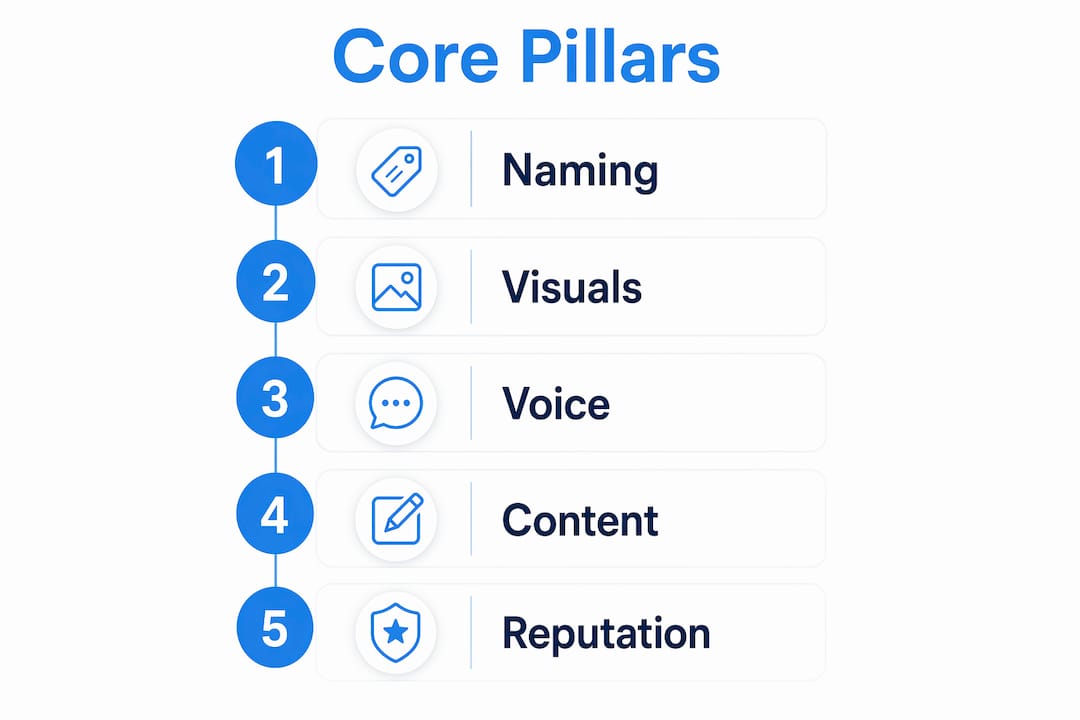
Reputation management
Reputation management means actively monitoring what is said about your brand across review platforms, social media, and search results. It is the fifth pillar because the other four can be executed perfectly and still be undermined by unaddressed negative reviews or off-brand third-party content.
Pro Tip: Conduct a quarterly brand audit. Search your brand name across Google, LinkedIn, Facebook, and any review platforms relevant to your sector. Note every instance where your logo, name, or tone differs from your brand guidelines, then fix the gaps in order of visibility.
How does brand consistency affect engagement and competitive advantage?
Brand consistency directly increases revenue, trust, and customer loyalty. The mechanism is straightforward: when customers see the same signals repeatedly, they build a mental model of your brand. That model reduces the cognitive effort required to make a buying decision.
“Brand trust is the most statistically significant factor in achieving competitive advantage online, with a beta coefficient of 0.356 at p<0.001. No other digital branding variable came close in the research.”
That finding from digital branding research is striking. It means that among all the things you could do to outperform competitors online, building trust through consistent branding has the greatest measurable effect. Trust is not a soft metric. It is the variable most directly linked to competitive position.
Visual consistency also drives purchase intent. Research on visual cohesion shows it more strongly influences buying intent for emotional brand styles than for detached or functional ones. If your brand carries warmth, personality, or aspiration, visual inconsistency costs you more than it would a purely utilitarian brand.
The practical effects of consistency on engagement follow a clear sequence:
- Recognition builds first. Customers see the same colours, logo, and tone repeatedly and begin to associate them with your business.
- Familiarity follows. Repeated exposure reduces perceived risk, which is the primary barrier to first purchase.
- Trust develops from familiarity. Customers who trust a brand return more often and spend more per visit.
- Advocacy emerges from trust. Loyal customers recommend brands they trust, generating word-of-mouth that no paid channel can replicate.
Brand inconsistency confuses buyers, slows internal operations, and risks direct revenue loss. That is not a theoretical risk. Every time a customer encounters a mismatch between your website and your social profile, you introduce doubt. Doubt delays decisions. Delayed decisions reduce conversion rates.
What challenges does online brand consistency face in a fragmented digital world?
The digital environment has become significantly harder to control. Customers no longer follow a linear path from advert to website to purchase. They arrive through scattered entry points: Instagram posts, Google reviews, ChatGPT summaries, LinkedIn articles, and comparison sites. Each of these touchpoints shapes brand perception, and most of them sit outside your direct control.
Fragmented customer journeys across AI tools, review platforms, and social channels actively fragment brand reputation. That is the defining challenge of brand management in 2026. You can publish perfect content on your own channels and still have AI tools synthesise an inaccurate or mixed picture of your brand from inconsistent signals across the web.
The AI dimension deserves specific attention. Generative AI tools pull from owned assets, third-party mentions, and indexed content. Inconsistencies in owned assets propagate through AI-generated summaries and search outputs, damaging brand authority without any direct action from a competitor. A business whose website describes itself as a “boutique consultancy” while its LinkedIn profile says “full-service agency” will receive mixed signals in AI-generated answers about what it actually does.
| Challenge | Effect on brand | Mitigation approach |
|---|---|---|
| Multiple entry points | Inconsistent first impressions | Audit all public-facing channels quarterly |
| Internal team silos | Mixed messaging across departments | Centralise brand guidelines and asset libraries |
| AI content synthesis | Inaccurate brand narratives in search | Maintain consistent owned-asset messaging |
| Distributed teams | Off-brand execution at scale | Use digital asset management (DAM) platforms |
Internal silos are the most common cause of inconsistency for established businesses. Marketing, sales, and customer service teams often operate with different versions of brand materials. The result is a customer who receives a polished marketing email, a mismatched sales proposal, and an off-brand support response, all within the same week.
Pro Tip: Assign a single brand guardian in your organisation. This person does not need to approve every piece of content, but they should own the brand guidelines document, manage the asset library, and run the quarterly audit. Without a named owner, brand consistency defaults to whoever published last.
How can businesses build and maintain brand consistency online?
Building consistency is a governance challenge as much as a creative one. The creative work produces the guidelines. The governance work makes sure they are followed.
- Conduct a brand audit first. Before creating new assets, catalogue what already exists. List every logo version, colour code, font file, and tone-of-voice document in use across your organisation. Gaps and conflicts become visible immediately.
- Create a single source of truth. A digital asset management (DAM) platform, or even a well-structured shared drive, gives every team member access to approved assets. Effective brand governance requires centralised asset management to prevent off-brand usage. Without a central library, teams default to whatever they can find quickly.
- Write a brand guidelines document. This document should cover logo usage rules, colour codes, approved fonts, voice and tone principles, and messaging pillars. It does not need to be long. A clear, usable ten-page document outperforms an elaborate fifty-page one that nobody reads.
- Build cross-functional collaboration into your workflow. Marketing, sales, product, and customer service teams should all contribute to and be trained on brand guidelines. Consistency breaks down at the handover points between departments.
- Repurpose content systematically. A blog post becomes a LinkedIn article, a short-form social post, and an email newsletter section. Each version carries the same core message in a format suited to the channel. This approach maintains unified messaging across platforms without requiring entirely new content for each one.
- Treat consistency as an ongoing discipline. Brand consistency is not a project with a completion date. It requires regular review, especially when you launch new products, enter new markets, or redesign your website.
Pro Tip: When redesigning your website, use the process as a full brand alignment exercise. A website redesign brief that explicitly references your brand guidelines will produce a far more consistent result than one focused purely on aesthetics.
Key takeaways
Brand consistency online is the single most controllable factor in building customer trust, and trust is the variable most directly linked to competitive advantage in digital markets.
| Point | Details |
|---|---|
| Revenue impact is measurable | Consistent branding across all platforms correlates with an average 23% revenue increase. |
| Trust outperforms all other digital factors | Brand trust has the highest statistical significance for competitive advantage online. |
| AI amplifies inconsistency risks | Inconsistent owned assets propagate through AI-generated summaries, damaging brand authority. |
| Governance makes consistency stick | A named brand guardian, centralised assets, and written guidelines prevent off-brand execution. |
| Consistency is a discipline, not a project | Regular audits and cross-functional collaboration are required to maintain alignment over time. |
Why brand narrative control matters more than ever
The brands I see struggling most with consistency are not the ones with bad design. They are the ones with good design and no governance. They have a beautiful website, a polished logo, and then a LinkedIn page that looks like it was set up by a different company in a different decade. The creative work was done. The discipline was not.
What concerns me most right now is the AI dimension. Businesses are spending time and money on their owned channels while ignoring the fact that generative AI tools are synthesising a version of their brand from whatever signals are available. If those signals are inconsistent, the AI-generated narrative will be too. And that narrative is increasingly the first thing a prospective customer encounters.
The businesses that will hold their ground in this environment are the ones that treat their owned digital assets as the authoritative source. Your website, your published content, your social profiles: these need to tell the same story, in the same voice, with the same visual identity. Not because it looks professional, but because it is now the input data for how AI describes you to your next customer.
Consistency also compounds. A brand that has maintained the same clear identity for three years is significantly harder to displace than one that reinvents itself every eighteen months. Recognition builds slowly and erodes quickly. The businesses that understand this invest in consistency the way they invest in any other long-term asset.
— Rob
How Cloud9 helps you build a consistent online brand
Maintaining brand consistency across a website, social channels, digital marketing campaigns, and CRM communications is genuinely difficult without the right infrastructure behind it.
Cloud9 works with established UK businesses to build the integrated digital systems that make consistency achievable at scale. From web design and development that reflects your brand guidelines precisely, to digital marketing services that carry consistent messaging across every channel, Cloud9 replaces the fragmented supplier model with a single partner who understands your brand end to end. If you are ready to close the gaps between how your business looks, sounds, and performs online, Cloud9 is the place to start.
FAQ
What is brand consistency online?
Brand consistency online is the alignment of a brand’s visual identity, voice, and messaging across every digital channel and touchpoint. It builds recognition, reduces buyer uncertainty, and directly supports revenue growth.
Why does brand consistency affect revenue?
Companies with consistent branding across all platforms see an average revenue increase of 23%, according to the Lucidpress State of Brand Consistency report. Consistency reduces cognitive friction for buyers, which accelerates purchasing decisions.
How does brand consistency affect engagement?
Consistent branding builds familiarity, which reduces perceived risk and increases the likelihood of repeat visits and purchases. Visual consistency in particular has a measurable effect on purchase intention, especially for brands with emotional or personality-driven identities.
What is the biggest challenge to maintaining brand consistency online?
Fragmented customer journeys across social media, review platforms, and AI-generated search summaries are the primary challenge. Inconsistencies in owned assets propagate through AI tools, creating inaccurate brand narratives outside your direct control.
How often should a business audit its brand consistency?
A quarterly audit is the recommended minimum. Search your brand name across all major platforms, compare every public-facing asset against your brand guidelines, and assign a named brand guardian to own the process and resolve gaps.