

A website redesign is defined as the strategic overhaul of a site’s structure, design, user experience, and underlying technology to improve business performance. This is distinct from a simple refresh, which adjusts surface elements like colours or fonts. A full redesign addresses information architecture, conversion pathways, mobile performance, and SEO foundations. For small businesses, membership organisations, and B2B companies, the stakes are high. An outdated site does not just look poor. It loses leads, ranks lower in search, and signals to prospects that your business is behind. This guide covers website redesign explained from definition through to execution, so you can make confident decisions.
What are the key benefits of a website redesign?
A well-planned redesign delivers measurable commercial returns, not just a visual upgrade. Redesigns focusing on UX and conversion strategy yield an average 41% ROI within six months, with full rebuilds reaching 68% ROI within nine months. That figure reflects what happens when redesign decisions are tied directly to business goals rather than aesthetic preferences.
The performance gains extend across several areas:
- Conversion rates. A 1% to 3% conversion rate increase can triple lead generation without additional ad spend. For B2B companies, this is the single most powerful argument for investing in a redesign.
- Search rankings. Technical improvements like mobile-first design and faster load times lead to 50–150% improvement in search engine rankings after a redesign. Better rankings mean more organic traffic without increasing your marketing budget.
- Bounce rates. A properly executed redesign can reduce bounce rates by approximately 28% within one month through layout and speed improvements. Lead volume can increase by 47% within three months from UX improvements alone.
- Maintenance costs. Modern codebases and current content management systems cost less to maintain than legacy builds. Fragmented, outdated sites accumulate technical debt that slows every future change.
- Revenue protection. Sites often underperform again within 12–18 months without ongoing attention. A redesign resets that clock, but only if paired with a plan for continuous management.
The critical pre-redesign question is not “what should it look like?” It is “what is our current site costing us by staying the same?” Framing the decision this way forces a commercial conversation rather than a creative one.
Pro Tip: Before requesting design concepts, pull three months of Google Analytics data. Identify your highest-exit pages and lowest-converting entry points. These numbers should drive every design decision.

What are the essential steps in a successful website redesign process?
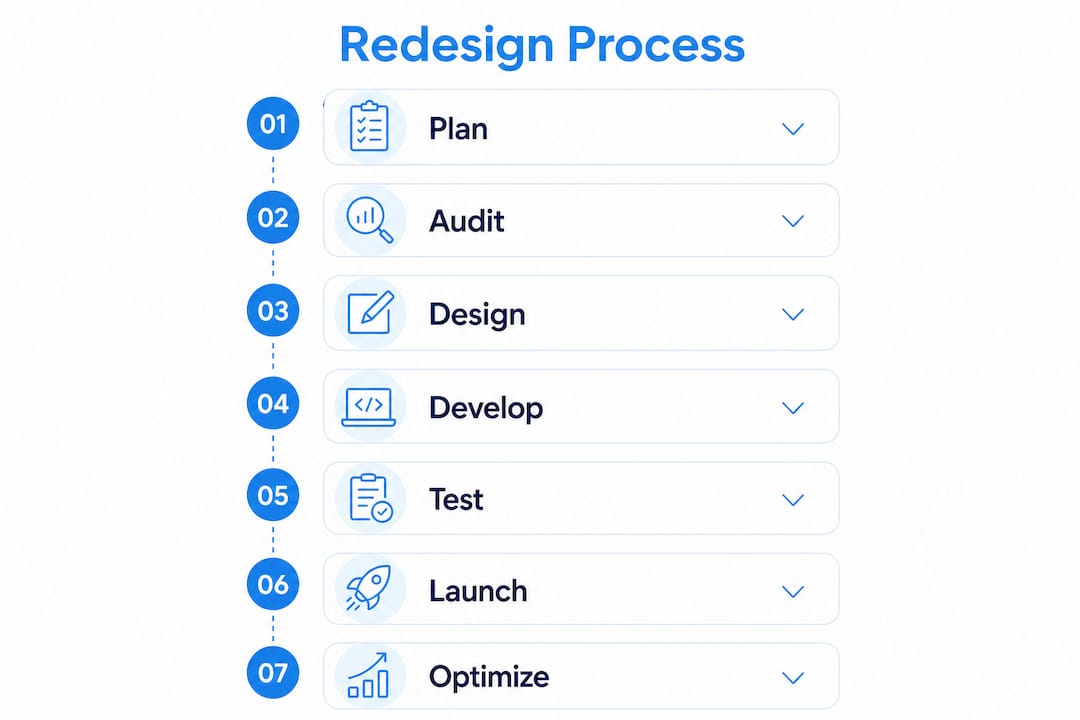
A website redesign is a technical migration project as much as a creative one. Treating it as purely a design exercise is the most common reason projects fail. The process below reflects what actually works for small and mid-sized organisations.
-
Assess whether you need a redesign or a refresh. Usability testing on your existing site before redesign helps determine whether optimisation or full redesign is warranted. A refresh addresses cosmetic issues. A redesign addresses structural ones. Confusing the two wastes budget.
-
Define goals and set KPIs. Every redesign decision must trace back to a measurable outcome. Examples include reducing bounce rate by 20%, increasing qualified enquiries by 30%, or cutting page load time to under two seconds. Vague goals produce vague results.
-
Align stakeholders and assign roles. Redesigns stall when approval chains are unclear. Identify one decision-maker per workstream: content, design, development, and SEO. Committees without clear ownership create delays and scope creep.
-
Audit content and plan information architecture. Information architecture and content auditing must precede visual design to avoid layout breaks and dysfunctional navigation. Map every page, identify what stays, what gets cut, and what needs rewriting before a single wireframe is drawn. The role of site architecture in both SEO and user experience cannot be separated from this step.
-
Conduct UX research and wireframing. Wireframes test structure without the distraction of visual design. User journey mapping at this stage reveals where prospects drop off and where messaging fails to convert.
-
Apply design and development best practices. Mobile-first design is not optional. Google’s indexing is mobile-first, meaning a site that performs poorly on mobile ranks poorly everywhere. Use your mobile design checklist before development begins.
-
Plan SEO migration. Failing to map 301 redirects for every URL before launch results in permanent organic traffic loss of 30–40%. SEO must run as a parallel workstream throughout development, not as an afterthought before go-live.
-
Test, launch, and monitor. Phased rollouts and incremental launches reduce redesign risk and allow better attribution of performance changes. Big-bang launches are a consistent failure mode. Plan a soft launch, gather data, then iterate.
Most small-to-mid-sized organisations’ redesigns take 8–16 weeks. Content readiness and approval cycles are the biggest schedule factors, not development. Start writing before the design phase begins.
Pro Tip: Treat your SEO migration plan as a separate project document. List every current URL, its new destination, and its redirect status. Review it in every development sprint, not just at launch.
What common mistakes should businesses avoid during a website redesign?
Most redesign failures are predictable. The same errors appear across organisations of every size, and they are almost always avoidable with better planning.
- Starting with visuals before defining goals. A website redesign should be treated as a product change, not a design project. When the brief opens with “we want it to look more modern,” the project has already lost its commercial anchor.
- Ignoring UX and conversion data. Sixty-one percent of redesigns cause UX issues due to poor planning, affecting specific pages rather than the whole site. Diagnosing actual problems before redesign focuses effort where it matters.
- Using placeholder copy during design. Designing with placeholder copy breaks layouts. Finalising content architecture before design prevents this. Real copy is longer, shorter, and structured differently than lorem ipsum. Layouts built around dummy text rarely survive contact with real content.
- Skipping SEO migration planning. This is the most expensive mistake. Changing URLs without 301 redirects tells search engines your content has disappeared. Recovering lost rankings takes months and sometimes never fully happens.
- Failing to test before launch. Cross-browser testing, mobile testing, and form submission testing are non-negotiable. A broken contact form on launch day costs real leads.
- Treating launch as the finish line. The redesign is not complete at go-live. Post-launch monitoring of Core Web Vitals, conversion rates, and user behaviour determines whether the project achieved its goals.
Pro Tip: Run a full crawl of your existing site using a tool like Screaming Frog before starting any redesign work. Export every URL, title tag, and meta description. This becomes your redirect map and your content audit in one document.
How to align website redesign with business strategy to maximise ROI
The highest-performing redesigns treat the website as a business asset, not a marketing brochure. This shift in thinking changes every decision from layout to copy to technology choice.
Shifting focus from aesthetics to performance metrics means defining success before the project starts. Metrics worth tracking include organic traffic volume, cost per lead, session duration, and goal completion rate. Web analytics should be configured before launch so you have a clean baseline from day one.
Conversion rate optimisation principles belong in the design brief, not as an afterthought. This means clear calls to action on every key page, trust signals near decision points, and forms with the minimum number of fields required to qualify a lead. For B2B companies, this often means replacing generic “contact us” pages with specific, outcome-focused landing pages.
User journey mapping reveals the gap between how you think visitors use your site and how they actually do. Membership organisations frequently discover that their most-visited pages are not their homepage or services pages. They are FAQs, event listings, or member login pages. Designing around actual behaviour rather than assumed behaviour produces better results.
Planning for continuous improvement rather than one-off redesigns is the most important strategic shift. The ROI from a redesign compounds when paired with ongoing content updates, A/B testing, and regular technical audits. A site left unchanged after launch begins declining in performance within months.
Key takeaways
A website redesign delivers measurable commercial returns only when it is treated as a structured technical and strategic project, not a visual refresh.
| Point | Details |
|---|---|
| Define goals before design | Set specific KPIs for conversion, traffic, and load speed before any creative work begins. |
| SEO migration is non-negotiable | Map 301 redirects for every URL before launch to avoid permanent organic traffic loss. |
| Content must precede design | Finalise information architecture and real copy before wireframing to prevent layout failures. |
| Phased launches reduce risk | Incremental rollouts allow performance attribution and reduce the chance of conversion drops. |
| Post-launch management compounds ROI | Sites without ongoing attention underperform again within 12–18 months of launch. |
Why most redesigns underperform, and what I’ve learned from the ones that don’t
The pattern I see most often is this: a business invests in a redesign, the site looks significantly better, and then six months later the leads have not moved. The team blames the agency. The agency points to the brief. Both are partly right.
The real issue is almost always that the project was scoped as a design project rather than a performance project. Nobody defined what “success” meant in numbers. Nobody owned the SEO migration. The content was written after the design was approved, which meant it never quite fitted. And post-launch, nobody was watching the data.
What works is treating the redesign as a product launch. That means a brief with measurable outcomes, a content audit completed before wireframing starts, and an SEO migration document that gets reviewed in every sprint. It means testing with real users before launch, not just internal stakeholders who already know how the site works.
The businesses that see genuine ROI from a redesign are the ones that plan for what happens after go-live. They set up analytics properly. They run usability tests on the new site within the first 30 days. They treat the launch as the beginning of an improvement cycle, not the end of a project.
One more thing: if your current site is generating leads, even slowly, be careful with a big-bang launch. A phased rollout lets you compare old and new performance directly. That data is worth more than any assumption you made during the planning phase.
— Rob
Cloud9’s approach to website redesign for UK businesses
Cloud9 works with small businesses, membership organisations, and B2B companies across the UK to plan and deliver website redesigns that are grounded in commercial goals rather than creative preferences.
The process starts with a clear brief. Cloud9’s redesign brief preparation guide walks you through goal-setting, stakeholder alignment, and scope definition before any development work begins. For businesses prioritising mobile performance, the mobile design checklist covers the technical and UX requirements that affect both rankings and conversions. Cloud9’s web design and development service combines UX, SEO, and technical delivery under one roof, removing the coordination overhead that fragments most redesign projects. Get in touch to discuss your goals and scope.
FAQ
What is a website redesign?
A website redesign is the full overhaul of a site’s structure, design, user experience, and technology to improve performance and meet business goals. It differs from a refresh, which only updates surface-level visual elements.
How long does a website redesign take?
Most small-to-mid-sized organisations’ redesigns take 8–16 weeks, with larger or more complex sites taking four to six months or more. Content readiness and internal approval cycles are the biggest factors affecting timeline.
How much does a website redesign cost?
The average website redesign ranges from £5,000 to £80,000, with complex projects exceeding £100,000 depending on custom development, e-commerce requirements, and integration complexity.
Will a redesign hurt my SEO rankings?
A redesign will damage SEO rankings if 301 redirects are not mapped for every existing URL before launch. Permanent organic traffic loss of 30–40% is the documented outcome of skipping this step.
When should a business redesign its website?
A business should redesign its website when conversion rates are declining, mobile performance is poor, the site is difficult to update, or the brand has changed significantly since the last build. Usability testing on the existing site confirms whether a full redesign or targeted optimisation is the right response.