AI Readiness Assessment: UK Leaders Find the Constraint in 2–4 Hours

An AI readiness assessment is a scored diagnostic across core pillars that delivers a ranked gap list and a staged roadmap with named owners. Most organisations complete a self-assessment scorecard in 2 to 4 hours, or a facilitated engagement over one week, drawing on frameworks from Gartner and MITRE.
TL;DR:
- A self assessment with roughly 15 questions takes 2 to 4 hours; involve the CEO or COO, IT lead, and a business sponsor.
- Use sector and risk appetite to interpret scores; fix the weakest pillar blocking the most use cases, favoring the quickest repair in a tie.
- Require a heat map, ranked gaps, and a staged roadmap with named owners and deadlines; ask outside assessors for technical appendices and monitoring plans.
- Run one or two pilots in the strongest pillars, set measurable success metrics, and require human review before outputs reach staff or customers.
- For recruitment, credit, insurance, or safety use cases, check the EU AI Act’s Annex III early, even if your organization operates only in the UK.
Table of Contents
- The pillars that make up AI readiness
- Choosing a format: quick scorecard or facilitated week
- Reading scores and finding your binding constraint
- What a completed assessment should hand you
- Governance and human oversight for UK organisations
- A staged plan to act on your results
- Getting the wider organisation on board
- Tailoring the assessment to your sector and size
- Connecting the results to your existing IT and digital strategy
- Tools and templates that make the assessment easier to run
- What happens after the assessment: monitoring and re-assessment
- What separates organisations that actually scale AI
- How we help you turn a diagnosis into a working pilot
- FAQ
- Sources
The pillars that make up AI readiness
Frameworks assess overlapping areas, though their pillars and labels differ. Gartner’s model groups them as strategy, data, governance, engineering and operating model, and culture, alongside AI product and value, and uses these to place organisations across five maturity stages from foundational to transformational. MITRE’s version splits readiness into six pillars: ethical use, strategy and resources, organisation, technology enablers, data, and performance and application.
For a leader reading a scorecard for the first time, what matters is the evidence behind each score, not the label on the pillar:
- Strategy: a named business owner for AI outcomes and measurable KPIs tied to specific use cases, not a vague ambition to “use more AI”.
- Data: centralised, queryable datasets with documented lineage, rather than knowledge locked in spreadsheets or individual inboxes.
- Talent and culture: staff who understand what AI can and cannot do, and a workforce that trusts the outputs enough to use them.
- Technology and infrastructure: systems that can connect to a CRM, database or membership platform without a rebuild.
- Governance and security: a documented review process, access controls and a clear escalation path when something goes wrong.
- Model management: a plan for monitoring, retraining and retiring models as data and business needs shift.
A single weak pillar caps the whole programme. A membership body with excellent strategy but data scattered across three unconnected systems will stall at the pilot stage, no matter how good its ambitions are.
Choosing a format: quick scorecard or facilitated week
Most teams start with a short self-assessment and only move to a facilitated engagement if the results show real complexity or disagreement about priorities.
- Self-assessment scorecard: roughly 15 questions across the pillars above, taking 2 to 4 hours, typically completed by the CEO or COO, the CIO or IT lead, and one business sponsor.
- Facilitated assessment: a facilitated engagement combining an executive workshop, deep dives into data and technology, stakeholder interviews, and a scored report presented with a roadmap.
- Evidence to gather beforehand: a list of current systems and data sources, existing AI or automation pilots, recent incident or compliance records, and a shortlist of use cases under consideration.
- Attendees to include: a business sponsor who owns the outcome, a data lead who knows where information actually lives, someone from security or compliance, and an operations owner who will feel the day-to-day impact.
Pro Tip: Run the quick self-assessment first. If scores cluster tightly and priorities are obvious, you may not need the facilitated week at all.
Reading scores and finding your binding constraint
Pillar scores and a composite score give you a rough map of maturity. As a working guide, Lower scores may suggest foundational gaps to address before serious automation, while stronger scores may support selective pilots or scaling. Interpret scores in the context of your sector and risk appetite. These thresholds are illustrative, not universal, and should flex with your sector and risk appetite.
The more useful concept is the binding constraint: the single lowest-scoring pillar that limits everything else. A professional services firm with strong strategy and talent but a low governance score should fix governance before launching a client-facing AI agent, because no amount of strategic clarity removes that bottleneck.
- Rank gaps by how many planned use cases each one blocks.
- Within tied priorities, favour the gap that takes the least time to close.
- Treat a gap blocking several use cases as urgent, regardless of its individual score.
Cisco’s AI Readiness Index found that organisations which scale AI successfully, which it calls “AI Pacesetters”, tend to win on infrastructure choices and governance guardrails such as live monitoring rather than on having better models. That matches what shows up in most assessments: the limiting factor is rarely the AI itself.
What a completed assessment should hand you
A proper assessment produces artefacts you can act on immediately, not just a score.
- A pillar heat map: a visual summary showing which pillars are strong, borderline or weak at a glance.
- A ranked gap list: every identified weakness ordered by how many use cases it blocks and how quickly it can be fixed.
- A binding-constraint diagnosis: a clear statement of the one pillar to fix first, with reasoning.
- A staged roadmap: specific actions, each with a named owner and a deadline.
Ask for technical appendices, data lineage maps, architecture diagrams and a monitoring plan, when you’re commissioning the work from outside, and treat their absence as a reason to push back before signing off the report.
Governance and human oversight for UK organisations
Scores mean little without governance that holds up once AI moves into production. The UK government’s AI playbook sets out the baseline: human oversight embedded into design, documented review and escalation processes, and monitoring and user research built into the AI lifecycle before anything scales.
A credible assessment checks for these artefacts, not just good intentions:
- A documented review board or named decision-maker for AI use cases.
- A decision log recording what was approved, by whom, and why.
- An incident register and a defined escalation path when outputs go wrong.
- Monitoring and rollback procedures that someone actually owns.
The same playbook stresses that user research and human-centred testing are needed to set realistic accuracy expectations and catch data drift over time, rather than assuming a model will keep performing as it did on day one.
Pro Tip: If any planned use case touches recruitment, credit, insurance or safety decisions, map it against the EU AI Act’s Annex III high-risk categories early, even if you only trade in the United Kingdom, since many organisations serve EU customers or partners indirectly.
A staged plan to act on your results
A good assessment is wasted without a sequence attached to it.
- First stage: assign named owners to each priority gap, define two or three measurable success metrics per pilot, audit data access for your top use cases, and fix any obvious permission or quality issues.
- Next stage: run one or two pilots in the pillars that scored highest, with explicit success metrics and a human reviewing outputs before they reach customers or staff.
- Following stage: formalise governance (review board, monitoring, incident process), agree a scaling budget, and assign ownership for the next wave of use cases.
This sequence deliberately keeps the first pilot small. A recruitment firm, for instance, might begin by cleaning candidate data in its CRM, then pilot an AI assistant that drafts shortlists for a single desk, with a consultant checking every output before it reaches a client.
Getting the wider organisation on board
An assessment that stays with four people in a workshop rarely survives contact with the rest of the business. Wider buy-in needs the same evidence-based approach as the assessment itself, not a slogan campaign.
Share the heat map and the binding-constraint finding with department heads soon after the workshop, in plain language rather than scorecard jargon. A finance director doesn’t need to understand pillar weightings, but does need to know why data quality is blocking a use case they care about. Run short briefings for affected teams, explaining what the pilot will and won’t touch, and where a person still makes the final call.
Invite frontline staff who will actually use or be affected by a pilot to flag concerns before launch, not after. In membership organisations, that often means involving the team who handle renewals or member queries directly, since they will spot practical problems a strategy workshop misses. In professional services, it means involving the fee-earners whose judgement the AI is meant to support, not replace.
Keep a visible decision log that non-technical staff can read: what was approved, what was rejected, and why. That single artefact does more for trust than a formal communications plan, because it shows the organisation that decisions are being made on evidence rather than enthusiasm. Revisit it at each stage of the plan so people see progress rather than a one-off announcement that then goes quiet.
Tailoring the assessment to your sector and size
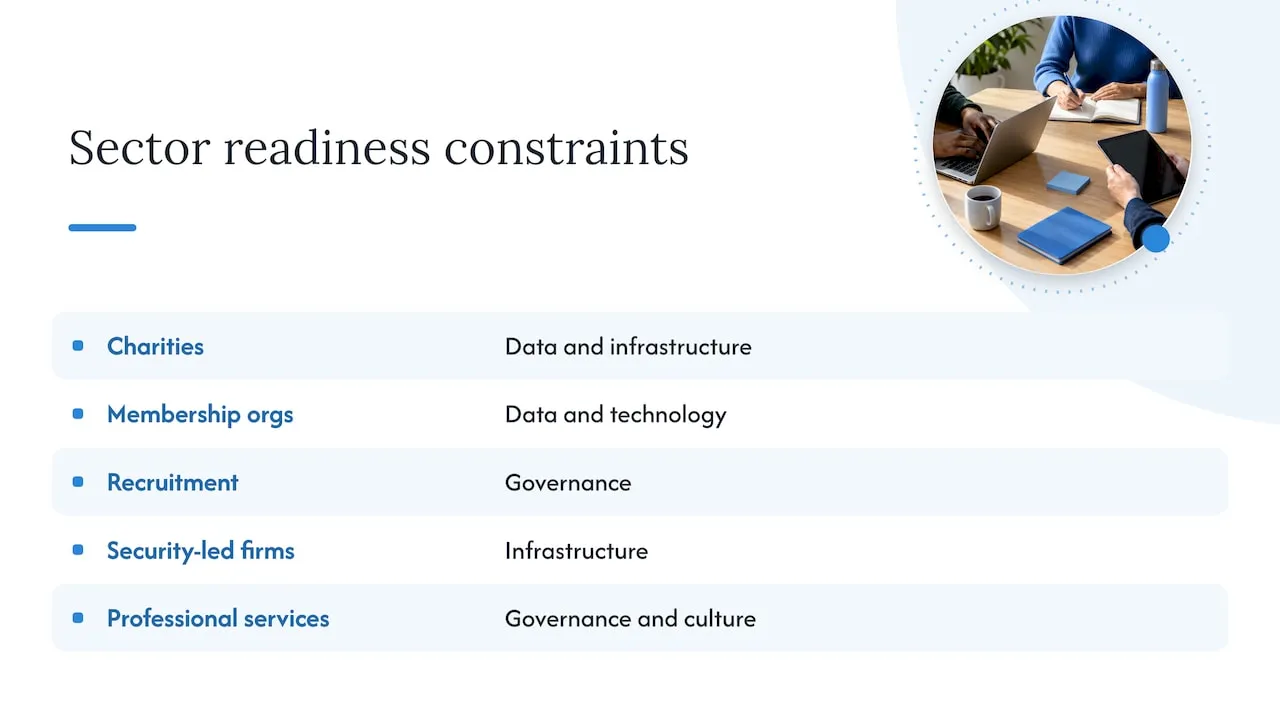
The pillars stay the same across sectors, but the weighting and the urgent gaps rarely do. A charity with a small team and a single legacy database will usually find data and infrastructure to be the binding constraint, while a larger professional services firm with mature systems more often struggles with governance or culture.
Membership organisations and trade associations typically carry rich but fragmented member data across a CRM, an events platform and email tools that don’t talk to each other. For them, the data and technology pillars usually need attention before strategy or talent, because no amount of ambition fixes a CRM that can’t answer a simple query about renewal risk. CRM AI automation often becomes the first practical use case once that data is in order.
Recruitment firms tend to score well on data, since candidate and client records are usually centralised, but weaker on governance, given the sensitivity of using AI to shortlist or assess people. Security and compliance-led businesses often show the reverse pattern: strong governance instincts, but infrastructure that wasn’t built with AI integration in mind.
Smaller organisations should weight the assessment towards quick wins achievable with existing staff and budget, rather than transformational use cases that need headcount they don’t have. Larger organisations can afford a facilitated assessment and a wider pilot portfolio, but should resist the temptation to run many pilots at once; the binding-constraint principle applies just as hard at scale, often harder, because more stakeholders mean more ways for a weak pillar to quietly block progress.
Connecting the results to your existing IT and digital strategy
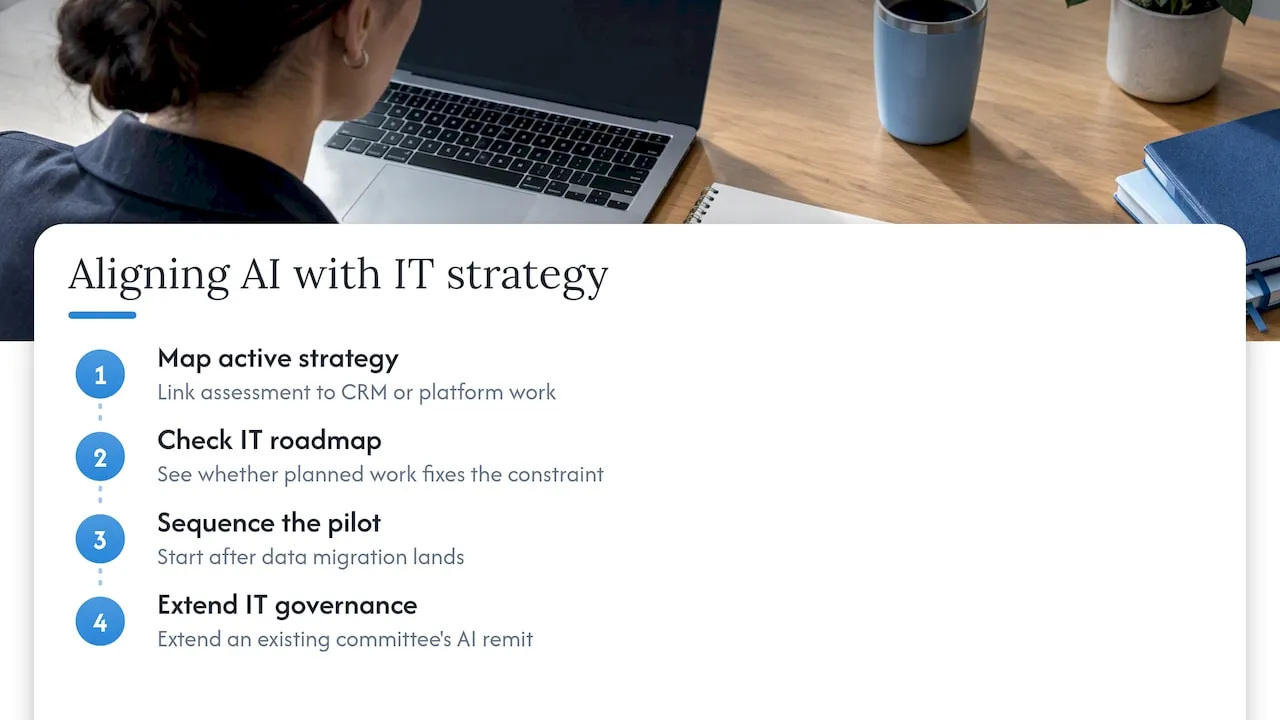
An AI readiness assessment that sits apart from your existing digital transformation plan tends to produce a roadmap nobody follows. The most useful assessments map directly onto a strategy already in motion: a CRM migration, a membership platform upgrade, or a planned systems integration project.
Before committing budget to a new AI pilot, check whether an existing IT roadmap already addresses the same binding constraint. If a data migration is scheduled for next quarter, it makes more sense to sequence your first AI pilot after that work lands, rather than building automation on top of data that’s about to move. Conversely, if the assessment reveals that your binding constraint is the same fragmented data a planned systems integration project is meant to solve, that project just became higher priority than it was before the assessment.
Governance decisions should also sit inside existing IT governance structures rather than creating a parallel process. If your organisation already has an IT steering group or a data protection officer signing off on system changes under UK GDPR, the AI review board role can often extend an existing committee’s remit rather than standing up a new one. That keeps accountability clear and avoids the common failure of AI governance becoming a side project that nobody with real authority attends.
Tools and templates that make the assessment easier to run
You don’t need to build a scorecard from scratch. Several published frameworks offer templates you can adapt directly: Microsoft’s seven-pillar assessment produces a scored report against business strategy, governance and security, data foundations, AI strategy and experience, organisation and culture, infrastructure, and model management. TDWI’s readiness assessment uses a multicategory questionnaire suited to teams that want a lighter-touch starting point.
MITRE publishes its full assessment tool as a downloadable guide, with multiple-choice questions that generate a score and a visual output, useful if you want a structured document to work through with a steering group rather than a workshop format. A simple internal survey, run anonymously across staff who would use or be affected by a pilot, often surfaces cultural and trust gaps that a leadership-only scorecard misses entirely, particularly in organisations where frontline teams are sceptical of change imposed from above.
Whichever template you choose, keep the output format consistent with what your organisation already uses for other strategic reviews, a simple RAG-rated heat map and a one-page roadmap travel further in a board meeting than a lengthy report.
What happens after the assessment: monitoring and re-assessment
A readiness assessment is a snapshot, not a permanent verdict. Data quality improves or degrades, staff turn over, and new regulation lands, so the score you get today will shift within months, particularly in the pillars that were weakest to begin with.
Build a light monitoring habit around the pillars you fixed first: a quarterly check on data quality metrics, a review of whether named owners from your 30/60/90 plan are still in post, and a look at whether any new incidents have landed in the register you set up during the governance phase. This doesn’t need to be a full re-assessment every time, a short pulse check against the original scorecard is usually enough to catch drift early.
Plan a full re-assessment periodically, or sooner if you’ve completed a major system migration, launched several new pilots, or had a change in senior ownership of the AI programme. Treat the second assessment as a chance to test whether your binding constraint has actually moved, rather than running through the same questions out of habit; if governance was your weak pillar last year and is now solid, the next constraint is waiting to be found, and it’s rarely the same one twice.
What separates organisations that actually scale AI
The assessments that lead somewhere share three habits. Every priority gap has a named owner, not a shared responsibility that nobody actually holds. Teams fix the binding constraint first instead of chasing the most exciting use case. And a person reviews outputs in production from day one, not as an afterthought once something has already gone wrong.
The failures look almost identical every time: no business owner for the outcome, data still locked in separate systems, and no one watching what the model does once it ships. Membership organisations and professional services firms tend to find their quickest wins in data access and CRM integration, not in flashier applications.
— Rob
How we help you turn a diagnosis into a working pilot
A scorecard tells you where the gaps are, but closing them without the right systems knowledge usually costs more time than the assessment itself. We provide AI Strategy & Readiness assessments and AI & Systems Integration, so the roadmap we hand back accounts for the CRM, database or membership platform you already run rather than assuming a clean slate.
Our work typically covers:
- An AI readiness assessment.
- An AI roadmap built around your actual systems.
- AI automation, such as an internal assistant or chatbot, with human oversight built in from the start.
If your assessment points to customer-facing use cases, it’s worth looking at how AI in customer support plays out in practice for organisations handling high support volumes with strict service levels, since the governance lessons carry across sectors.
Book a discovery call through our services page and we’ll tell you honestly whether you need the full facilitated assessment or just a focused pilot.
FAQ
What is the 30% rule in AI?
There is no single, universally recognised percentage rule in AI readiness frameworks; definitions vary across contexts. If you’ve seen it referenced for a specific framework, treat it as that framework’s own rule of thumb rather than an industry standard.
What are the three pillars of AI readiness?
Three-pillar versions typically simplify readiness down to strategy, data, and governance (or technology), but most established frameworks use more granular breakdowns. Gartner and MITRE, for example, both use five or six pillars rather than three.
What are the five pillars of AI readiness?
Common five or six-pillar models cover strategy, data, talent and culture, technology and infrastructure, and governance and security, sometimes with model management as a sixth. Microsoft’s assessment uses seven, so the exact count depends on which framework you choose.
What is a readiness assessment?
A readiness assessment is a structured diagnostic that scores an organisation across core pillars like strategy, data, governance and talent, then produces a ranked list of gaps and a prioritised action plan. It’s typically delivered through a short self-assessment scorecard or a facilitated workshop, and the output should include named owners for each next step.
Sources
- Gov
- Gartner AI Maturity Model and AI Roadmap Toolkit | Gartner
- The MITRE AI Maturity Model and Organizational Assessment Tool Guide | MITRE