Cloud infrastructure is defined as the integrated combination of hardware, software, networking, and virtualisation resources that deliver computing services over the internet. The role of cloud infrastructure has shifted from a cost-saving tactic to the operational foundation of modern business. The World Bank now identifies cloud infrastructure as critical for AI-ready economic growth, placing it alongside roads and power grids as a development priority. For business leaders and IT decision-makers, understanding this shift is not optional. It determines how fast you can move, how securely you can operate, and how effectively you can compete.
What is the role of cloud infrastructure in modern business?
Cloud infrastructure replaces the traditional model of owning physical servers in on-premises data centres. Instead of committing large capital expenditure upfront, organisations access compute, storage, and networking resources on demand, paying only for what they use. This shift from CapEx to OpEx removes the financial burden of maintaining ageing hardware and frees IT budgets for growth activities.
The industry term for this model is “cloud computing infrastructure,” though business leaders often encounter it simply as “the cloud.” The distinction matters because cloud infrastructure is the physical and virtual layer beneath every cloud service you use, from email platforms to AI tools. Without it, none of those services exist.
Cloud infrastructure also acts as the connective layer between your people, your data, and your applications. It is the operational core that links automation, analytics, and security into a single, manageable system. That integration is what makes digital transformation possible at scale, rather than a collection of disconnected technology projects.

What are the components and architecture of cloud infrastructure?
Cloud infrastructure is built from four core components: compute (processing power), storage (data capacity), networking (connectivity between systems), and virtualisation (the software layer that makes physical resources shareable). Each component can be provisioned independently, which gives organisations precise control over costs and capacity.
Service models define how these components are delivered:
- Infrastructure as a Service (IaaS): You rent raw compute, storage, and networking. You manage the operating system and everything above it.
- Platform as a Service (PaaS): The provider manages the underlying infrastructure. You focus on building and deploying applications.
- Software as a Service (SaaS): The provider manages everything. You access a finished application via a browser or app.
Deployment models determine where the infrastructure lives and who controls it:
- Public cloud: Resources are shared across multiple organisations on a provider’s global network.
- Private cloud: Resources are dedicated to a single organisation, either on-premises or hosted.
- Hybrid cloud: A combination of public and private, connected to allow data and workloads to move between them.
- Sovereign cloud: A newer model designed to keep data within specific national or regulatory boundaries, increasingly relevant for UK public sector and regulated industries.
The practical implication of choosing the wrong architecture is significant. A professional services firm handling sensitive client data may need a private or sovereign cloud model. A membership organisation with fluctuating seasonal traffic may benefit most from a public cloud with autoscaling. Architecture decisions made at the start shape your costs, compliance posture, and operational agility for years.
How does cloud infrastructure improve operational efficiency?
Speed is the most immediate benefit. Cloud infrastructure reduces provisioning lead times from weeks down to minutes. That means a development team can spin up a testing environment in the time it previously took to raise a purchase order for hardware. The downstream effect on product release cycles is substantial.
The operational gains compound through automation. Four capabilities stand out:
- Autoscaling: The system automatically adds or removes compute capacity based on real-time demand, so you never pay for idle resources or lose performance during traffic spikes.
- Self-healing systems: Cloud environments detect and replace failed components without human intervention, reducing unplanned downtime.
- Automated patching: Security updates are applied across your infrastructure without manual effort, closing vulnerabilities faster than traditional IT cycles allow.
- Centralised monitoring: A single dashboard gives IT teams visibility across all environments, replacing the fragmented tooling that slows incident response.
These capabilities matter most when your business faces unpredictable demand. A membership organisation running an annual conference, for example, can scale its web infrastructure for the registration peak and scale back immediately after, paying only for the hours of elevated capacity.
Pro Tip: Before migrating to cloud infrastructure, map your current workloads by demand pattern. Workloads with predictable, steady demand often suit reserved capacity pricing. Workloads with spikes suit pay-as-you-go. Getting this wrong costs more than staying on-premises.
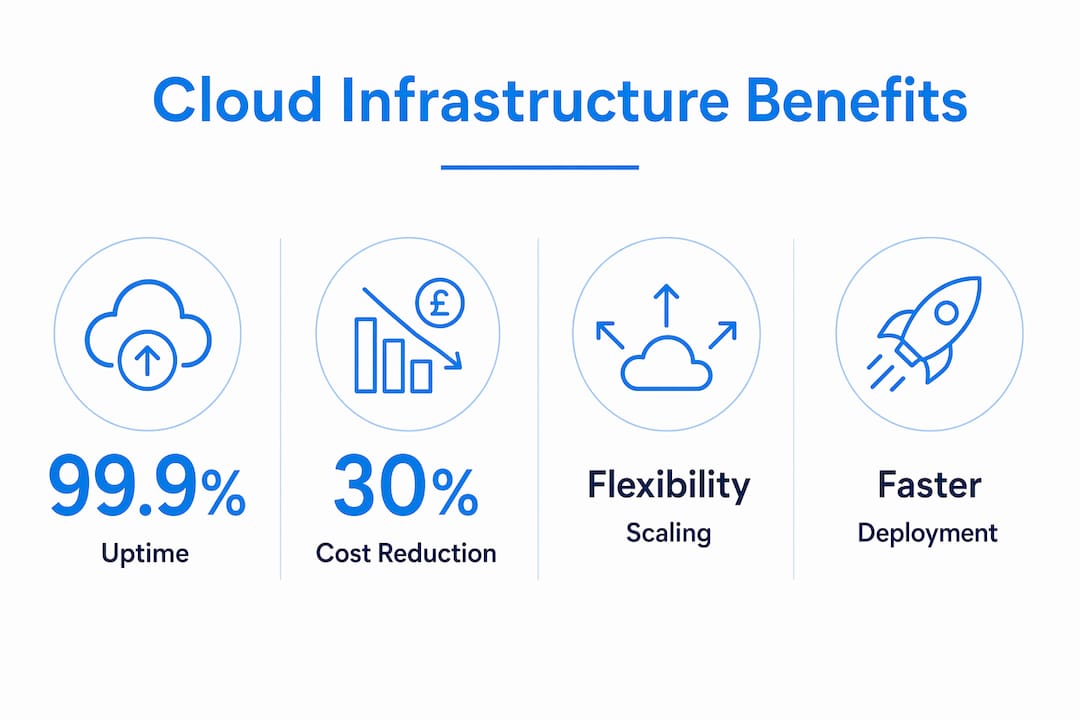
The cost model shift also changes how IT leaders present investment cases to boards. Variable cloud spending is easier to justify against specific business outcomes than a five-year hardware depreciation schedule. That alignment between IT spend and business results is one of the less-discussed advantages of cloud computing.
What security and resilience advantages does cloud infrastructure provide?
Enterprise-grade security is no longer the exclusive territory of large organisations. Cloud infrastructure gives small and medium businesses access to sophisticated security tools that would be cost-prohibitive to build and maintain on-premises. That democratisation of security capability is one of the most consequential shifts in modern IT.
The security capabilities built into cloud infrastructure include:
- 24/7 automated network monitoring: Threats are detected and flagged continuously, without relying on a human analyst to be watching at 3AM.
- Redundant data backups: Data is replicated across multiple availability zones, so a failure in one location does not result in data loss.
- Failover mechanisms: Traffic and workloads automatically redirect to healthy systems when a component fails, maintaining service continuity.
- Compliance frameworks: Major cloud providers maintain certifications such as ISO 27001 and SOC 2, which support your own compliance obligations without duplicating effort.
Resilience, however, requires more than uptime targets. BCG’s research on digital infrastructure makes a critical distinction:
“Digital infrastructure must be designed for stress scenarios, not just stable conditions. Resilience frameworks that only account for normal operation leave essential services exposed when crises occur.”
This matters for business leaders because most cloud adoption conversations focus on availability percentages. The harder question is whether your architecture can recover independently when a regional cloud outage coincides with a business-critical event. The answer depends on whether you have independently tested recovery paths that do not rely on the same systems that failed. Cloud 9’s backup, security, and recovery services are built around this principle, ensuring that recovery plans are tested, not assumed.
What strategic role does cloud infrastructure play in digital transformation?
Cloud infrastructure is the operating system of digital change. Every AI tool, analytics platform, and automation workflow your organisation wants to deploy runs on top of it. Without a well-designed cloud foundation, digital transformation initiatives stall at the pilot stage because the underlying infrastructure cannot support them at scale.
The World Bank’s position is unambiguous: organisations must adopt cloud-first procurement and risk-based governance strategies to fully leverage AI-driven innovation. That means evaluating new technology purchases against cloud compatibility before committing, not retrofitting cloud thinking after the fact.
| Strategic capability | What cloud infrastructure enables |
|---|---|
| AI and machine learning | Access to GPU compute and pre-built model APIs without owning specialist hardware |
| Big data analytics | Process large datasets on demand, scaling compute to the job rather than the job to the compute |
| Global reach | Deploy applications closer to users via edge locations, reducing latency |
| Autonomous operations | Infrastructure that monitors, repairs, and scales itself, reducing IT management overhead |
Cloud infrastructure also enables a category of capability that was previously inaccessible to most UK SMEs: advanced AI and analytics. Access to AI and machine learning at scale, once reserved for enterprises with dedicated data science teams, is now available through cloud platforms on a pay-per-use basis. That levels the competitive field considerably.
Pro Tip: Treat cloud infrastructure as a governance question, not just a technology question. Assign clear ownership of cloud architecture decisions at board or senior leadership level. Organisations that leave cloud strategy entirely to IT teams often end up with fragmented environments that are expensive to consolidate later.
Leadership teams that understand managed services in business efficiency are better positioned to make cloud investment decisions that align with business outcomes rather than technology trends.
Key takeaways
Cloud infrastructure is the foundational layer that determines how fast, securely, and cost-effectively a business can operate and grow in a digital environment.
| Point | Details |
|---|---|
| CapEx to OpEx shift | Cloud replaces upfront hardware investment with variable, demand-based spending that aligns IT costs to business activity. |
| Speed of provisioning | Resources that previously took weeks to procure can be deployed in minutes, accelerating product releases and IT response times. |
| Security democratisation | SMEs gain access to enterprise-grade monitoring, backup, and failover capabilities without building them from scratch. |
| Stress-tested resilience | Effective cloud design accounts for crisis scenarios, not just normal uptime, requiring independently tested recovery paths. |
| Strategic AI enablement | Cloud infrastructure gives organisations of all sizes access to AI, machine learning, and analytics tools at scale. |
Why cloud infrastructure is more than a technology decision
I have worked with enough business leaders to know that cloud infrastructure conversations almost always start in the wrong place. The first question is usually “how much will it cost?” The more important question is “what does our current infrastructure prevent us from doing?”
The organisations that get the most from cloud are the ones that treat it as a strategic capability, not a hosting arrangement. They make architecture decisions at leadership level, not just IT level. They test their recovery plans before they need them. And they build governance around cloud spending from day one, rather than trying to control costs after the environment has sprawled.
The mistake I see most often is assuming that regional cloud availability is guaranteed. It is not. Regional cloud unavailability during a crisis is a real operational risk, and most organisations discover this only when it happens. The businesses that avoid this problem are the ones that have designed and tested independent recovery paths before they are needed.
Cloud infrastructure is not a destination. It is a discipline. The technology will keep evolving, but the organisations that build strong governance, clear ownership, and tested resilience into their cloud foundations will outperform those that treat it as a commodity purchase.
— Rob
How Cloud 9 supports UK businesses with managed cloud services
Cloud 9 works with established UK businesses that want the benefits of cloud infrastructure without the complexity of managing it themselves.
Cloud 9’s managed cloud services cover the full lifecycle, from initial architecture design through to ongoing monitoring, patching, and performance management. For businesses moving away from on-premises systems, Cloud 9’s cloud migration support provides a structured path that reduces disruption and builds a foundation designed for long-term reliability. The result is a cloud environment that works for your business, rather than one that requires constant internal IT attention to keep running. If you want to understand what the right cloud foundation looks like for your organisation, Cloud 9 is the place to start.
FAQ
What is cloud infrastructure?
Cloud infrastructure is the combination of compute, storage, networking, and virtualisation resources that deliver computing services over the internet. It replaces physical on-premises hardware with on-demand, pay-as-you-use resources managed by a provider.
What are the main benefits of cloud computing for businesses?
The primary benefits include faster resource provisioning, variable cost models that replace capital expenditure, enterprise-grade security, and access to AI and analytics tools at scale. Cloud environments also provide built-in redundancy and automated failover that reduce downtime risk.
How does cloud infrastructure support digital transformation?
Cloud infrastructure functions as the operational foundation for digital transformation by connecting automation, analytics, and security into a single manageable system. Without it, AI tools and data platforms cannot be deployed or scaled effectively across an organisation.
What is the difference between public, private, and hybrid cloud?
Public cloud shares resources across multiple organisations on a provider’s network. Private cloud dedicates resources to a single organisation. Hybrid cloud combines both, allowing workloads and data to move between environments based on security, compliance, or performance requirements.
How do small businesses benefit from cloud infrastructure?
Small and medium businesses gain access to security tools, disaster recovery capabilities, and AI platforms that were previously affordable only for large enterprises. The shift from capital to operational expenditure also removes the need for significant upfront hardware investment.