Membership churn rate is the percentage of members who stop their membership within a set period. The formula is simple: (members lost ÷ members at start) × 100. Pick a measurement window, monthly is the standard, and calculate this month’s number now, before you read another word further.
Quick answer: if you started March with 800 members and lost 40, your monthly churn rate is 5%. Anything consistently above 20% annually needs urgent attention, according to Sequence Consulting’s benchmarking work.
Key Takeaways
Membership churn rate, calculated as (members lost ÷ members at start) × 100, is the single clearest signal of whether your organisation is growing or quietly leaking value.
| Point | Details |
|---|---|
| Know your formula | Churn rate = (members lost ÷ members at start) × 100; calculate monthly, not just annually. |
| Watch the 20% threshold | Annual churn above 20% signals urgent action; 75-85% annual retention is typical for many associations. |
| Fix involuntary churn first | Payment failures are the cheapest churn to recover; automated retries catch cancellations before they happen. |
| Measure by cohort, not headline | Group members by join date to see real retention decay rather than one blended percentage. |
| Joined-up systems reduce friction | Cloud 9 connects CRM, onboarding automation and payment recovery so fewer members lapse by accident. |
Table of Contents
- What is churn rate in a membership context, really?
- What types of churn should you actually track?
- How do you calculate churn rate step by step?
- What is a good churn rate for a membership?
- Why does churn actually matter to the bottom line?
- What actually reduces membership churn?
- How do you measure churn without fooling yourself?
- Sources
- FAQ
What is churn rate in a membership context, really?
Churn, retention and attrition get used as if they mean the same thing. They don’t, and mixing them up leads to bad decisions.
Churn rate is the percentage of members you lost in a period. Retention rate is its mirror image, the percentage you kept. If churn is 15%, retention is 85%. Attrition is often used interchangeably with churn, but in HR and some association circles it carries a slightly different weight, referring more to natural, expected drop-off (people moving house, retiring, changing careers) rather than dissatisfaction-driven cancellation.
- Churn rate measures loss; used by finance, operations, and membership managers tracking health.
- Retention rate measures what’s kept; used in board reports and growth targets.
- Attrition often implies unavoidable, natural loss; used more in HR and some professional-body contexts.
A gym with 1,000 members that loses 50 in a month has 5% churn and 95% retention. Same number, two frames, two conversations.
What types of churn should you actually track?
Not all churn is equal, and tracking the wrong metric hides the real problem.
Customer churn (sometimes called logo churn) counts the number of members who left, regardless of what they paid. Revenue churn tracks the money lost instead, using monthly recurring revenue (MRR) rather than headcount. A membership body could lose ten small-tier members and barely notice on revenue churn, but lose two corporate accounts and take a serious hit. The Amplitude formula guide recommends tracking both, because volume and value tell different stories.
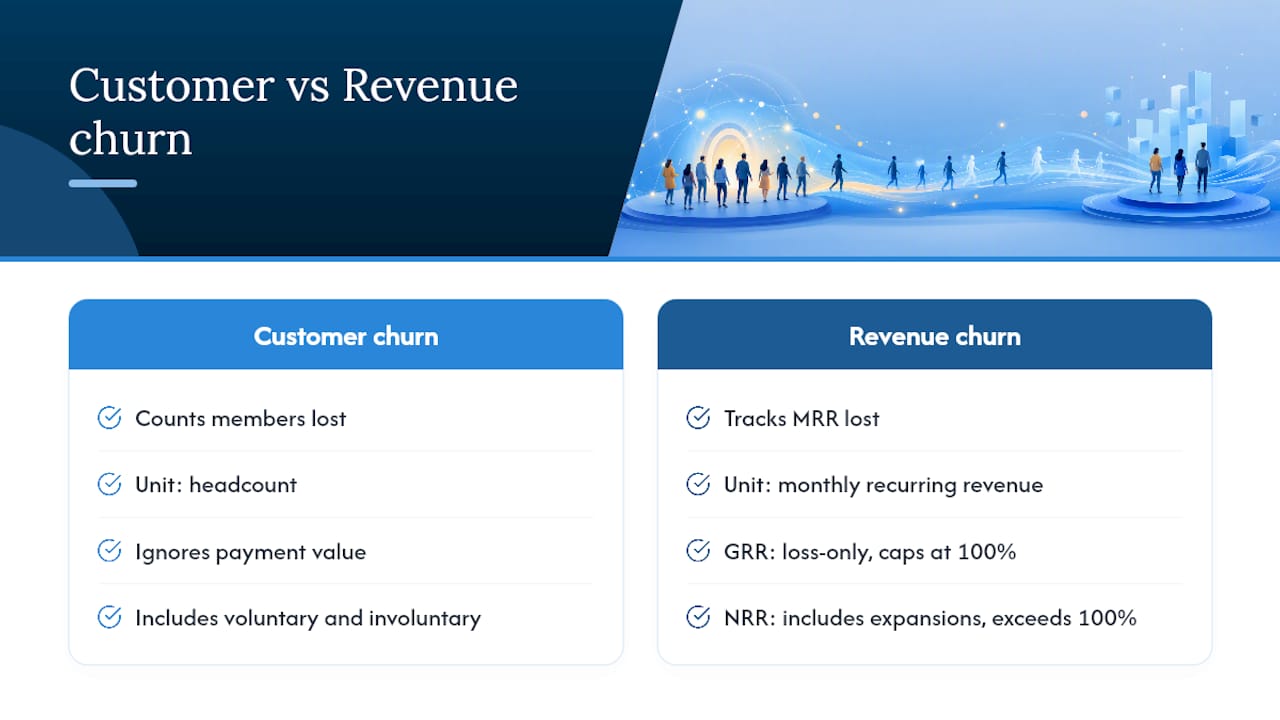
Within revenue churn sits gross revenue retention (GRR), which only counts losses and caps at 100%, and net revenue retention (NRR), which factors in upgrades and expansions and can exceed 100% if existing members spend more even as some leave.
Churn also splits by cause. Voluntary churn happens when someone actively decides to leave: they don’t see the value anymore, or a competitor’s offer looks better. Involuntary churn happens when a card expires or a payment fails silently, and nobody notices until the account lapses. High-ARPU membership models (professional bodies, B2B networks) should watch revenue churn closely; volume-driven consumer memberships should watch logo churn and payment failures.
How do you calculate churn rate step by step?
The core formula, again, because it’s worth repeating precisely: churn rate = (members lost during the period ÷ members at the start of the period) × 100.
Revenue churn follows the same logic with money instead of headcount: (MRR lost during the period ÷ MRR at the start of the period) × 100, as set out by Amplitude.
Here’s a worked example:
- Start of month: 1,000 members.
- Members lost during the month: 200.
- Calculation: (200 ÷ 1,000) × 100 = 20% monthly churn.
- Implication: to simply stand still, you need 200 new members that month just to break even, before any growth target.
One critical trap: don’t multiply monthly churn by 12 to get an annual figure. Churn compounds. A steady 3% monthly churn doesn’t equal 36% annually; using the compounding formula 1 − (1 − monthly churn)^12, it works out closer to 30.6%, according to Directive Consulting’s glossary. Monthly measurement is the standard for subscription and membership businesses precisely because it surfaces problems faster than an annual snapshot, as Stripe’s guidance on monthly churn explains.
What is a good churn rate for a membership?
Context decides whether a number is fine or alarming.
Many associations sit at 75-85% annual retention, meaning 15-25% annual churn, with 85%+ considered strong and 90%+ excellent, per Sequence Consulting’s data. Sector norms vary sharply too: gyms often run around 30% annual churn, Amazon Prime sits closer to 5-7%, and WeWork has reported figures around 11%, according to Churnkey’s benchmark research.
Credentialed professional bodies (where membership carries a licence or qualification) tend to churn far less than voluntary interest groups or low-commitment community memberships. Compare your number to your own model, not a generic industry average.
Why does churn actually matter to the bottom line?
The maths is unforgiving.
Replacing a lost member costs far more than keeping one. Bain-cited research on retention economics shows acquisition typically costs several times more than retention, and a retention improvement of just a few percentage points can lift profit substantially. It’s compounding: those members refer others, upgrade tiers, and cost nothing extra to acquire twice.

What actually reduces membership churn?
Fix the easy losses first. Involuntary churn, people who wanted to stay but got dropped by a failed payment, is the cheapest win available.
- Payment recovery first. Automated retry sequences and card-update prompts recover a meaningful share of failed payments before they become cancellations.
- Onboarding second. A 30/60/90-day sequence matters more than almost anything else you’ll build: a welcome email on day one, a “getting the most from your membership” nudge by day 30, a milestone check-in at day 60, and a renewal-focused touchpoint by day 90.
- Engagement third. Members with three or more high-value interactions (events, forums, resources used) renew at close to 100%, according to Cavuno’s association research. Most organisations don’t have a formal process for creating those touchpoints, which is exactly why it’s an opportunity.
For lapsed members, a short win-back flow beats a generic “we miss you” email:
- Send a targeted reactivation offer within two weeks of lapse, while the relationship is still warm.
- Ask one honest question: what changed, or what’s missing?
- Offer a low-friction re-entry point (a shorter commitment, a trial tier) rather than the full-price ask.
For monitoring, ProfitWell and ChartMogul both specialise in subscription analytics and churn benchmarking. GoCardless handles recurring payments and payment-failure recovery specifically. Mighty Networks is built for community engagement inside membership models, and GlueUp serves as a membership-specific CRM for associations managing renewals and communications in one place.
Pro Tip: Set your win-back flow to trigger automatically the day a membership lapses, not a week later. The first 48 hours after a cancellation get the highest response rate to any reactivation offer.
How do you measure churn without fooling yourself?
A single headline percentage hides more than it reveals. Cohort analysis fixes that: group members by their join month and track how each cohort’s retention decays over time, rather than blending everyone into one number.
A useful churn dashboard includes:
- Starting member count and members lost, by period.
- New members added, so net change is visible alongside churn.
- MRR lost, plus GRR and NRR side by side.
- Payment-failure rate as its own line, separate from voluntary cancellations.
- First-30-day activity rate, since early engagement predicts renewal.
Track churn alongside retention, lifetime value (LTV) and average revenue per member.
Pro Tip: Set an automatic alert for any member with zero logins or engagement in their first 30 days. That single signal predicts non-renewal better than almost anything else you can measure.
How joined-up systems cut churn before it starts
Payment failures, clunky onboarding, and generic communications all drive avoidable churn. A membership organisation running its payments, CRM and email flows as separate, disconnected tools tends to lose members to friction rather than genuine dissatisfaction.
- Central CRM holding renewal dates, engagement history and payment status in one record.
- Automated email sequences triggered by behaviour, not sent on a fixed calendar.
- Payment retry logic that catches failed cards before cancellation.
- A self-service member portal reducing support friction.
What I’d watch first, and where to focus
If you measure one thing this month, measure your first-30-day activity rate. It predicts renewal better than any other single number I’ve seen in this data.
Focus month one entirely on fixing involuntary churn: payment failures cost you members who never wanted to leave.
Getting your systems working together
There are ways to chip away at churn with spreadsheets and manual reminders, but most membership managers we talk to are stitching together three or four disconnected tools: one for payments, one for email, one for the member portal, none of them talking to each other. Cloud 9 builds the connective layer instead: a CRM that tracks renewal dates and engagement in one place, automated onboarding sequences that trigger on real behaviour, and payment retry logic that catches failures before they become cancellations.

That’s the practical difference: less manual chasing, fewer members lost to a declined card nobody noticed, and a clearer view of which cohorts are actually at risk. If your membership portal or renewal flow feels held together with tape, a redesign built around retention, not just aesthetics, through Cloud 9’s web design and development service is the sensible starting point. For the automation side, Cloud 9’s CRM and marketing automation service sets up the onboarding sequences and payment recovery flows described above. Book a short systems review to see where your setup is leaking members.
Sources
- Retention guide: Move from 78% to 85%+ | i4a
- Churn rate formula (Amplitude)
- Monthly churn 101 | Stripe
- Membership churn: benchmarks, calculator and best practices to improve churn | Churnkey
FAQ
What is churn rate in simple words?
It’s the percentage of members or customers who stop paying or renewing within a set period, calculated as (lost ÷ starting total) × 100.
What is a subscription churn rate?
It works the same way as membership churn: the percentage of subscribers who cancel within a given month or year, tracked separately from revenue churn, which measures money lost rather than headcount.
What does a 20% churn rate mean?
Annually, it means one in five members leaves each year, requiring that many new members just to maintain current size; this level is widely treated as a warning threshold demanding intervention, per Sequence Consulting.
What is a good churn rate for a membership organisation?
Most associations aim for 75-85% annual retention (15-25% churn), with 85%+ considered strong, though sector norms vary widely, from around 5-7% for models like Amazon Prime to roughly 30% for gyms, according to Churnkey’s benchmarks.