AI search visibility means how often, and how accurately, tools like ChatGPT, Google’s AI Overviews, and Perplexity cite or mention your brand when answering a relevant question. The fastest first check is free: run your brand through HubSpot’s AI Search Grader and inspect your generative results in Search Console, following Google’s own optimisation guidance. Our client treats this as a standing measurement discipline, not a one-off audit.
TL;DR:
- The ability to be crawled, indexed, and rendered in HTML is crucial, especially avoiding client-side-only content that many AI crawlers cannot access.
- Regular monitoring with tools like Search Console or HubSpot’s AI Search Grader helps detect drops in citation share, prompting timely content updates.
- Vague claims without sources or content hidden in images or PDFs actively harm chances of being cited by AI systems.
- Building third-party mentions and earning authoritative citations remain vital for sustained AI visibility and brand trust signals.
Table of Contents
- Why AI search visibility needs its own scorecard
- How AI engines source, parse and cite web content
- How to measure AI search visibility
- Practical checklist to improve AI search visibility
- How often should you check and refresh AI visibility?
- Common mistakes that harm AI visibility
- How Cloud 9 approaches AI visibility for clients
- Get your AI visibility fixed properly, not patched
- Sources
- FAQ
Why AI search visibility needs its own scorecard
Traditional SEO tracks rankings and clicks. AI visibility tracks something different: whether an assistant reads your page, trusts it enough to lift a sentence, and attaches your brand name to the answer. A page can rank first on Google and still be invisible in ChatGPT if its content isn’t written in a way the model can extract and reuse.
This gap has a name. Generative Engine Optimisation (GEO) and Answer Engine Optimisation (AEO) describe the practice of shaping content specifically for citation inside AI-generated answers, rather than for a blue-link result. Google frames this as an extension of core technical Search requirements, not a separate discipline. The distinction matters because zero-click behaviour is rising: readers get their answer inside the AI response and never visit a website at all, which means a mention or citation there may be the only brand exposure that search interaction produces.
Two outcomes hinge on this:
- A membership organisation cited by name in an AI answer about “best UK trade bodies for X” gets a direct trust signal, even without a click.
- A professional services firm that goes unmentioned while three competitors get named effectively disappears from that buyer’s research phase, regardless of its Google ranking.
Structuring content into clear, semantically distinct answer blocks rather than dense keyword-heavy paragraphs can increase the likelihood of being included in AI answers by around 2.44 times, according to a 2026 ACL study on GEO methods. That’s the scale of the gap between content written for rankings and content written for extraction.
How AI engines source, parse and cite web content
Every AI assistant runs its own index and its own crawler, which is why ChatGPT might cite you while Google’s AI Overviews ignore you entirely, and vice versa. There is no single “AI index” to optimise for. Coverage differs by engine, refresh cycle, and which third-party sources each model weights most heavily.
Once a page is indexed, most systems don’t read it as a whole document. They break it into passages, score each one for relevance, and lift the passage that answers the query most directly and self-containedly. Microsoft’s guidance on structuring content for AI search answers recommends clear headings, snippable lists, and schema markup specifically because these make passages easier to isolate and trust.
Three technical prerequisites decide whether you’re even in the running:
- The page must be crawlable and indexed under normal Search technical requirements before any generative feature can consider it.
- Content should render in the initial HTML payload, since many AI crawlers fetch raw HTML without executing JavaScript.
- Passages should read as complete, self-contained statements, because a sentence that depends on the paragraph before it rarely survives extraction.
Statistic to remember: GEO-structured content saw close to a 2.44x visibility uplift over keyword-heavy writing in controlled testing, one of the clearest signals yet that structure, not keyword density, drives AI citation.
How to measure AI search visibility
Measurement works best across three layers, moving from technical eligibility to commercial impact.
- Crawl eligibility — is the page indexed and technically fetchable at all? Check Search Console’s generative reports, which Google recommends as the primary source for how a domain performs in generative features.
- Citation and share of voice — how often does your brand name or URL actually appear when relevant questions are asked, and what share of that visibility goes to competitors instead?
- Recommendation and sentiment — when you are mentioned, is the framing positive, neutral, or does it push readers towards someone else?
A practical three-layer model like this, separating raw technical access from commercial outcome, is consistent with the framework described in comparative analysis of AI search versus traditional search, which found citation patterns behave differently from classic ranking signals.
Metrics worth tracking against those layers:
- Linked mentions — instances where an AI answer includes a clickable source link to your domain.
- Mention share — your brand’s proportion of total citations against named competitors for a given query set.
- Sentiment — whether the AI’s characterisation of your brand is accurate and favourable, not just present.
- Citation half-life — how long a piece of content keeps getting cited before it drops out of rotation.
For tooling, start free and add depth as the programme matures. HubSpot’s AI Search Grader gives a one-time snapshot across multiple engines and is a sensible starting point before committing budget. Search Console’s generative reports cover the Google side specifically. For ongoing, engine-by-engine tracking with historical trend data, a dedicated platform such as Prescy gives marketing teams a repeatable way to watch mention share and sentiment shift over time, rather than relying on manual spot-checks.
Practical checklist to improve AI search visibility
Improvement splits into three workstreams: what you write, how the page is built, and where else your brand gets mentioned.
- Write snippable answers. Lead each section with a direct, one-to-two sentence answer before expanding into detail, so the opening lines can stand alone if lifted.
- Attribute claims explicitly. Naming a source in-text (“according to Ofcom’s 2025 report”) gives AI systems a verifiable fact to extract, which practitioners note AI systems favour over unsourced assertions.
- Use dates and figures. Vague claims get skipped; specific, dated statistics get quoted.
- Fix rendering first. If your site relies on client-side JavaScript, critical content may never reach the crawler. Server-side rendering or pre-rendering solves this, and it’s worth reviewing alongside broader site architecture and internal linking work.
- Add structured data. Article, FAQ, and Author schema help engines understand what type of content they’re reading and who stands behind it.
- Confirm crawlability. Check robots.txt and sitemap coverage; a blocked page can’t be cited regardless of how well it’s written.
- Earn third-party citations. PR placements on independent publications carry more weight with AI systems than brand-owned pages, since earned media often outweighs owned content in citation decisions.
- Get listed on authoritative directories. Structured data on trade bodies, review platforms, or industry associations gives AI systems a second, independent source to corroborate your claims.
Pro Tip: Align your page title, H1, and meta description word-for-word where possible. Consistent, matching signals across those three elements improve machine interpretability, not just human click confidence, according to the ACL GEO research.
How often should you check and refresh AI visibility?
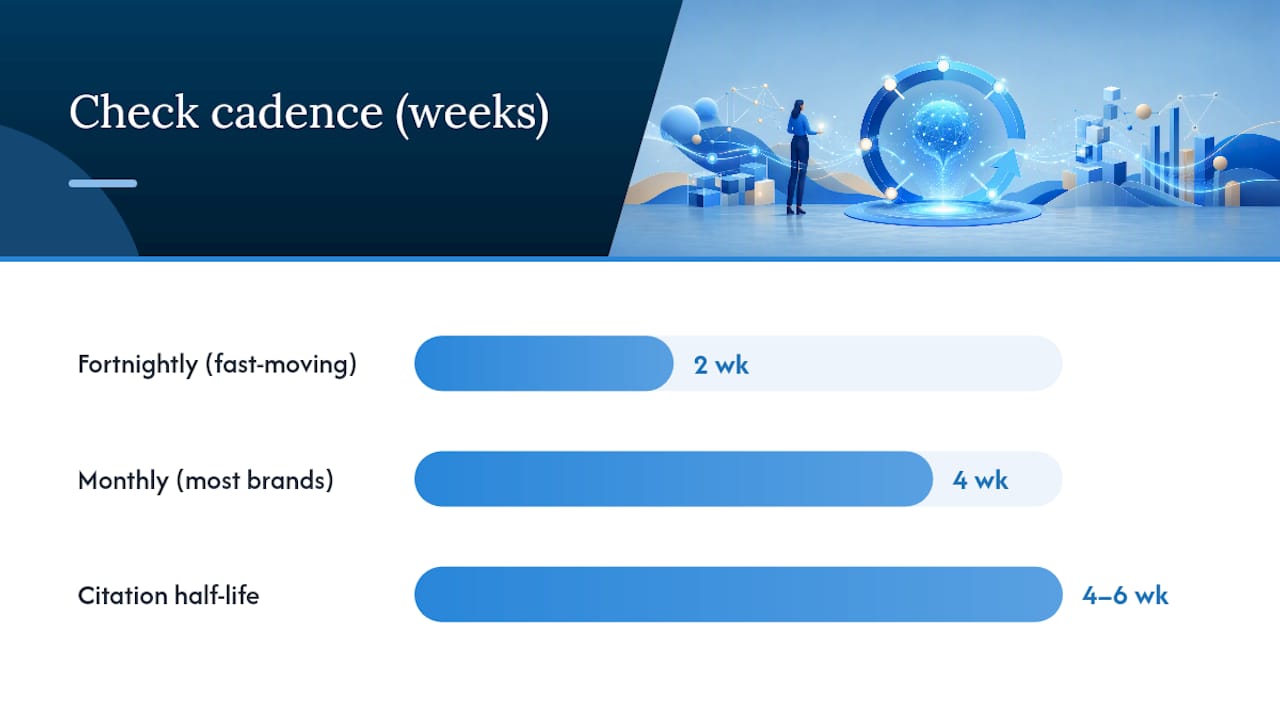
Monthly checks are enough for most brands; anything with fast-moving competitor activity or seasonal queries benefits from fortnightly spot-checks. Citation half-life in some studies runs as short as four to six weeks, meaning a page cited reliably in January can quietly disappear from AI answers by March without a single change on your end.
A simple dashboard covers most needs:
- Engine-by-engine breakdown (ChatGPT, Google AI Overviews, Perplexity) so you can see where you’re strong and where you’re absent.
- A handful of actual AI-generated excerpts mentioning your brand, kept as evidence for stakeholders who haven’t seen this firsthand.
- A sentiment trend line, even a simple positive/neutral/negative tag, tracked month to month.
When a page’s citations start dropping, that’s the trigger to refresh the content, update the stats, and consider a fresh PR push to rebuild the earned-media signal that helped it get cited in the first place.
Common mistakes that harm AI visibility
Most visibility problems come down to a handful of repeat offenders, all fixable without a full rebuild.
- Answers hidden in images or PDFs. Text trapped in a graphic is invisible to most parsers; move key facts into real HTML text.
- Client-side-only rendering. If your page’s content only appears after JavaScript runs, many AI crawlers never see it; server-side rendering fixes this at the source.
- Vague claims with no source. “Studies show” convinces nobody, human or machine; name the study.
- Long, unstructured walls of text. Without headings or lists breaking up the content, there’s no clean passage for a model to lift.
How Cloud 9 approaches AI visibility for clients
The workflow is consistent: audit crawl and rendering issues first, fix the technical blockers, then reshape existing content into the snippable, sourced format AI systems favour, before layering in PR to build earned citations. Cloud 9’s SEO services handle the technical and content side; the AI automation work supports ongoing monitoring once the fixes are live.
Pro Tip: Treat AI visibility checks as a standing line item in your monthly marketing report, not a one-off project. Citation decay is fast, and a quarterly glance will miss it.
— Rob
Get your AI visibility fixed properly, not patched
The client exists for exactly this problem: businesses stuck juggling a web developer, an SEO freelancer, and an AI consultant who don’t talk to each other, while pages stay slow, poorly structured, and invisible to the assistants their customers now use to research decisions. As a single partner handling both the technical build and the content structure, they fix the rendering and schema issues that block AI crawlers and rewrite the content itself to be citation-ready, in one coordinated project rather than three separate invoices.

If your site is still running on client-side rendering or hasn’t been touched structurally in years, that’s usually the first blocker worth solving. Cloud 9’s web design and development service covers exactly that groundwork. Get in touch for a discovery call and find out where your current site is losing AI visibility before you spend another month guessing.
Sources
- ACL 2026 paper on GEO methods
- Optimizing your content for inclusion in AI search answers (Microsoft)
- ArXiv comparative analysis of AI search vs traditional search (2025)
- HubSpot AI Search Grader
FAQ
How do I check my AI search visibility?
Run your brand through a free diagnostic like HubSpot’s AI Search Grader for a multi-engine snapshot, then check Search Console’s generative reports for Google-specific performance data.
What is the 30% rule in AI search?
There’s no single verified “30% rule” specific to AI search visibility; if you’ve seen this term, it likely refers to informal estimates about zero-click search share and isn’t a standard, sourced metric worth building strategy around.
How can I increase my AI search visibility?
Structure content into concise, self-contained answer blocks with clear headings and sourced claims, fix any client-side rendering issues, and build earned media coverage on third-party sites, since AI systems weight independent sources heavily.
What are the best tools for tracking AI search visibility?
Search Console’s generative reports and HubSpot’s AI Search Grader work well for initial snapshots, while a dedicated platform like Prescy suits ongoing, engine-by-engine tracking over time.
Does traditional SEO still matter if I’m optimising for AI visibility?
Yes. Technical SEO, indexing, and crawlability remain the foundation; AI visibility work builds on top of that base rather than replacing it.