Site architecture is defined as the organised framework of a website’s pages, determining how content is structured, linked, and presented to both visitors and search engine crawlers. It is the foundational blueprint that shapes every interaction a user has with a site, and every signal a crawler receives about its content. The role of site architecture extends far beyond visual layout. It governs crawl efficiency, link equity distribution, topical authority, and the speed at which visitors find what they need. Web developers, UX designers, and digital marketers who treat architecture as an afterthought consistently pay for it in lost rankings and poor engagement. The industry term for this discipline is “information architecture,” though “site architecture” is the widely used technical shorthand across SEO and development practice.
How does site architecture affect user experience and navigation?
Visitors form an opinion about a website’s credibility in approximately 50 milliseconds. That window is too short for content to register. Structure and visual clarity do the work instead. A disorganised page hierarchy, ambiguous menu labels, or buried content all signal untrustworthiness before a single word is read.
Good site architecture guides visitors through a logical journey without friction. The key structural tools are:
- Clear page hierarchy. A top-level structure of Home, Services, Resources, and Contact gives visitors an immediate mental map of the site.
- Intuitive navigation labels. Navigation built around user thought processes, not internal org charts, reduces bounce rates. Labels like “How we help” confuse; “Services” does not.
- Breadcrumb trails. These show visitors exactly where they are within the site and provide a quick path back. They also appear in Google search results, improving click-through rates.
- Shallow navigation depth. Keeping key pages within two or three clicks from the homepage reduces the effort required to find information and keeps visitors engaged longer.
The benefits of site layout extend to trust signals as well. A site that feels logically organised communicates professionalism. Visitors associate structural clarity with competence, which directly influences whether they contact a business or leave.
Pro Tip: Test your navigation with five people who have never seen the site. Ask them to find a specific page without guidance. If they struggle, the labels or hierarchy need rethinking, not the content.

How does site architecture affect SEO performance and crawl efficiency?
Search engines do not read websites the way humans do. Googlebot follows links from page to page, building a map of the site’s content and relationships. The structure of that map determines which pages get indexed, how quickly, and with what priority.
Crawl depth has a direct impact on indexing priority. Pages buried more than three or four clicks from the homepage are crawled less frequently and rank lower, regardless of content quality. This is not a minor penalty. A well-written article that sits six clicks deep may never appear in search results at all.
The four mechanisms through which architecture shapes SEO performance are:
- Crawl depth. Keep every important page within three clicks of the homepage. Pages beyond that threshold receive less crawl budget and lower indexing priority.
- Internal linking. Links between pages pass authority, known as PageRank, through the site. A page with many internal links pointing to it signals importance to Google.
- URL hierarchy. Clean, descriptive URLs such as
/services/web-design/tell crawlers about page relationships and topic relevance before the page is even read. - Topic clusters. Grouping related content around a central hub page, then linking cluster pages back to the hub, reinforces topical authority. Topic clusters and hub-spoke internal linking improve trust and competitive rankings by showing depth on a subject.
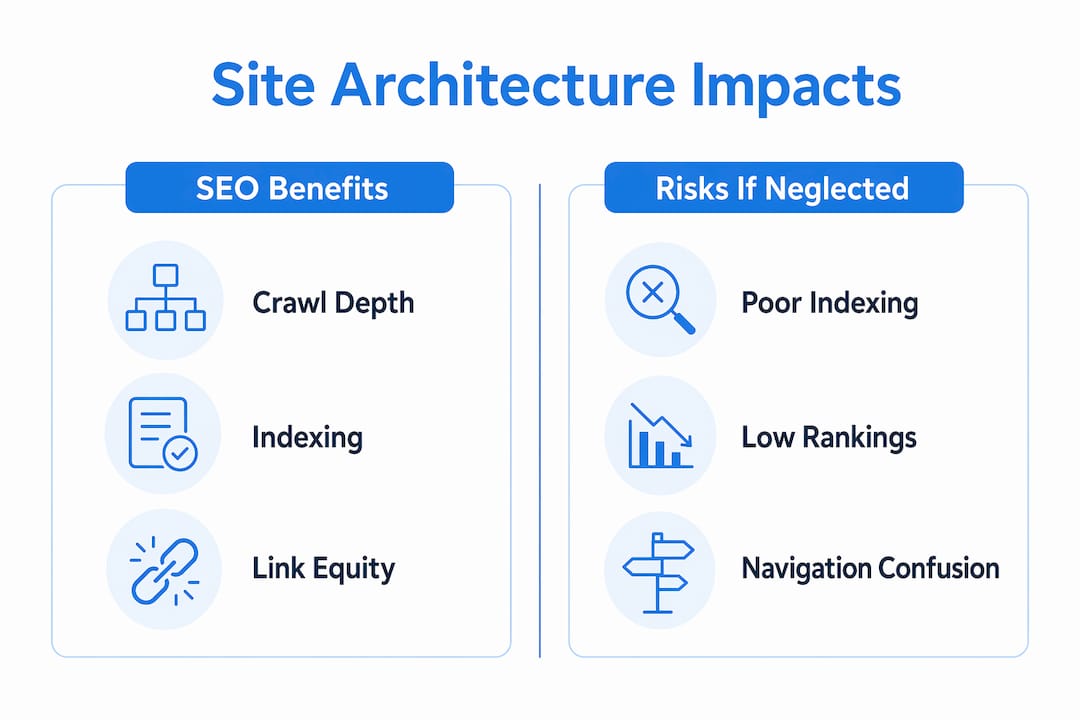
| Architecture element | SEO impact | Risk of neglect |
|---|---|---|
| Crawl depth (max 3–4 clicks) | Higher indexing priority | Pages go unindexed |
| Internal linking | Distributes PageRank | Authority pools in silos |
| Clean URL structure | Signals topic relevance | Crawlers misread hierarchy |
| Topic clusters | Builds topical authority | Thin, disconnected content |
The importance of website structure becomes most visible during a technical SEO audit. Sites with fragmented architectures routinely show large numbers of orphaned pages, wasted crawl budget, and ranking gaps that no amount of content alone can fix.
Pro Tip: Use Google Search Console’s Coverage report to identify pages that are “Discovered but not indexed.” A high count almost always points to crawl depth or internal linking problems, not content quality.
Does site architecture matter for AI search systems?
AI-powered search engines, including Google’s AI Overviews and tools like Perplexity, assess websites differently from traditional crawlers. They evaluate entity relationships, topical coherence, and the structural signals that indicate a site is an authoritative source on a given subject.
Site architecture helps AI search systems evaluate topical authority and entity relationships, increasing the likelihood of being cited as authoritative. A site with a clear hub-and-spoke structure around a topic signals to AI systems that its content is organised, complete, and trustworthy. A site with scattered, poorly linked pages signals the opposite.
Architecture also determines whether Google awards sitelinks, the additional links that appear beneath a main search result. Google awards sitelinks automatically to sites with clear, authoritative hierarchies. There is no manual request process. The site either earns them through structural clarity or it does not. Sitelinks significantly increase click-through rates by occupying more space on the search results page.
Practical steps to prepare site architecture for AI search in 2026:
- Build explicit topic clusters with a clearly labelled hub page for each core subject area.
- Use descriptive, consistent internal anchor text so AI systems can interpret page relationships.
- Avoid duplicate or near-duplicate URLs that create ambiguity about which page is authoritative.
- Connect your AI knowledge systems to a well-structured site so that AI tools can surface accurate, organised information.
“Site architecture is increasingly vital for AI search systems that assess both entity relationships and topical authority, making it a critical factor for future-proof SEO success.”
The practical implication is clear. A site built with clean hierarchies and explicit topic relationships is far more likely to appear in AI-generated answers than one with a flat, disorganised structure.
What are the most common site architecture pitfalls?
The single most damaging mistake in site architecture is treating it as a post-launch task. Treating site architecture as a post-launch fix causes structural debt, greatly increasing the complexity and cost of later corrections. Retrofitting a logical hierarchy onto a site that has grown organically is expensive, disruptive, and often incomplete.
Common pitfalls that create structural debt include:
- Fragmented URL structures. URLs that do not reflect a logical hierarchy, such as
/page?id=4521, give crawlers no useful information about content relationships. - Missing topic hierarchies. Publishing content without placing it within a clear category structure creates orphaned pages that neither users nor crawlers can find easily.
- Over-reliance on tags and categories. Tagging systems can create thousands of thin, auto-generated pages that dilute crawl budget and confuse topical signals.
- Navigation built for internal convenience. Menus organised around business departments rather than user needs consistently underperform on both engagement and SEO metrics.
The cost of ignoring the importance of website structure compounds over time. Each new page added to a poorly structured site makes the problem harder to fix. Content scalability suffers because there is no clear place for new material to live.
Pro Tip: Before publishing any new content, map it to a specific place in your existing hierarchy. If it does not fit cleanly, that is a signal to review your category structure, not to create a new one-off page.
Practical guidelines for effective site architecture in 2026
Building a well-structured site requires planning before a single page is written. The architecture should be defined at the same time as the content strategy and SEO plan, not after them.
A shallow, logical hierarchy following the pattern Home → Category → Subcategory → Detail improves both crawlability and topical authority signalling. This pattern keeps pages within the three-to-four click threshold and makes the site’s subject matter immediately clear to crawlers.
The practical steps to design effective site architecture are:
- Map your page hierarchy first. List every page the site needs, then group them into logical categories before building anything.
- Define your URL structure. Agree on a consistent URL pattern, such as
/category/subcategory/page-name/, and apply it without exceptions. - Plan internal links deliberately. Identify which pages should carry the most authority and build internal linking to support them from the outset.
- Integrate SEO, UX, and content planning. Architecture decisions affect all three disciplines. Developers, designers, and marketers should agree on the structure together before work begins.
- Audit regularly. Use a website performance audit to identify crawl issues, orphaned pages, and navigation problems before they compound.
When planning a redesign, the architecture review should come before the visual design brief. A redesign brief that locks in visual direction before resolving structural questions almost always produces a site that looks good but performs poorly.
The best practices for website architecture in 2026 also account for mobile-first indexing. Google crawls the mobile version of a site first. Navigation that works on desktop but collapses into an unusable menu on mobile creates a structural gap that directly harms rankings.
Key takeaways
Well-planned site architecture is the single most cost-effective investment a web team can make, because every other digital effort, from content to paid search, performs better on a structurally sound foundation.
| Point | Details |
|---|---|
| Architecture drives crawl priority | Keep all important pages within three clicks of the homepage to maximise indexing. |
| Structure shapes user trust | Visitors judge credibility in 50 milliseconds, making structural clarity a conversion factor. |
| Topic clusters build authority | Hub-and-spoke internal linking signals topical depth to both search engines and AI systems. |
| Plan before you build | Treating architecture as a post-launch fix creates structural debt that compounds with every new page. |
| AI search rewards clear hierarchies | Clean, entity-rich structures increase the likelihood of appearing in AI-generated search answers. |
Why I think most teams get site architecture backwards
Most web projects I have seen start with design. The visual direction gets agreed, the brand colours are chosen, and then someone asks where the pages should go. That sequence is backwards, and it costs teams months of rework.
The uncomfortable truth is that site architecture is a strategic decision, not a technical one. It determines which topics you can credibly claim authority on, which pages will rank, and whether visitors trust the site within the first few seconds. Developers cannot fix a bad architecture with clever code. Designers cannot compensate for it with attractive visuals. Marketers cannot overcome it with more content.
What I have found works is a single planning session before any design or development begins, where the developer, UX designer, and SEO lead agree on the page hierarchy, URL structure, and internal linking logic together. That one session eliminates the most expensive problems before they exist.
The emerging AI search dimension makes this even more pressing. AI systems do not just read pages. They assess the relationships between them. A site with a coherent, well-linked structure is far more likely to be cited as authoritative than one where content exists in isolation. Developers and marketers who understand this now will have a measurable advantage as AI-driven search continues to grow.
Architecture is not a one-time task either. It needs reviewing as the site grows. A quarterly audit of crawl coverage, internal linking, and navigation performance is the difference between a site that compounds its authority over time and one that gradually loses ground.
— Rob
How Cloud 9 approaches site architecture for established businesses
Cloud 9 works with established UK businesses that need their websites to perform, not just look good. The starting point is always architecture: mapping the page hierarchy, URL structure, and internal linking logic before any design or development work begins.

Cloud 9’s web design and development service is built around planning-first principles. Every project begins with a structural audit or architecture map, so the site is built to rank, convert, and scale from day one. For businesses that already have a site, Cloud 9’s SEO services include a full architecture review to identify crawl issues, orphaned pages, and missed ranking opportunities. If your site is not performing as it should, the structure is usually where the answer lies.
FAQ
What is site architecture in web development?
Site architecture is the organised structure of a website’s pages, defining how they are grouped, linked, and navigated. It determines how both users and search engine crawlers move through the site.
How does site architecture affect SEO rankings?
Pages buried more than three to four clicks from the homepage are crawled less frequently and rank lower, regardless of content quality. Internal linking and URL hierarchy also distribute PageRank across the site.
What is a topic cluster in site architecture?
A topic cluster groups related pages around a central hub page, with each cluster page linking back to the hub. This structure signals topical depth and authority to search engines and AI systems.
Why do AI search systems care about site architecture?
AI search systems evaluate entity relationships and topical coherence when assessing authority. Sites with clean, hierarchical structures and explicit topic clusters are more likely to be cited in AI-generated answers.
When should site architecture be planned?
Site architecture should be planned before any design or content work begins. Treating it as a post-launch fix creates structural debt that increases the cost and complexity of every future change.