How to Rank in ChatGPT: A Practical Guide for UK Organisations

You can’t buy a position in ChatGPT, and there is no single ranking list to climb. ChatGPT writes one answer, then cites or names a handful of sources. To appear in it, you need three things. Your site must be open to OpenAI’s search crawler. Your pages must answer specific questions more clearly than anyone else’s. Other credible sites must mention your organisation by name, in your sector’s own language.
This guide covers each of those in order, with the checks we would run first for a membership body, recruiter, charity, security firm, ecommerce business or professional services firm. It also covers where AI search advice is thin, and where a person should stay in charge.
TL;DR
- ChatGPT does not rank pages in a list. It builds an answer from live web search and its training, then cites some sources. Your aim is to be one of them.
- Start with access: allow OAI-SearchBot in robots.txt, make sure Bing can index you, and keep key pages in plain, crawlable text.
- Publish pages that answer one buyer question each, name the author, and state facts you can stand behind.
- Brand mentions on trade press, directories and expert sites appear to matter more than backlinks. Earn them deliberately.
- Measure by testing real buyer prompts monthly. Keep a person reviewing anything AI-written before it goes live.
Table of Contents
- What “ranking” means in ChatGPT
- Step 1: Make sure ChatGPT can reach you
- Step 2: Publish pages that answer one question each
- Step 3: Get mentioned where your sector talks
- Step 4: Fix the data behind the pages
- Where AI should not drive this work
- Perspective: what we see on real systems
- How to measure whether it is working
- A sensible first 90 days
- Where we can help
- FAQ
- Sources
What “ranking” means in ChatGPT
In Google you hold a position on a results page. In ChatGPT the output is a written answer, and your organisation is either in it or not. OpenAI explains that ChatGPT can search the web to answer questions with current information and links to sources, so what you can influence is the pool of pages it draws from and how easily it can quote them.
Two routes lead into an answer:
- Live retrieval. ChatGPT searches, reads pages and cites them. This is the route you can influence fastest, because it depends on your current site.
- Learned associations. The model has absorbed patterns about which organisations belong with which topics. This is slower, and depends mostly on what is said about you elsewhere.
Because the answer is a single response, being the sensible second or third citation is still a win. A buyer asking “which payroll software suits a 50-person recruiter” or “who can audit our CCTV compliance” may never see page two.
One honest caveat: results vary by prompt, by user and by day. Anyone promising a guaranteed position is selling something. What follows raises your odds. It does not fix them.
Step 1: Make sure ChatGPT can reach you
This is the cheapest fix and the one most often missed.
OpenAI runs separate crawlers, and its documentation says allowing OAI-SearchBot is what makes a site eligible for ChatGPT search. Blocking GPTBot, a different crawler, stops your content being used to train its models without removing you from search. The same page says changes to robots.txt typically take about 24 hours to reflect.
That gives you a policy choice, and it belongs with whoever owns data and legal risk, not only marketing:
- Allow OAI-SearchBot if you want to be cited in ChatGPT search.
- Decide on GPTBot separately, depending on whether you are comfortable with training use. A membership body with a paywalled member library, for example, may want to block it and keep the library behind login.
OpenAI’s publishers and developers FAQ states that any public website can appear in ChatGPT search, and lists the guidelines to follow so your content can be discovered and cited. Read it once and have your developer or site manager confirm the robots.txt rules match your decision.
Check Bing, not just Google
Much AI search advice points to Bing’s index as a foundation for what ChatGPT finds. One analysis of ChatGPT’s recommendations, from Parse, concludes that the practical recipe is to rank in Bing for the rephrased version of a question, stay crawlable and refresh content substantively. That is one vendor’s analysis rather than OpenAI’s statement, so treat it as a strong hint. Verifying your site in Bing Webmaster Tools and checking your key pages are indexed costs an afternoon.
Keep important facts in plain text
If your services, locations, membership tiers or accreditations sit inside images, PDFs, scripts or tabs that need a click, a crawler may never read them. Put the facts in ordinary page text.
Step 2: Publish pages that answer one question each
ChatGPT quotes passages, not whole sites. A page that tries to cover everything gives it nothing clean to lift.
Start from the questions buyers actually type into an AI assistant. For a UK audience they tend to look like this:
| Sector | A prompt a buyer might type | The page that should exist |
|---|---|---|
| Trade association | What does membership of a UK trade body for installers include? | A plain membership benefits page with tiers, who qualifies and what is covered |
| Recruitment | How do I choose a specialist recruiter for finance roles? | A criteria page: sectors covered, process, how candidates are checked |
| Charity | How do I support a charity helping carers in my area? | A page on who you help, where, and how donations are used |
| Security | What should a business ask a CCTV or guarding supplier about compliance? | A buyer’s checklist with the relevant standards named |
| Ecommerce | Which supplier ships next-day trade orders in the UK? | Delivery, stock and returns details in text, matching your product data |
| Professional services | What does a small business need from an employment solicitor? | A scoped explainer with typical situations and when to seek advice |
Then write each page like this:
- Put the answer first. Two or three plain sentences under a heading that states the question or topic.
- Be specific. Names, numbers, locations, timescales and conditions. Vague claims are not quotable.
- Show who wrote it. A named author with a visible role. BetterAISearch’s review of AI citation studies reports that named authors with credentials are among the signals associated with higher citation rates.
- Say what you do not do. Limits make you more trustworthy to a reader and a more precise match for the right query.
- Refresh it. Update pages when facts change and show the date.
This is not a trick. Google’s own guidance on helpful, reliable, people-first content describes the same discipline, and Google states that the best practices for SEO remain relevant for AI features such as AI Overviews, with no extra requirements to appear. If your pages are good for people, you have done most of the work for both.
Step 3: Get mentioned where your sector talks
Backlinks were the currency of traditional search. For AI answers, the evidence points to something broader. One analysis found that branded web mentions correlated at 0.664 with AI visibility, against 0.218 for backlinks. That is a single study from a vendor, so read it as direction rather than proof. The logic is plausible, though: language models build associations from text, and a mention of your name next to a topic counts even without a hyperlink.
For an established UK organisation, the practical sources are:
- Trade press and sector publications that cover your industry.
- Industry directories and professional registers you genuinely qualify for.
- Conference programmes, speaker pages and panel write-ups.
- Expert commentary quoted in news and sector articles.
- Genuine customer or member reviews on the platforms your buyers use.
- Partner and supplier pages that describe what you do accurately.
Membership bodies and trade associations are well placed here. You already convene the sector, publish research and run events, and each of those creates named mentions. If you run events, the same principle applies to getting them found: this piece on getting events visible in ChatGPT and Google shows how structured, consistent event details help.
Keep the wording of your description consistent across these places. If your own site says “specialist healthcare recruiter”, a directory says “general staffing” and a press mention says something else, the association gets blurry.
Step 4: Fix the data behind the pages
For ecommerce and any organisation with structured catalogues, listings or events, the page text is only half the story. Product identity, variants, attributes, price, availability and fulfilment details increasingly form part of what AI shopping and search tools retrieve, as Core dna’s guide to product feeds for AI search sets out. It also notes that platforms do not all ask for the same data.
The practical consequence is a data-quality job, not a content job. If your CRM, product database and website disagree on a price, a stock status or a membership fee, an AI system may repeat the wrong one. Fixing that means connecting the systems so that one source feeds the others, which is where our own work sits.
Where AI should not drive this work
Using AI to chase AI visibility has obvious traps.
- Do not publish unreviewed AI-written pages. Volume without accuracy hurts you. A person who knows the subject should check every claim, number and legal statement before it goes live.
- Do not let AI write regulated advice. Pages on employment law, fundraising rules, security standards or financial matters need sign-off from someone qualified to give that advice.
- Do not paste personal or member data into public AI tools. Set clear data boundaries and follow UK GDPR. Decide in writing which data may go into which tool.
- Do not fake mentions. Planted reviews and invented testimonials breach consumer rules and platform policies, and they are the quickest way to lose trust.
- Do not trust a guarantee. No agency or tool controls ChatGPT’s output.
Perspective: what we see on real systems
Most of the advice about ranking in ChatGPT treats it as a content problem. In our experience it is at least as much a systems problem.
We have spent more than 20 years connecting websites, databases, CRMs, APIs and membership systems. When we look at why an established organisation is invisible or misrepresented in AI answers, the cause is often dull. Services described differently on three sites. A directory entry nobody has updated since a rebrand. Member benefits living in a PDF. Prices in the CRM that do not match the website.
So we would do the work in this order. First, fix access and consistency: crawlers, one agreed description, one source of truth for facts. Second, write the handful of pages that answer your buyers’ real questions, reviewed by a person who knows the subject. Third, earn mentions in the places your sector reads. Only then measure and tune.
We are sceptical of the hype. Nobody outside OpenAI can say exactly how ChatGPT chooses, and any claim of a secret formula should be treated with caution. The sound approach is the unglamorous one: be easy to find, accurate, and well described by others. And keep a person in control of what is published in your name.
— Rob
How to measure whether it is working
Traditional rank trackers do not map neatly onto ChatGPT, so keep it simple and repeatable.
- Build a prompt list. Write 15 to 25 questions your buyers would genuinely ask, in their words, covering problems, comparisons and “who should I use” queries.
- Test monthly. Run each prompt, record whether your organisation is named, cited or absent, and who appears instead. Use the same wording each time and log the date.
- Check your referrals. Look in your analytics for visits from chatgpt.com and compare enquiry quality, not just volume.
- Ask new enquirers. Add “how did you hear about us?” to forms, with an AI assistant as an option.
- Review what is cited. If ChatGPT cites a competitor’s guide or a directory instead of you, that tells you which page or listing to improve.
Expect noise. Answers differ between runs, so look for trends over three months rather than reacting to a single result. Our 8 point AI search visibility checklist walks through the review in more detail.
A sensible first 90 days
Weeks 1 to 2: access and audit. Confirm robots.txt choices, Bing indexing and plain-text key facts. Write down your one-line description and check it against every listing.
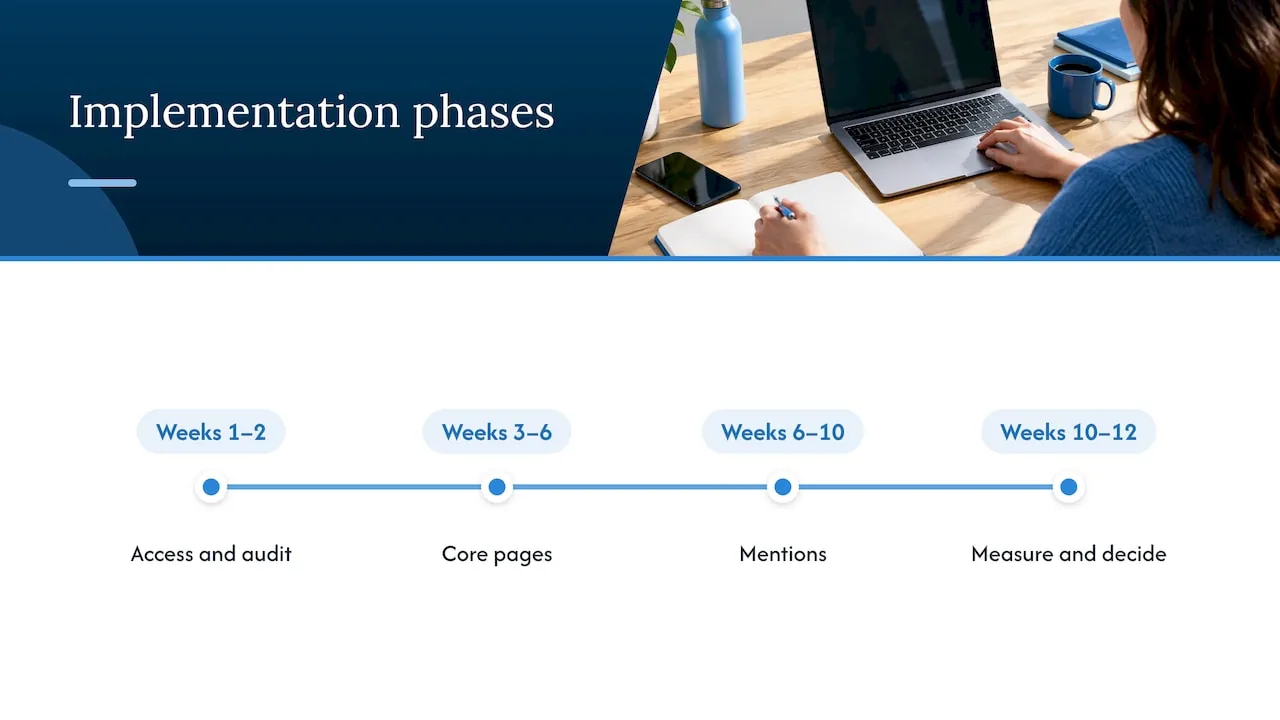
Weeks 3 to 6: core pages. Pick the five to ten buyer questions with the most commercial value. Write or rewrite one page for each, with a named author and a human review.
Weeks 6 to 10: mentions. Pitch a piece of data, a commentary or a case study to the two or three publications your buyers read. Complete the directories and registers you qualify for.
Weeks 10 to 12: measure and decide. Re-run your prompt list, compare with your baseline, and decide where to invest next.
This is small enough for a lean team and does not need a large budget to start.
Where we can help
If you would rather not do this alone, our AI SEO, GEO and AIO service covers the audit, the page plan and the monitoring, and connects it to the CRMs and data your business already runs. If you are earlier on and want to decide where AI belongs in your organisation at all, start with our AI services overview, or get in touch to talk through your situation.
FAQ
Can I pay to rank in ChatGPT?
Not for organic answers. You cannot buy a place in ChatGPT’s generated response, so be wary of anyone who says they can sell you one. What you can do is make your site eligible, publish clear answers and earn credible mentions.
Do I need to allow OpenAI’s crawler?
To be eligible for ChatGPT search, OpenAI says to allow OAI-SearchBot in robots.txt. GPTBot is separate and relates to training, so you can treat the two differently. Changes typically take around 24 hours to take effect.
Is ranking in ChatGPT the same as SEO?
They overlap heavily but are not identical. Google says SEO best practice still applies to its AI features, and ChatGPT also rewards clear passages and third-party mentions. Good fundamentals help in both.
How long does it take to appear?
Technical changes can register within days, but being recommended consistently usually takes months of better pages and more mentions. Results also vary from one prompt to the next, so judge progress by trends over a quarter.
Should I use AI to write the content?
AI can help with outlines and first drafts, but a knowledgeable person should check every fact, figure and claim before publishing. Never use it unreviewed for legal, financial or regulated advice, and never put personal data into public tools.
Sources
- Overview of OpenAI Crawlers
- Searching the web with ChatGPT, OpenAI Help Center
- Publishers and Developers FAQ, OpenAI Help Center
- How ChatGPT decides which brands to recommend, Parse
- Backlinks vs brand mentions for AI visibility, signals.sh
- E-E-A-T for AI search, BetterAISearch
- AI Features and Your Website, Google Search Central
- Creating Helpful, Reliable, People-First Content, Google Search Central
- Product Feed Optimization for AI Shopping and AI Search, Core dna