ChatGPT can speed up and personalise customer support, but only when it answers from your verified data rather than its own general training. Raw, ungrounded ChatGPT is not safe for direct customer-facing replies. The right starting point is agent assist, not full automation: pilot a narrow use case with retrieval grounding, tight fallback rules, human monitoring, and clear KPIs before letting it near an unsupervised inbox.
TL;DR:
- Rely on retrieval-anchored ChatGPT to ensure responses are grounded in your verified data and prevent hallucinations that can occur with ungrounded models.
- Use RAG to index current help articles, policies, and past tickets, enabling accurate, context-specific answers and timely updates.
- Monitor hallucination, fallback frequency, and key performance metrics such as ticket deflection and customer satisfaction during pilot and rollout phases.
- Conduct thorough readiness audits and limit initial use cases to high-volume, low-risk tasks like drafting replies and triage before expanding the deployment.
- Maintain human oversight for regulated or complex interactions to avoid legal liabilities and preserve judgment that AI cannot reliably replicate.
Table of Contents
- What can ChatGPT actually do for customer support?
- What ChatGPT alone gets wrong
- How does RAG make ChatGPT reliable for support?
- How do you take a ChatGPT pilot from test to production?
- What KPIs prove ChatGPT is working in support?
- Cloud 9’s perspective: managed AI assistants for support teams
- Sources
- FAQ
What can ChatGPT actually do for customer support?
Used well, ChatGPT handles the repetitive, high-volume work that eats agent time without needing to be right about every edge case on its own. Common, low-risk tasks include drafting replies, summarising long threads, translating messages, and scripting prompts agents can adapt on the fly, according to TechTarget’s analysis of ChatGPT in customer service. None of that requires the model to know your order history or refund policy from memory.
Five use cases consistently deliver value early:
- Agent assist — drafting reply variants, adjusting tone, translating a customer’s message, or summarising a ten-message thread into two lines for a supervisor.
- Automated triage and prioritisation — reading incoming tickets and routing them by urgency, topic, or sentiment before a human ever opens the queue.
- Self-service answers grounded in company data — resolving “where’s my order” or “what’s your returns policy” queries by pulling from your actual policies and order records, not general web knowledge.
- Internal knowledge assistants — letting new agents ask plain-English questions of your help centre and product documentation instead of hunting through folders during a live call.
- Training and simulation — generating realistic customer scenarios for coaching, so team leads can rehearse difficult conversations without waiting for a real one to happen.
Notice what’s missing from that list: nothing there asks ChatGPT to make a final call on a refund, a complaint escalation, or a contract dispute. That’s deliberate, and it’s the boundary most teams get wrong first.
What ChatGPT alone gets wrong
Hallucination is the headline risk, and it’s structural rather than a bug you can patch away. A model trained on general text will confidently invent a returns window, a refund amount, or a delivery date because it’s predicting plausible language, not looking up your actual database. Ask it about an order without giving it order data, and it will often answer anyway.
Beyond fabrication, a few operational risks matter just as much:
- No live business context: the model doesn’t know today’s stock levels, an active SLA exception, or a refund already issued five minutes ago.
- Data and privacy exposure: pasting customer PII into a public model endpoint can breach your own data-handling obligations, not just the model provider’s terms.
- Regulated or high-stakes interactions (billing disputes, safety complaints, anything touching legal liability) need a human decision-maker, full stop.
- Over-automation risk: lean too hard on the assistant and agents lose the judgement and product knowledge that only comes from handling real cases.
Pro Tip: Run a “red team” week before launch: feed the assistant deliberately tricky, ambiguous, or unanswerable questions and log every wrong or fabricated answer. It tells you more about real-world failure modes than any demo ever will.
Forrester’s analysis of generative AI in contact centres is blunt about this: without human oversight and ongoing prompt and retrieval tuning, generative AI in support settings underperforms the pitch.
How does RAG make ChatGPT reliable for support?
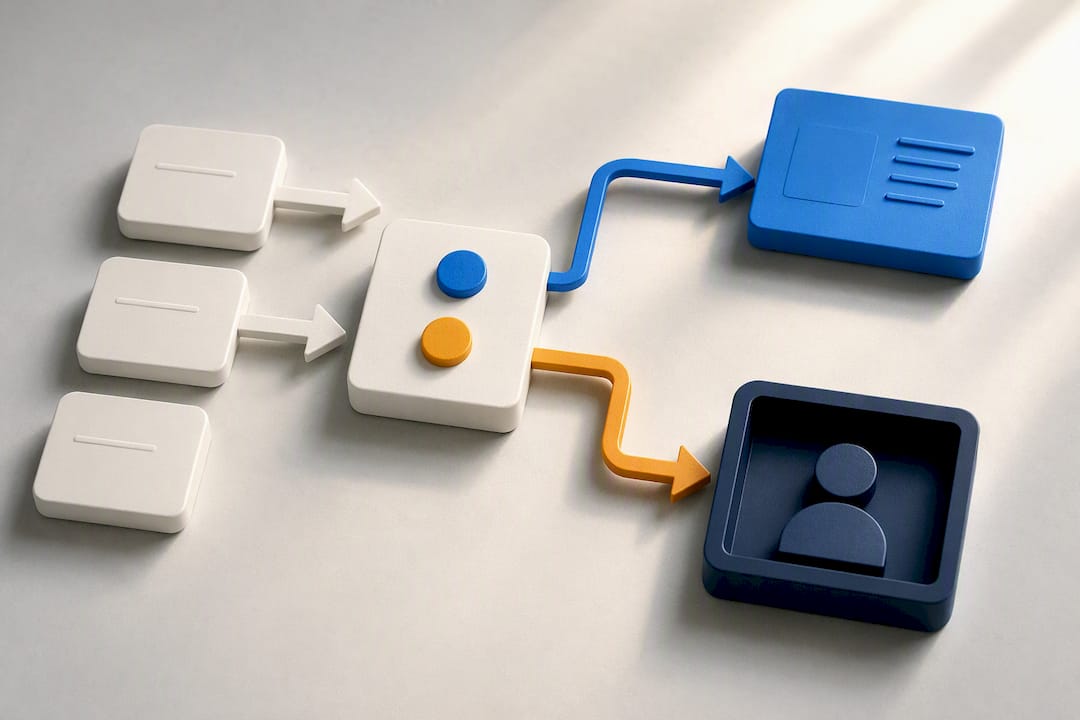
Retrieval Augmented Generation, or RAG, is the mechanism that turns a plausible-sounding chatbot into one that answers from your actual policies. The pattern is straightforward: index your knowledge sources, retrieve the passages relevant to a customer’s question, then hand those passages to the model as context before it generates a reply. Rather than guessing from memory, the model is answering an open-book question, and that single change is what separates professional deployments from raw ChatGPT, according to Meilisearch’s breakdown of RAG for customer support.
What gets indexed matters as much as the mechanism itself:
- Help centre articles and FAQs, kept current and tagged by product line or region.
- Product specs and policy documents, including anything with dates, prices, or eligibility rules.
- Past resolved tickets, which capture the edge cases your official documentation never quite covers.
- Metadata such as last-updated date and owner, so stale content can be flagged and retired.
Technically, this means converting documents into embeddings and storing them in a vector database, then running similarity search against each incoming query. Re-indexing cadence depends on how fast your policies change: weekly is common for fast-moving retail or SaaS support, monthly is often enough for stable professional services content.
The other half of RAG is knowing when to say nothing. Systems built well are explicitly programmed to reply “I don’t know” and escalate to a human agent when retrieval confidence is low, rather than filling the gap with an invented answer, per Meilisearch’s guidance on grounded support agents. That single fallback rule prevents most of the embarrassing hallucinations you’ll read about elsewhere.
Privacy controls belong in the same conversation as the technical build. Decide what gets retained, for how long, and under what model-provider settings, before a single customer message touches the system, not after a complaint arrives.
How do you take a ChatGPT pilot from test to production?
Most failed AI support projects fail at the readiness stage, not the technology stage. Support leaders increasingly treat “AI-ready” documentation as a prerequisite: audit and clean your knowledge base before connecting any model to it, because AI will amplify existing gaps and errors rather than fix them, according to ClickHelp’s research on AI-powered knowledge bases.
A practical rollout runs in five stages:
- Readiness audit. Review your knowledge base for missing articles, contradictory policies, and outdated pricing, and map which systems (CRM, order management, ticketing) hold the live data you’ll eventually need to connect.
- Pilot design. Pick one narrow domain, such as order status or returns, rather than “all support.” Choose a representative sample of real customer intents, set target KPIs up front, and write explicit safety rules covering what the assistant must never attempt alone.
- Integration. Build connectors into your ticketing and CRM systems, generate embeddings for your indexed content, and write prompt templates that force the model to cite or rely on retrieved passages rather than free-associating.
- Validation and tuning. Route a percentage of pilot conversations through human-in-the-loop review. Track hallucination rate and fallback rate weekly, and treat both as tuning signals rather than one-off pass/fail checks.
- Rollout and governance. Set service-level agreements for response accuracy and escalation speed, log every conversation for audit, agree a content update cadence, and name an owner responsible for the knowledge base’s ongoing accuracy.
Pro Tip: Assign one named person as “knowledge base owner” before the pilot starts, not after. Without an owner, documentation drifts out of date within weeks and your grounding quietly degrades.
What KPIs prove ChatGPT is working in support?
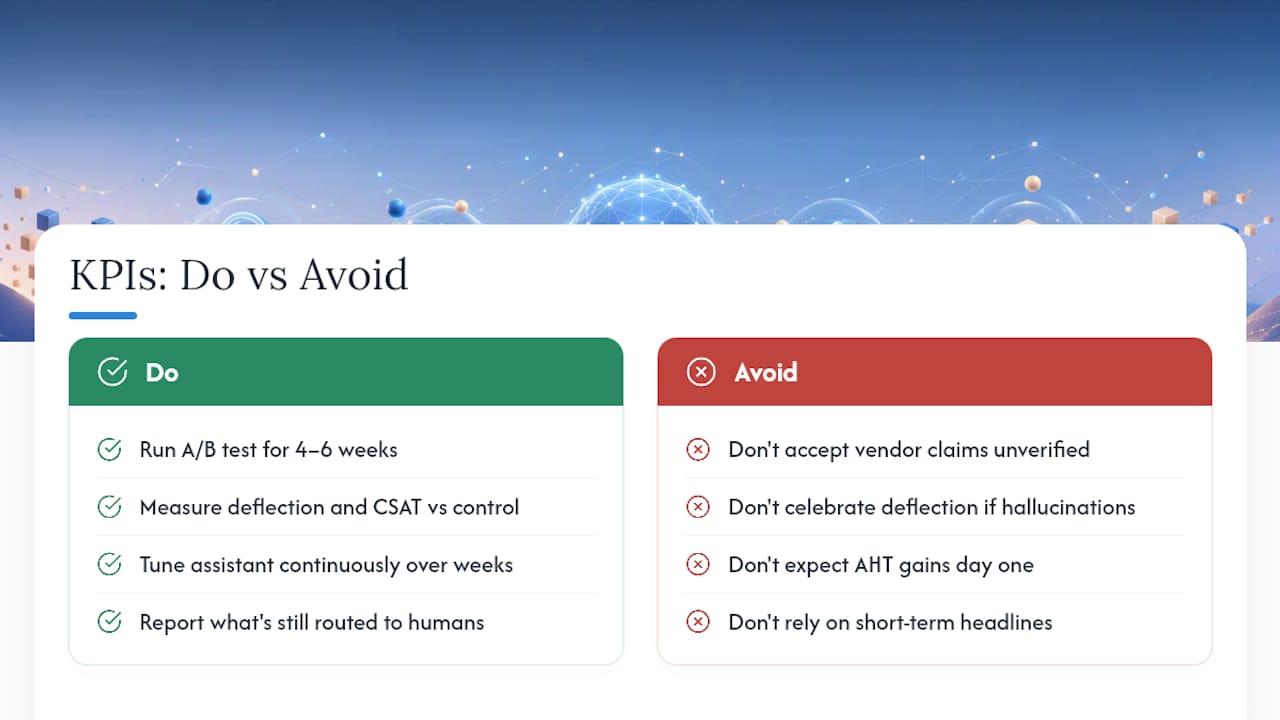
Six numbers tell you whether the deployment is earning its keep: ticket deflection rate, average handle time (AHT), first contact resolution (FCR), customer satisfaction (CSAT), escalation rate, and the hallucination or fallback frequency inside the assistant itself. That last pair matters more than most dashboards give it credit for. A high deflection rate paired with a rising hallucination rate is not a win, it’s a problem wearing a good headline number.
Run an A/B test against a control group of tickets handled the old way, over at least four to six weeks, so seasonal ticket patterns don’t skew the comparison. Early projects typically show their first measurable gains in summarisation and triage speed, with deflection and AHT improvements building over several weeks of continuous tuning rather than appearing on day one, per YourGPT’s implementation notes on ChatGPT for customer service.
Treat vendor headline claims, such as Zendesk’s public claim that its AI agent resolves 80% of support issues, as a starting benchmark to test against your own data, not a number to repeat to your board unverified. When you present results internally, lead with your own measured deflection and CSAT movement against the control group, and be explicit about what’s still routed to humans and why.
Cloud 9’s perspective: managed AI assistants for support teams
We build these systems on the same principle running through this whole guide: grounding and governance come before automation, not after. A pilot typically runs eight to twelve weeks, covering the readiness audit, RAG integration, and a monitored rollout with defined escalation rules, followed by ongoing support as your policies and product catalogue change. Building this in-house works well if you already have engineering capacity and a clean knowledge base. Most established SMEs don’t have spare capacity for either, which is where a managed partner earns its fee. We’re transparent that measurement and governance remain a shared responsibility. We can build the system and set the KPIs, but someone on your team needs to own the knowledge base long after launch.
If you’re weighing this against other technical priorities, our AI chatbots and internal knowledge assistants page covers how we approach the indexing and readiness work in more depth.
— Rob
Sources
For the technical mechanics of grounding, Meilisearch’s guide to RAG for customer support and ClickHelp’s research on AI-ready knowledge bases are worth reading in full. TechTarget’s practical breakdown and Forrester’s analysis of generative AI’s limits in contact centres both temper the hype usefully. For a managed route, see Cloud 9’s AI automation services and systems integration guide.
For readers weighing broader AI infrastructure partners, 121 Group’s AI automation services cover enterprise-grade architecture considerations worth comparing against an in-house build.
Ready to put grounded AI support in front of real customers without the guesswork? Cloud 9’s web design and development team can also help if your support channels sit on a site that needs work before any assistant goes live.
- RAG for customer support (Meilisearch)
- AI‑powered knowledge base (ClickHelp)
- How to use ChatGPT for customer service (TechTarget)
- Is generative AI falling short in the contact centre? (Forrester)
FAQ
Can ChatGPT be used for customer service?
Yes, but only reliably when it’s connected to your verified company data through retrieval grounding rather than answering from general training alone. Used this way, it handles reply drafting, triage, summarisation, and self-service queries well; used raw, it will confidently invent answers.
How do you start using AI for customer support?
Begin with a readiness audit of your knowledge base, pick one narrow use case such as order status queries, and pilot it with RAG grounding, explicit fallback rules, and human review before any wider rollout. Track hallucination and fallback rates alongside standard metrics like deflection and CSAT from day one.
What should you never tell ChatGPT in a support context?
Avoid pasting customer personal data, payment details, or confidential account information into a public ChatGPT endpoint, since that data can be retained or exposed outside your own privacy controls. Regulated or high-stakes cases, such as billing disputes or safety complaints, should stay with a human agent regardless of what the model suggests.
Does ChatGPT support human agents rather than replace them?
In most production deployments, yes: ChatGPT works best as agent assist, drafting replies, summarising threads, and surfacing knowledge base answers, while humans handle judgement calls and exceptions. Full automation without human oversight tends to increase escalation rates and erode agent product knowledge over time.