LLM SEO: how to get your business cited in AI answers

LLM SEO is the work of making your content easy for large language models to find, understand and quote when someone asks ChatGPT, Google AI Overviews or a similar tool a question. It is not a separate trick. It sits on top of sound search fundamentals, and it adds a new goal: being named and described accurately inside the answer, not only ranked in a list of links.
This guide is for UK leaders in membership bodies, recruitment, professional services, security, charities and ecommerce who want a plain view of what is worth doing, what is noise, and where a person should stay in control.
TL;DR
- LLM SEO, GEO, AIO and LLMO are largely different names for one discipline: making your brand visible and citable in AI-generated answers.
- The foundations still decide most outcomes: crawlable pages, indexed content, and expert material that answers real buyer questions.
- Skip the gimmicks. Google’s guidance says special LLM files such as llms.txt are not needed.
- Measure citations, accuracy and enquiries, not just traffic. Check what AI tools say about you, and have a named person own corrections.
- Use AI to speed up research and monitoring, but keep human review on anything published or sent to a client.
Table of Contents
- What LLM SEO actually means
- LLM SEO versus traditional SEO
- What helps you get cited
- What to ignore
- Where AI should not be used in your LLM SEO
- Our perspective
- A practical 30-day starting plan
- How to measure it
- How we help
- FAQ
- Sources
What LLM SEO actually means
Large language models answer questions in sentences. When they have live search switched on, they retrieve pages, pick passages and cite some of them. LLM SEO is about being one of the pages they pick, and about what they say once they have picked you.
The terminology is messy. Search Engine Land’s guide treats GEO, AIO and LLMO as different lenses on one emerging discipline, which it calls AI SEO. Semrush defines GEO in similar terms: improving your site so that AI answers in tools like Google AI Overviews and ChatGPT mention or link to you. For a leadership team, the label matters less than the outcome: when a prospective member, candidate or client asks an AI tool about your sector, are you in the answer, and is it correct?
LLM SEO versus traditional SEO
They are complementary. Traditional optimisation aims to rank in results pages and win clicks. LLM optimisation aims to be cited in the generated answer, often with no click at all.
Two data points keep the debate honest:
- Organic traffic has not collapsed. A large-scale analysis reported by Search Engine Land found organic search traffic was down just 2.5% year over year, far from the 25% to 60% drops sometimes quoted.
- Clicks do fall when an AI answer appears. Search Engine Land’s guide reports that click-through rates typically drop by 35% when AI Overviews show.
Both can be true. Fewer people click, so the sentence the AI writes about you carries more weight. A commentary piece from the same publication makes the point that the value proposition must be clear inside the citation itself, because the reader may never visit your site.
| Traditional SEO | LLM SEO | |
|---|---|---|
| Goal | Rank and earn clicks | Be cited and described accurately |
| Unit of success | Position, visits | Mentions, citations, correct claims, enquiries |
| Content shape | Pages targeting keywords | Passages that answer complete questions |
| Main risk | Losing rank | Being misdescribed or absent |
What helps you get cited
Start with access
If a crawler cannot reach your page, nothing else matters. Google’s guidance says the basics remain: the site must be indexed in Google Search, not blocked by robots.txt, and offer helpful content.
For ChatGPT, OpenAI’s publisher FAQ says that to be surfaced and cited in search you should not block OAI-SearchBot. A noindex tag has the same effect. This is worth checking, because security rules added years ago by an IT supplier or a content delivery layer sometimes block crawlers nobody remembers approving.
Note the distinction: letting a search bot read your pages is a different decision from allowing your content to be used for model training. Your leadership team can make those choices separately, and it should make them deliberately.
Write non-commodity content
Models have read a thousand generic summaries of every topic. A page that repeats them gives no reason to be chosen. What stands out is first-hand expertise: your own data, your own process, the questions your members or clients really ask, and answers with the specifics a practitioner would give.
Examples of what that looks like in practice:
- Membership body: a clear explanation of what each membership tier includes, who qualifies, what it costs and how renewals work, written so a passage makes sense on its own.
- Recruitment firm: salary and market commentary for a niche you really place in, with your method stated.
- Security firm: how you scope a site risk assessment, what you need from the client and what you will not promise.
- Charity: plain eligibility and referral information for the people who need it, kept current.
- Professional services: worked examples of a typical engagement, with realistic stages and the points where the client decides.
Make passages self-contained
AI systems lift passages, not whole pages. Put the answer under a heading that states the question, make the first sentence do the work, and avoid pronouns that only make sense in context. A useful test is to read one paragraph in isolation and ask whether a stranger would understand who it is about and what it claims. For a worked treatment of how to shape B2B copy for direct quotation, see this guide on structuring B2B content for AI direct quotes.
Be cautious about over-engineering here. Google’s own guidance lists content chunking and special rewriting among tactics it does not require for its AI features, according to a commentary on the May 2026 guide. Write clearly for people and the structure follows.
Build consistent brand signals
Models assemble a picture of an organisation from many places: your site, directories, professional registers, press, reviews and the way others describe you. Contradictions cause trouble. If your site says one thing about your services and a directory entry says another, an AI answer may repeat either. Audit the basics: legal name, services, locations, leadership, accreditation and pricing language.
What to ignore
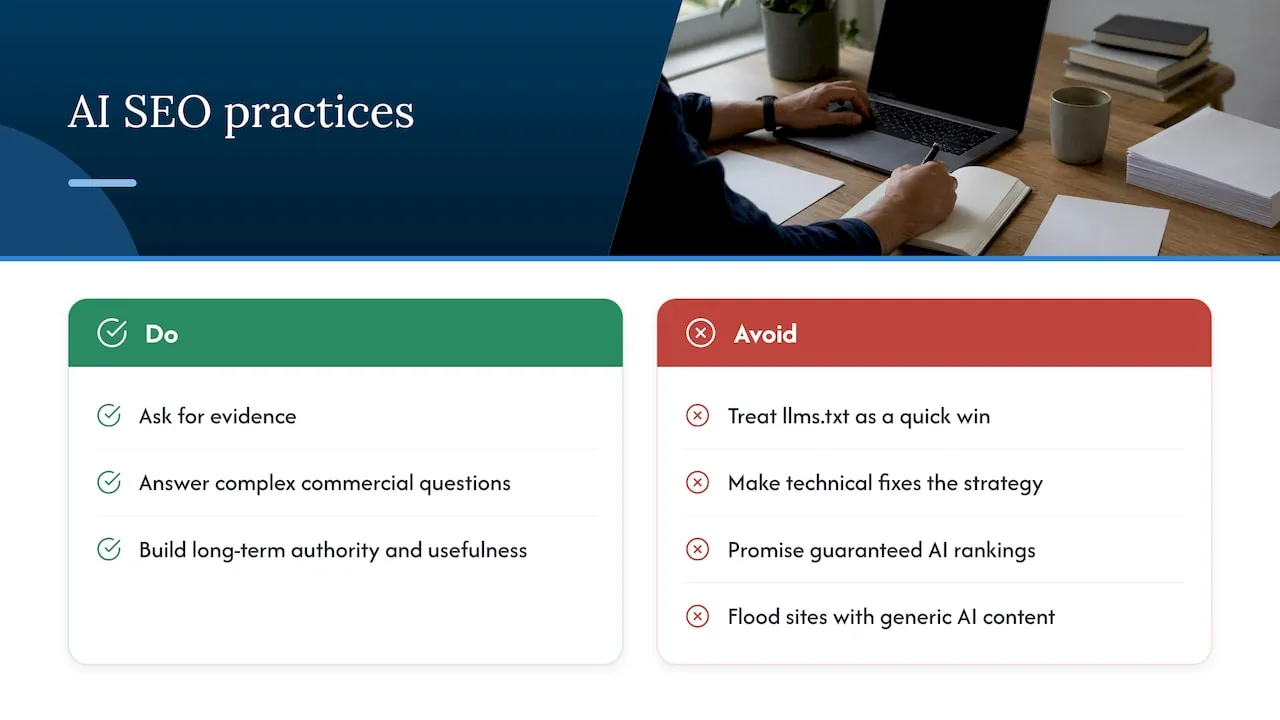
llms.txt. Search Engine Land’s review of AI search myths says the claim that an llms.txt file meaningfully improves AI visibility has been repeatedly debunked. Google’s documentation likewise says it is unnecessary. If someone sells it as a quick win, ask for the evidence.
Minor technical fixes as the main strategy. The same article argues that polishing alt text and meta descriptions rarely moves results, while content that answers complex, commercial-intent questions improves your chances of being cited. Technical hygiene is fine, but it is not a strategy.
Guaranteed rankings in AI answers. Google says there is no hack to force inclusion, only long-term authority and usefulness. Nobody can promise you a place in a model’s answer. Treat any such promise as a red flag.
Mass-produced AI content. Using a model to flood your site with generic articles is the opposite of non-commodity content. It produces what models already have plenty of.
Where AI should not be used in your LLM SEO
AI is useful in this work, but some jobs need a person.
- Publishing factual claims. Anything about eligibility, fees, legal status, safety or regulation should come from an approved source and be signed off by someone accountable. A model can draft; it should not be the last reader.
- Prioritising fixes. The same myth-busting article notes that AI finds technical errors easily but often struggles to rank them by importance. Use it to list issues, then let a person decide the order.
- Client or member data. Do not paste personal data into public AI tools to research or write content. Set clear data boundaries and a list of approved tools. Government research found that ethical concerns and data safety were the barrier most firms cited, and that work needs to satisfy UK GDPR. If a project will process personal data, plan a Data Protection Impact Assessment at the start, not after launch.
- Replying to people. Where AI-generated text goes to a client, member or candidate, a person reviews it first.
Our perspective
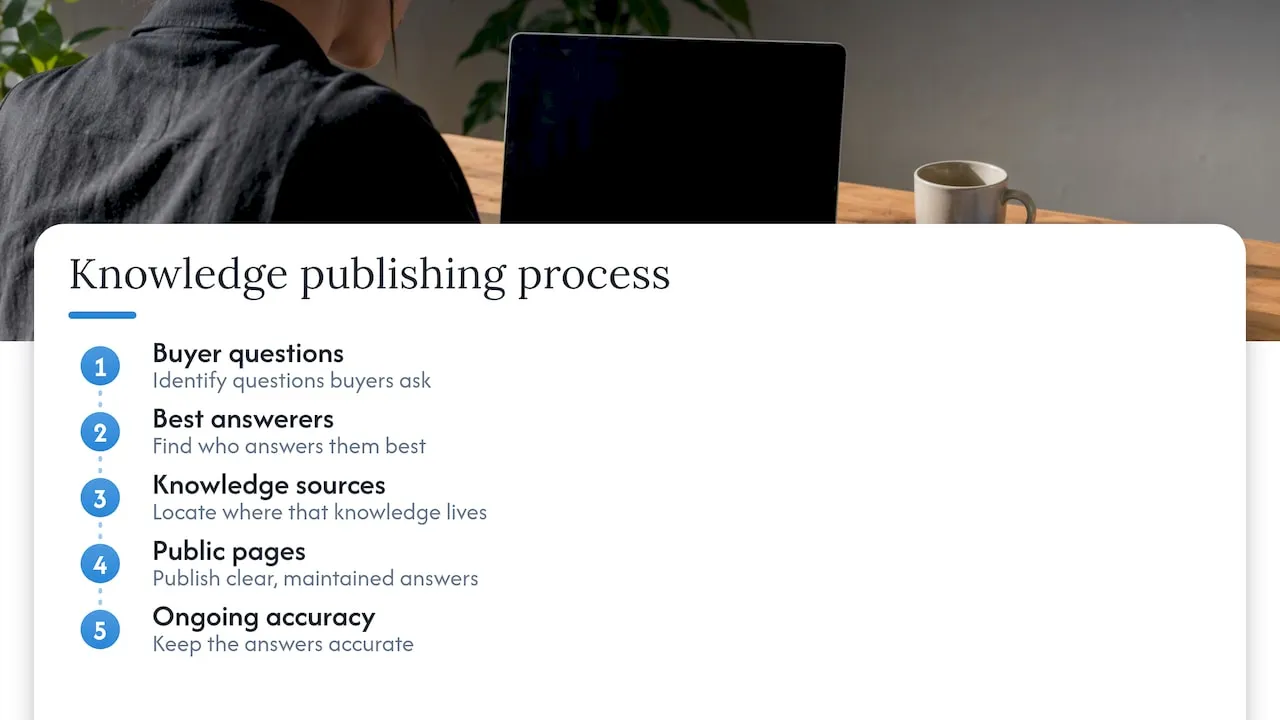
We build AI on top of the systems organisations already run, and that shapes how we see LLM SEO. Most of the useful answers a business can give an AI tool already exist somewhere: in a CRM, a membership database, a knowledge base, a bid library, a set of case notes. The problem is that they sit in fragmented places and in inconsistent wording.
So we start with the work, not the label. Which questions do buyers actually ask before they contact you? Who in the business answers them best? Where does that knowledge live? The strongest LLM visibility comes from getting those answers out of people’s heads and systems and into clear, maintained, public pages, then keeping them accurate.
We are sceptical of anything sold as an AI visibility trick. We are also sceptical of the idea that you can wait. Government research found that only about 1 in 6 businesses currently use AI and most have no active plans, while ONS reports that self-reported use among firms with 10 or more employees has risen from around 12% to around 35% since late 2023. Buyers are moving faster than most suppliers, and the gap is an opening for firms that get their answers in order.
Our rule is simple: a clear business case, approved sources, a named person in control, and nothing that would embarrass you if a prospect read it aloud.
— Rob
A practical 30-day starting plan
- Week 1: check access. Confirm key pages are indexed, not set to noindex, and that robots.txt and any security layer are not blocking search crawlers you want, including OAI-SearchBot. Decide your stance on training crawlers separately.
- Week 1: ask the tools. Put 20 to 30 realistic buyer questions to ChatGPT, Google AI Overviews and other tools your audience uses. Record whether you are named, how you are described and which sources are cited. Repeat monthly, as answers vary.
- Week 2: find the gaps. List the questions where you are absent or misdescribed. Rank them by commercial value, such as questions asked just before an enquiry, not by search volume alone.
- Weeks 2 to 3: fix the source pages. Rewrite or create pages that answer those questions with first-hand detail. Put the answer first, name the audience, state limits and keep dates visible.
- Week 3: tidy brand signals. Align your descriptions across directories, registers and profiles.
- Week 4: set ownership. Name one person responsible for reviewing AI answers about the organisation, correcting source material and reporting monthly to leadership.
Our AI search visibility checklist for marketing teams covers the same ground in a checklist format, and our piece on SEO for B2B buying committees shows how the questions differ across the people involved in a purchase.
How to measure it
Measurement is still imperfect, so be honest about it. Useful measures include:
- Citation presence: how often you are named or linked for your priority questions.
- Citation accuracy: whether the description is right. A wrong fee, service or eligibility rule is worse than no mention.
- Referral traffic and enquiries: visits from AI tools, plus new enquiries where the contact says they asked an AI tool. Add that option to your enquiry form.
- Branded search: a rise in people searching your name after an AI mention.
Government research on adoption shows many firms report productivity gains from AI but not yet a measurable change in revenue. Apply the same discipline here: agree what you will count before you start, and do not claim a revenue effect you cannot trace.
How we help
If you want a practical view of where your organisation stands in AI answers, our AI SEO, GEO and AIO service starts with how buyers ask, what the tools currently say and which of your systems hold the answers. We can then connect that to the wider AI strategy and automation work that keeps content and data accurate, with human review and clear data limits built in. To talk it through, start from our main site.
FAQ
What is the difference between traditional SEO and LLM SEO?
Traditional SEO aims to rank pages in search results and win clicks. LLM SEO aims to get your brand cited, and described correctly, inside AI-generated answers, often without a click. They overlap heavily and work best together.
Does llms.txt help me appear in ChatGPT or AI Overviews?
The evidence says no. Google’s guidance says such files are not needed, and Search Engine Land’s review of the data calls the claim debunked. Spend the time on content and crawl access instead.
Is SEO going away because of AI?
Not on the current evidence. Organic traffic was only about 2.5% lower year over year in the analysis cited above. What is changing is how visibility is measured: citations and accuracy now matter alongside clicks.
Which LLM is best for SEO work?
There is no single answer, because the right tool depends on the task and your data rules. Use whichever your organisation has approved for research, drafting and analysis, keep personal data out of it, and have a person check every factual claim before publication.
Sources
- SEO vs. GEO, AIO, LLMO: What marketers need to know, Search Engine Land
- GEO vs. SEO: A Comparative Guide for Digital Marketers, Semrush
- Organic search traffic is down 2.5% YoY, Search Engine Land
- 7 AI search myths, debunked, Search Engine Land
- AI optimization guide, Google Search Central
- Publishers and Developers FAQ, OpenAI Help Center
- AI Adoption Research, GOV.UK
- Artificial intelligence in UK businesses, ONS
- Should I Create an llms.txt File? 2026 Guide, Passion Fruit