

A website redesign brief is the single document that determines whether your project runs smoothly or collapses into costly revisions. Getting the website redesign brief preparation steps right before you brief an agency is the difference between a focused proposal and a guessing game. The industry standard process moves from brief review through discovery call to proposal, and each phase depends entirely on the quality of what you hand over first. A well-constructed brief, typically 4–8 pages, gives agencies enough context to propose accurately without boxing them into your assumptions.
What are the essential components of a website redesign brief?
A ten-section brief structure is recognised industry practice, covering company background, project goals, audience, scope, technical requirements, budget, timeline, and success criteria. Each section serves a distinct purpose. Miss one and you create a gap that agencies fill with guesswork, which costs you money later.
The core sections every brief needs are:
- Business overview. Describe what your organisation does, who it serves, and what makes it different. Agencies cannot write accurate proposals without this context.
- Project objectives. State what the redesign must achieve in measurable terms. “Increase qualified enquiries by 30%” is a goal. “Make the site look more modern” is not.
- Audience definition. Include user personas with real behavioural data. Describe how your customers find you, what they need, and where they drop off on the current site.
- Scope and deliverables. List the types of pages and features you need, framed as context rather than rigid requirements. This gives agencies room to propose the right solution.
- Technical requirements. Specify your CMS preference, integrations, accessibility standards such as WCAG 2.2, and any hosting constraints.
- Design direction. Share brand guidelines, reference sites you admire, and any visual constraints. Avoid dictating layouts unless you have a specific reason.
- SEO requirements. Note whether you need URL migration planning, structured data, or Core Web Vitals improvements baked into the build.
- Budget and timeline. Give a realistic range. Agencies who know your budget can propose what is actually achievable, not what sounds impressive.
- Success metrics. Define how you will judge the project a success six months after launch.
Pro Tip: Keep your brief between 4 and 8 pages. Shorter briefs lead to assumptions; longer ones lose focus and discourage thorough responses from agencies.
How to conduct effective audits before writing your brief
Audit work is the foundation of every credible redesign brief. Without it, your objectives are opinions rather than evidence. Analysing current site performance, including navigation, page speed, content condition, and competitor positioning, gives you the data your brief needs to be taken seriously.
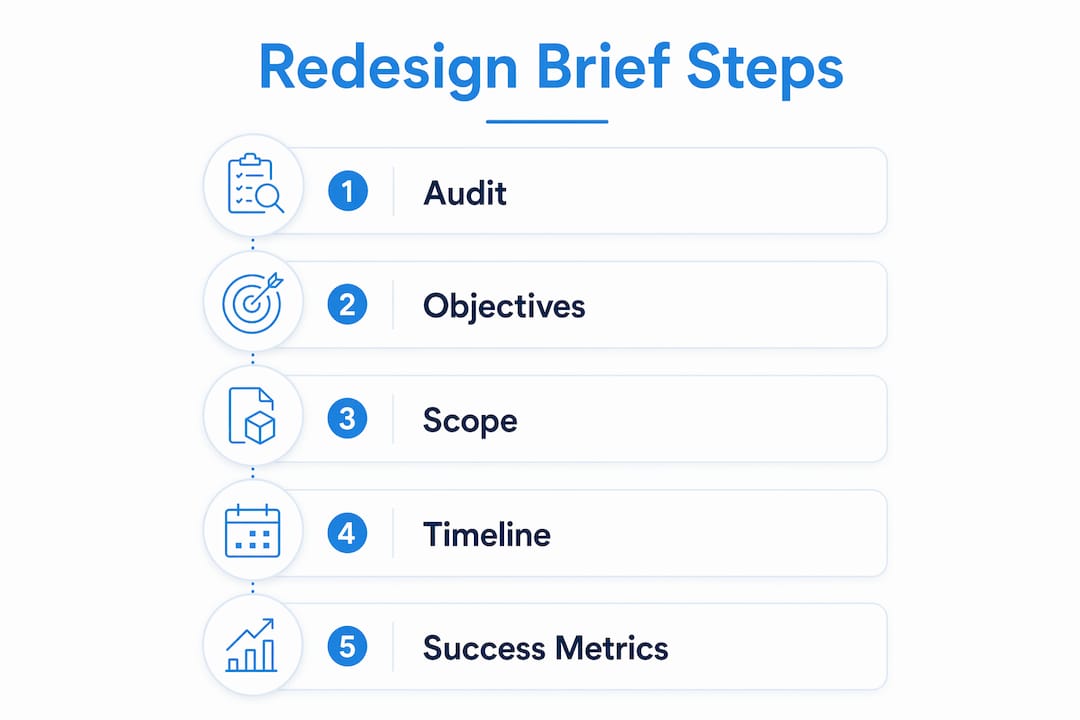
A structured pre-brief audit covers four areas in sequence:
- Performance and technical review. Run your site through Google PageSpeed Insights and Google Search Console. Record your Core Web Vitals scores, crawl errors, and mobile usability issues. These numbers belong in your brief as the baseline you are redesigning from.
- UX and conversion analysis. Review your analytics for high-exit pages, low-conversion forms, and broken user journeys. If you use heatmapping tools, export the key findings. This tells agencies where the site is failing people, not just where it looks dated.
- Content inventory and structure mapping. List every page type you currently have and assess whether the content is still accurate, useful, and well-structured. Structuring content for both humans and AI using answer-first formats, FAQ sections, and schema markup can increase AI-driven search visibility significantly. This is no longer optional for businesses that want to appear in AI-generated search results.
- Competitor and market review. Identify three to five competitors and note what their sites do well. You are not copying them. You are understanding the baseline your customers compare you against.
| Audit area | What to record | Why it matters |
|---|---|---|
| Technical performance | Core Web Vitals, crawl errors | Sets measurable improvement targets |
| UX and conversion | Exit rates, form completions | Identifies where users abandon the site |
| Content inventory | Page count, accuracy, structure | Informs scope and content governance |
| Competitor review | Navigation, messaging, features | Clarifies your differentiation requirements |
Pro Tip: Export your Google Analytics and Search Console data before you start writing. Raw numbers make your brief credible and give agencies a clear picture of what they are inheriting.
What steps ensure your brief aligns stakeholder expectations?
Stakeholder misalignment is the most common cause of redesign projects going over budget. The brief is the tool that prevents it, but only if the right people contribute to it before it leaves your building.
The steps that create genuine alignment are:
- Appoint a single project owner. This person holds final sign-off authority and is the primary contact for the agency. Projects with multiple decision-makers and no clear owner routinely stall during review phases.
- Assemble a cross-functional input group. Bring in sales, marketing, customer service, and IT for one structured session. Each team surfaces requirements the others miss. Sales knows what questions prospects ask. IT knows what integrations are non-negotiable.
- Run a discovery call before finalising the brief. Discovery calls clarify goals and constraints and reduce scope creep by establishing shared understanding early. A 30–60 minute call with your shortlisted agency before you submit the final brief is standard practice and saves weeks of revision later.
- Define content ownership in the brief itself. Specify who is responsible for writing, approving, and updating content after launch. Governance planning is what keeps a site coherent twelve months after the project closes. Without it, the redesign degrades quickly.
- Set a brief review window. Give agencies 1–3 days to review your document before the discovery call. This is standard industry practice and ensures the conversation is productive rather than spent reading the brief aloud.
The brief is not a one-way document. It is the opening move in a professional dialogue. Treat it that way and you will get better proposals, faster.
How to define scope, timeline, and success metrics clearly
Vague scope is the single biggest driver of inaccurate proposals. Agencies price what they understand. If your scope is unclear, they either over-price to cover risk or under-price and cut corners later.

Describing scope without over-specifying
Describe the types of pages you need rather than a fixed count. “A homepage, three service pages, a blog, and a contact page” is more useful than “fifteen pages.” Framing scope as context rather than rigid requirements gives agencies room to propose the right architecture for your goals.
Setting realistic timelines
Build in buffer for discovery, content production, and revision rounds. A typical redesign for an established business runs 8–16 weeks from kickoff to launch. Proposal preparation alone takes agencies 3–7 days after your brief review. Factor that into your planning before you set a launch date.
Defining measurable success criteria
Specific KPIs and budget ranges focus agency responses and make post-launch evaluation straightforward. Define success in terms your business already tracks: form submission rates, organic search rankings, bounce rates on key landing pages, or Core Web Vitals scores. Avoid defining success as “the site looks better.” That is a preference, not a metric.
Pro Tip: State your budget as a range rather than a fixed number. A range of £15,000–£25,000 signals seriousness and gives agencies room to propose the most appropriate solution within your means.
Common mistakes in website redesign brief preparation
Most briefs fail for one of four reasons. Recognising them before you write saves you from the most expensive redesign mistakes.
- Defining success with aesthetics only. Vague aesthetic goals undermine redesign success. “We want a cleaner look” gives agencies nothing to measure against. Replace aesthetic language with measurable outcomes wherever possible.
- Over-specifying the solution. Telling an agency exactly which CMS to use, how many columns each page should have, and where every button sits removes their ability to solve your actual problem. Give them the problem. Let them propose the solution.
- Ignoring content governance. The brief should name who owns content post-launch, how often it will be audited, and who approves changes. Without this, sites become outdated within months and the redesign investment erodes.
- Neglecting AI visibility in content planning. Structuring your content for AI-generated search results is now part of a credible redesign brief. Answer-first page structures, FAQ sections, and schema markup are no longer advanced tactics. They are baseline requirements for businesses that want to appear in AI-driven search responses.
- Skipping the audit phase. Briefs written without performance data produce redesigns that look different but perform the same. The audit is what turns a cosmetic project into a business improvement.
Key takeaways
A well-prepared website redesign brief, grounded in audit data, clear objectives, and defined governance, is the single most effective way to reduce project risk and improve agency proposals.
| Point | Details |
|---|---|
| Brief length matters | Keep your brief to 4–8 pages to balance clarity with agency flexibility. |
| Audit before you write | Base your objectives on real performance data, not assumptions about what needs fixing. |
| Define measurable goals | Replace aesthetic targets with specific KPIs such as form conversions or Core Web Vitals scores. |
| Assign content ownership | Name who manages and updates content post-launch to protect your investment. |
| Run a discovery call | A 30–60 minute call before finalising the brief reduces scope creep and improves proposals. |
What I have learned from briefs that actually work
The briefs that produce the best projects share one quality: they are honest about what the business does not know. The clients who write “we are unsure whether we need a full CMS rebuild or a reskin” get better proposals than the ones who specify every technical detail upfront. Agencies respect candour. It gives them room to apply their expertise rather than just execute instructions.
The other pattern I have noticed is that businesses which treat the brief as a governance document from day one have far smoother post-launch experiences. When the brief names a content owner, sets a six-month review schedule, and defines what success looks like, the project does not end at launch. It continues as a managed asset. That is a fundamentally different relationship with your website than most businesses have.
The discovery call is where most of this gets resolved. A 30–60 minute conversation before the brief is finalised surfaces assumptions on both sides. I have seen projects saved by a single discovery call that revealed the client’s primary goal was lead generation, not brand awareness. The brief they had written was optimised for the wrong outcome entirely.
My honest advice: write the brief, then read it as if you are the agency receiving it. Ask yourself whether you could price this accurately and propose a solution with confidence. If the answer is no, the brief needs another draft.
— Rob
How Cloud9 helps businesses get their redesign right
A well-prepared brief is only as good as the agency that receives it. Cloud9 works with established UK businesses to design and build websites that are grounded in business objectives, not just visual preferences. The team brings together web design and development, SEO services, and managed hosting under one roof, which means the brief you write is actioned by people who understand how each element connects.
Cloud9 also supports the pre-brief phase, helping businesses conduct audits, clarify objectives, and structure briefs that attract accurate proposals. If you are preparing for a redesign and want a partner who treats your website as a business asset rather than a creative project, Cloud9’s full services are worth exploring before you write a single word of your brief.
FAQ
What should a website redesign brief include?
A redesign brief should cover company background, project objectives, audience definition, scope, technical requirements, design direction, SEO needs, budget range, timeline, and success metrics. Industry practice recommends a ten-section structure to ensure agencies have sufficient context.
How long should a website redesign brief be?
An effective brief runs 4–8 pages. Shorter documents lead to assumptions and inaccurate proposals; longer ones lose focus and reduce the quality of agency responses.
Why is a discovery call part of the redesign brief process?
Discovery calls clarify goals and constraints before the agency finalises its proposal. A 30–60 minute call reduces scope creep, surfaces misaligned assumptions, and produces more accurate and relevant proposals.
How do I define success in a redesign brief?
Define success with specific, measurable KPIs such as form submission rates, Core Web Vitals scores, or organic search rankings. Avoid vague aesthetic targets, which give agencies nothing to measure against after launch.
What is the most common mistake in redesign brief preparation?
The most common mistake is defining success with aesthetic language rather than measurable outcomes. Briefs that lack specific goals produce redesigns that look different but deliver no measurable business improvement.