
Most businesses choosing between website chatbot options are picking from five categories: live chat, rule-based bots, SaaS AI agents, hybrid bots, and internal knowledge assistants. For most small and medium businesses, the sensible starting point is a SaaS AI agent grounded in your own knowledge base, with a managed or self-hosted setup reserved for when scale or data sensitivity demands it. Integration and data-protection checks come before any rollout, not after.
TL;DR:
- The recommended starting point for most small and medium businesses is a SaaS AI agent grounded in their own knowledge base, with more complex setups reserved for larger scale or sensitive data needs.
- Proper grounding through retrieval-augmented generation is essential to prevent AI answers from being confidently incorrect by referencing internal documents rather than external training data.
- The choice of chatbot type should align with specific goals, such as support reduction, lead capture, FAQ coverage, or internal efficiency, rather than platform features alone.
- Implementation success depends on a staged pilot process involving discovery, grounding, prototyping, live testing, and gradual scaling, with governance and compliance factored into every phase.
- Evaluating integrations and privacy controls upfront, including GDPR compliance, escalation rules, and accessibility, is critical for building a trustworthy and effective chatbot system.
Table of Contents
- Types of website chatbots and when to use each
- Which type to pick for different business needs: a quick decision matrix
- Features and integrations to compare when evaluating options
- How to plan and deploy a chatbot: a five-stage pilot, timelines and costs
- Privacy, GDPR and a practical compliance checklist
- Cloud 9 perspective: the five-stage pilot and choosing a managed approach
- Why most chatbot advice gets the priority order backwards
- Getting a chatbot live without the guesswork
- FAQ
- Sources
Types of website chatbots and when to use each
Each chatbot category solves a different problem, and picking the wrong one is the most common reason pilots stall.
Live chat puts a real person behind the widget, sometimes with canned replies to speed things up. It suits businesses with complex sales conversations or high-value enquiries where a human touch closes more deals, but it does not scale outside office hours and costs grow with headcount.
Rule-based bots follow decision trees: click a button, get a fixed answer, click another button. They work well for narrow, predictable journeys such as order tracking or opening hours, and they are cheap to build. Their weakness shows the moment a visitor types a question in their own words rather than selecting from a menu. Anything open-ended breaks them.
SaaS AI agents use a large language model to hold a natural conversation, answer varied phrasing, and often connect to a knowledge base so answers stay accurate. These suit FAQ handling, lead qualification, and general support deflection. The risk is a model answering confidently from general training data rather than your actual policies, which is why grounding matters.
Hybrid bots combine rule-based flows for sensitive or regulated steps (bookings, payments, account changes) with an AI layer for open conversation. This gives predictability where it matters and flexibility everywhere else, and it is often the practical middle ground for firms that need both structure and natural language handling.
Internal knowledge assistants sit behind the scenes rather than on the public website, helping staff find policy documents, pricing rules, or product specs instantly instead of searching shared drives. They do not face customers directly, but they often deliver the fastest return because they cut internal search time across a whole team.
The business goal should decide the category, not the other way round:
- Reduce support load: SaaS AI agent or hybrid bot grounded in a help-centre knowledge base.
- Increase conversions and capture leads: hybrid bot with a rule-based qualification flow feeding a CRM.
- Answer repetitive FAQs: rule-based bot if the questions are predictable, SaaS AI agent if phrasing varies widely.
- Speed up internal operations: an internal knowledge assistant rather than a customer-facing bot at all.
The limitation to watch for with any AI-driven option is grounding. A pure large language model with no connection to your own documents will answer plausibly and sometimes wrongly, because it has no visibility into your actual pricing, policies, or stock levels. Pairing it with retrieval from your own content, often called RAG (retrieval-augmented generation), is what keeps answers tied to reality rather than invention.
Which type to pick for different business needs: a quick decision matrix
Matching your goal, budget, and team skills to the right category avoids the two most common mistakes: overbuilding a simple FAQ bot into an expensive AI project, or underbuilding a sales tool that needed real conversational flexibility.
- Reducing support ticket volume: pick a SaaS AI agent connected to your help centre if questions vary in wording; pick a rule-based bot if the top questions are genuinely repetitive and few in number.
- Lifting website conversions: pick a hybrid bot that qualifies leads through a short structured flow, then hands warm leads to sales or a CRM.
- Covering FAQs without ongoing maintenance: pick a rule-based bot for a handful of static questions; anything beyond about fifteen branching paths usually needs an AI layer instead.
- Speeding up internal knowledge retrieval: pick an internal knowledge assistant over any customer-facing option, since the audience and governance needs are different.
- Operating in a regulated or high-risk sector: pick a hybrid bot with a hard escalation rule to a human for anything involving money, health, or legal advice.
Resource thresholds matter as much as the goal. A rule-based bot needs almost no technical skill to maintain but breaks under open conversation. A SaaS AI agent needs someone comfortable managing a knowledge base and reviewing transcripts weekly. A hybrid or self-hosted deployment needs IT involvement for integration work and ongoing monitoring, which is where many SMEs underestimate the commitment.
Pro Tip: Before comparing platforms, write down the ten questions your support team answers most often. If an AI agent cannot answer eight of them accurately from your existing documentation, your knowledge base needs work before the bot does.
A short “best if” checklist helps narrow the field quickly: rule-based suits a small, stable set of questions and a near-zero budget. SaaS AI agents suit teams wanting natural conversation without building infrastructure. Hybrid bots suit businesses needing both structured transactions and open-ended support. Internal knowledge assistants suit teams losing hours weekly to internal document searches.
Features and integrations to compare when evaluating options
Once the category is clear, the real differences between website chatbot options show up in the integrations and controls underneath the chat window.
Start with the connections that determine whether the bot is genuinely useful or just a scripted toy:
- CRM integration: does the bot push captured leads and conversation context into your existing CRM, or does someone have to copy details across manually?
- Helpdesk and ticketing: can unresolved conversations open a ticket automatically, with the transcript attached?
- Commerce platform access: for retail sites, can the bot check real stock and order status rather than guessing?
- Knowledge store connectors: can it pull directly from your existing help centre, document library, or intranet rather than needing content duplicated into a separate system?
Direct knowledge-base connectors matter more than they sound. A bot grounded through RAG retrieves relevant passages from your own content before generating a reply, which keeps answers anchored to what you actually publish rather than what the underlying model assumes. Microsoft Azure’s AI Bot Service documents hosting paths that support this kind of grounding while keeping data residency within the EU, a relevant option for firms that want enterprise-grade control without self-hosting everything.
Handoff design is where many deployments fail quietly. A good pattern sets a confidence threshold: below it, the bot stops guessing and routes to a human, ideally with the full conversation history attached so the customer never repeats themselves. Define an SLA for that handoff, even an informal one such as “escalated chats answered within one business hour,” so the bot does not become a dead end.
Analytics should go beyond “number of conversations.” The metrics worth tracking are containment rate (the share of chats resolved without a human), resolution rate (whether the customer’s actual question got answered), and lead capture rate for sales-oriented bots. Without these, it is impossible to tell whether the bot is helping or just adding another channel to monitor.
A tightly scoped, domain-specific chatbot with clear escalation rules reduces user friction and legal risk, as shown by the ICO’s own digital assistant, which answers fee and registration queries and guides users through assessments using pre-populated storycards before escalating to a human contact route when needed. It is a useful reference point precisely because it is narrow by design rather than trying to answer everything.
Accessibility is often an afterthought until a complaint arrives. Chat widgets are interactive interfaces, so they fall under the Web Content Accessibility Guidelines (WCAG) 2.2, which set requirements for keyboard navigation, screen reader compatibility, and colour contrast. Checking a shortlisted platform against these before signing a contract avoids an expensive retrofit later.
Partner integrations matter beyond the website itself. A partner guide on chatbots and mobile app engagement covers how the same conversational layer can extend into app-based customer touchpoints, worth a look if your business operates across both web and app.
How to plan and deploy a chatbot: a five-stage pilot, timelines and costs
Treating a chatbot as a project with stages, rather than a single launch event, is what separates pilots that get adopted from ones that get quietly switched off after a month.
- Discovery (1 to 2 weeks): map the top questions customers ask, identify the knowledge sources the bot will draw from, and agree what success looks like before any build starts.
- Data preparation and grounding: organise and clean the documents, FAQs, and policies the bot will retrieve from, since answer quality depends entirely on this step, not on the model chosen.
- Prototype (2 to 4 weeks): build a limited version covering the highest-value questions only, tested internally before any customer sees it.
- Pilot (4 to 8 weeks): run the bot live on a limited section of the site or for a limited audience, reviewing transcripts weekly and adjusting grounding content as gaps appear.
- Iterate and scale (8 to 16 weeks): widen coverage, add integrations such as CRM handoff, and formalise ongoing monitoring once the pilot proves out.
Cost bands vary by approach rather than by ambition. A low-code SaaS subscription suits businesses wanting a working bot within weeks and accepting less control over data handling. A managed pilot, where a specialist team handles grounding and integration, suits businesses that want enterprise-grade setup without hiring for it. A self-hosted deployment gives maximum control over data but carries higher total cost of ownership once hosting, maintenance, and security patching are factored in, a trade-off Azure’s documentation makes explicit when comparing hosted and self-managed routes.
Stakeholders worth involving from day one include IT (for integration and security), compliance (for data protection sign-off), customer service (who will review transcripts and handle escalations), and product or marketing (who own the messaging and tone the bot should reflect). Leaving any of these out tends to surface as a blocker later rather than a smooth conversation now. A detailed walkthrough of this staged approach, including how RAG grounding fits into an 8 to 12 week pilot, is covered in our guide to a staged chatbot pilot for support teams.
Privacy, GDPR and a practical compliance checklist
Data protection is not a box to tick after launch. It shapes which chatbot category is even viable for your business.
Run a Data Protection Impact Assessment (DPIA) whenever the bot will process personal data at scale, handle special category data, or make automated decisions that affect customers. The assessment should cover what data is collected, where it flows, how long it is kept, and who can access conversation logs. The ICO’s guidance on lawfulness in AI recommends documenting lawful basis separately for development and deployment data flows, since they are not the same processing operation.
When selecting an LLM provider, a short checklist keeps the decision defensible:
- Signed Data Processing Agreement (DPA) covering how customer data is processed and protected.
- Zero-retention API options, so conversation content is not used to retrain the underlying model.
- Data residency, ideally EU or UK-hosted, rather than assuming a default region applies.
- Clear retention settings that match your own policy rather than the provider’s default.
Janus Compliance’s guide to building a GDPR-compliant AI chatbot lays out exactly these checks when comparing providers, and notes that for most SMEs a hybrid setup, a SaaS agent paired with a RAG-grounded company knowledge base, balances speed of deployment against accuracy and governance better than either a pure off-the-shelf bot or a fully self-built system.
Minimise personal data wherever possible: avoid collecting information the bot does not need, consider tokenising identifiers before they reach a third-party model, and document the full data flow so a regulator or customer can be told plainly where their information goes.
Separate development and training data flows from deployment flows in the DPIA, and document lawful basis for each one individually rather than assuming a single basis covers the whole system.
ICO guidance on AI and data protection
Fail-closed design reduces legal exposure as much as it improves customer experience. Set a confidence threshold below which the bot stops answering and hands off to a person, and disable the bot from making commitments, such as promising refunds or contractual terms, that it cannot actually honour.
Cloud 9 perspective: the five-stage pilot and choosing a managed approach
We use a five-stage structure for chatbot and internal knowledge assistant pilots: discovery, data preparation and grounding, prototype, live pilot, then iteration and scale. The reason we hold to that order is simple. Skipping grounding to get a prototype live faster is the single most common cause of a bot that answers confidently and wrongly.
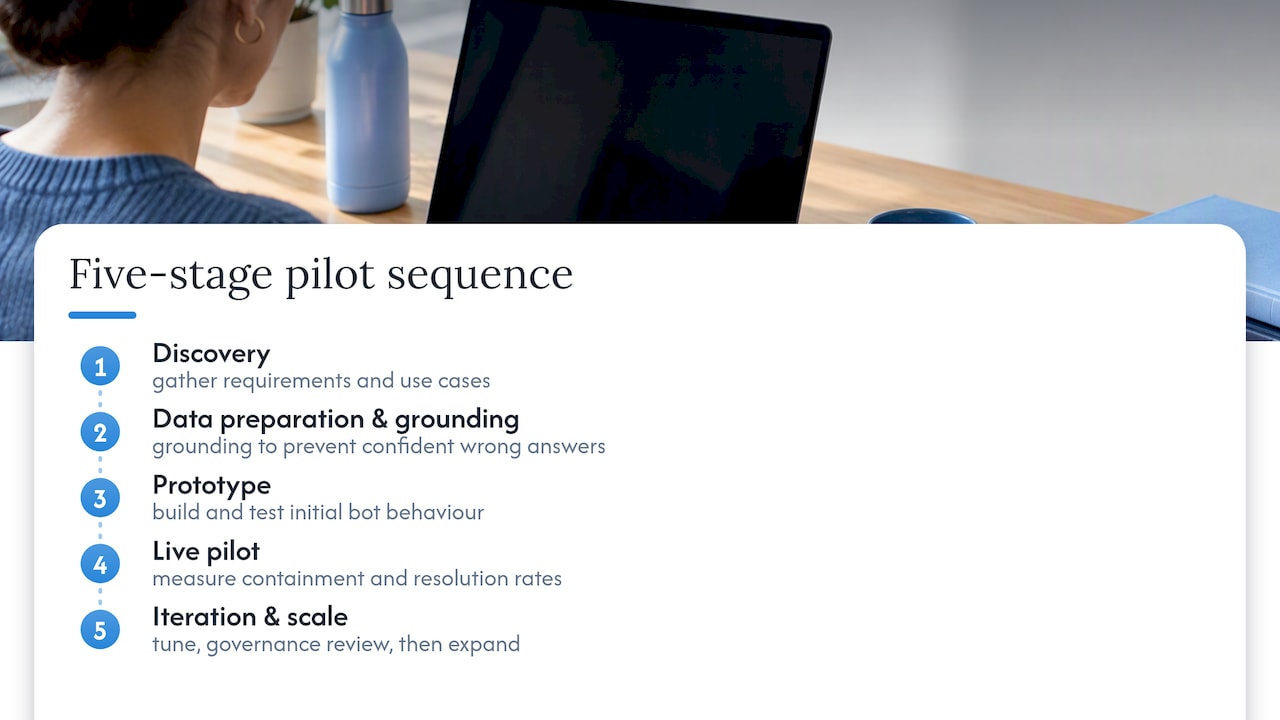
The trade-off between a managed pilot and an in-house build usually comes down to two things: speed and ongoing governance. Building in-house gives full control but means someone on your team owns prompt tuning, knowledge-base upkeep, and compliance documentation indefinitely. A managed approach hands that upkeep to a team that already has the DPIA templates, provider checklists, and escalation patterns built, which tends to shorten the path from idea to a working, defensible bot.
What we watch most closely during a pilot is containment rate against resolution rate together, since a bot that contains conversations without actually resolving the customer’s question just defers frustration rather than cutting it. Governance does not end at launch either: retention settings, provider contracts, and escalation thresholds need reviewing periodically as usage grows, not just signed off once.
More detail on how we structure chatbot and internal assistant pilots, including governance-first examples, sits on our AI chatbots and internal knowledge assistants page.
Why most chatbot advice gets the priority order backwards
Most guides treat platform choice as the first decision and data protection as a late-stage formality. That ordering is wrong. The category of chatbot you can responsibly deploy depends on your data governance capacity, not the other way round. A business without a DPA checklist or a clear retention policy has no business running an AI agent on customer data yet, regardless of how good the platform looks in a demo.
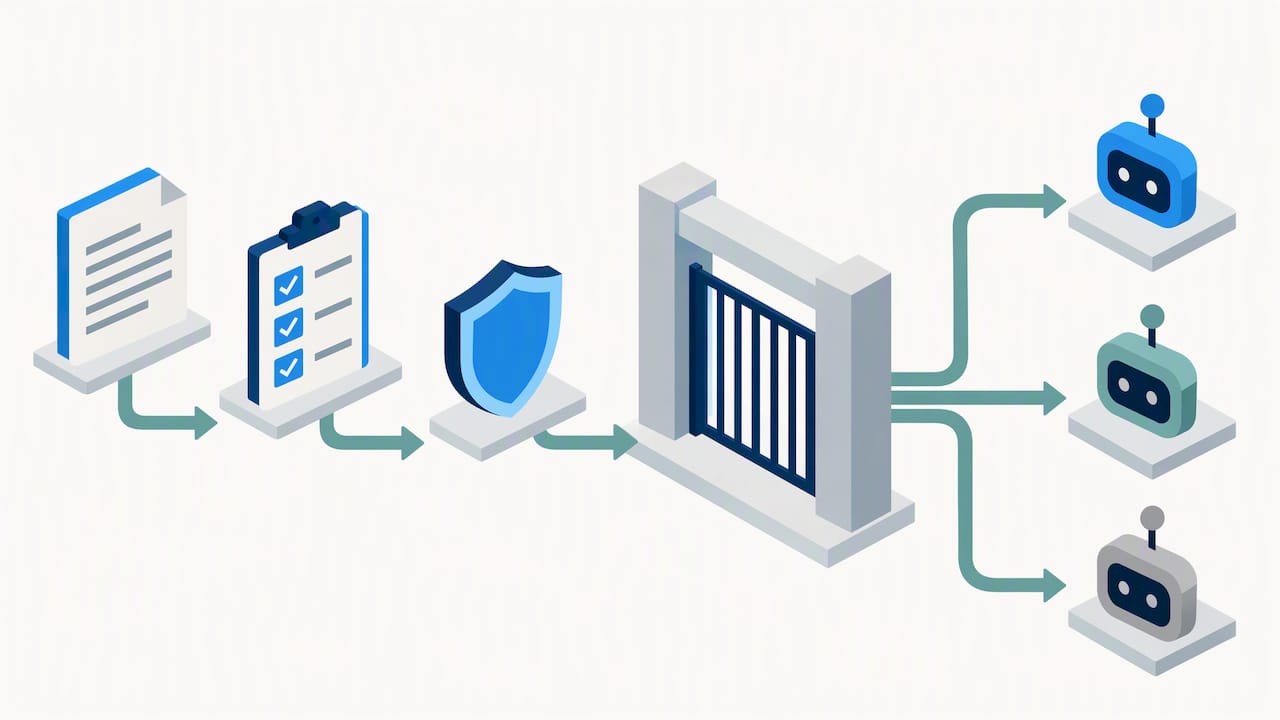
The most overrated feature in chatbot marketing is sheer conversational range. A bot that can discuss anything is usually the one giving the least accurate answers, because breadth comes at the cost of grounding. The underrated factor is escalation design: a bot that knows when to stop and hand over to a person outperforms one that tries to answer everything, both in customer trust and in legal exposure.
If you take one thing from this, prioritise your knowledge base and your escalation rules before you shortlist a single platform. The platform is replaceable. Bad grounding and no fail-closed rule are not problems a better interface fixes.
— Rob
Getting a chatbot live without the guesswork
If the checklist above feels like a lot to manage alongside running a business, that is exactly the gap our AI Automation Services close. We handle the grounding, the provider checks, and the escalation design as part of a structured pilot, rather than leaving you to assemble a DPA, a knowledge base, and an integration plan on your own.
Our relevant services for this include AI chatbots and internal knowledge assistants, RAG-grounded pilots built on your own documentation, CRM integration so captured leads land where your sales team already works, and Website as a Service for businesses that want their chatbot and website managed as one joined-up system rather than two separate suppliers.
- AI chatbots and internal knowledge assistants: customer-facing and internal options, both grounded in your own content.
- RAG-grounded pilots: discovery through to live pilot, following the staged approach outlined above.
- CRM and marketing automation: so chatbot leads flow straight into existing sales workflows.
- Website as a Service: a managed website and chatbot combination for businesses wanting one point of contact.
Pilots typically run 60 to 90 days from discovery to a live, monitored bot, with transcripts reviewed weekly so grounding content improves as real questions come in. If you want a second opinion on which chatbot approach actually fits your business, start with our Website as a Service page and get in touch to talk through a pilot.
FAQ
What is the best chatbot for a website?
There is no single best option. For most small and medium businesses, a SaaS AI agent grounded in your own knowledge base through RAG offers the best balance of natural conversation and accurate answers, while a rule-based bot suits businesses with a handful of static, predictable questions.
What are the four types of chatbots?
The four commonly recognised types are rule-based bots that follow fixed decision trees, AI or large language model agents that generate natural responses, hybrid bots that combine structured flows with AI for open conversation, and live chat, where a human handles the conversation directly.
Can I create a chatbot for my website?
Yes, low-code SaaS platforms let businesses build a basic chatbot without development skills, typically within a few weeks. More complex options, such as a hybrid bot grounded in your own knowledge base with CRM integration, generally need a short staged pilot like the one outlined above rather than a same-day setup.
What are the five things you shouldn’t tell ChatGPT?
Avoid entering customer personal data, financial details, health information, confidential business documents, or login credentials into a consumer-facing chat interface, since these tools are not built with the data processing agreements or retention controls business use requires. Enterprise API routes with a signed DPA and zero-retention settings are the appropriate alternative for business data.
How do I measure chatbot performance?
The three metrics worth tracking from week one are containment rate (conversations resolved without a human), resolution rate (whether the actual question got answered, not just acknowledged), and lead capture rate for sales-oriented bots. Reviewing transcripts weekly during a pilot catches gaps in grounding content before they affect a wider rollout.
Sources
- ICO chatbot — algorithmic transparency record
- Build a GDPR-compliant AI chatbot: architecture, costs & mistakes to avoid | Janus Compliance
- Web Content Accessibility Guidelines (WCAG) 2.2