

A focused redesign generally takes several weeks, a typical full B2B redesign requires a few months, and a comprehensive replatform can take several months. The right bucket depends on content readiness, the number of system integrations, and how many stakeholders need to sign off at each stage. Before you commit to a date, check whether your content is actually ready and whether your approvers have the time blocked out.
TL;DR:
- Content readiness and stakeholder approval timing are critical factors that can add weeks to a redesign schedule if neglected beforehand.
- A focused redesign suits small teams with minimal integrations, while large-scale replatforms require extensive planning, testing, and longer timelines of several months.
- SEO tasks like redirect mapping and monitoring should be integrated into the schedule, with redirects kept active for at least 180 days after launch.
- Project governance benefits from a single decision owner and fixed review windows, preventing schedule delays caused by uncoordinated feedback.
- Phased delivery is recommended for complex projects with ongoing updates or low risk tolerance, whereas big-bang launches work best for simultaneous rebranding and product changes.
Table of Contents
- At-a-glance timeline shapes: when to choose each
- Phase-by-phase breakdown: deliverables, durations and owners
- Variables that make projects run faster or slower
- Three concise sample roadmaps you can adapt
- SEO actions to schedule and timing for site moves
- Governance, reviews and KPIs to keep the project on track
- Cloud 9 resources and how we support redesign planning
- When to build in phases versus launch everything at once
- Keeping your redesign timeline predictable
- FAQ
- Sources
At-a-glance timeline shapes: when to choose each
A focused redesign suits a business refreshing design and messaging on an existing content base, with few or no new integrations. It works when a small team can make decisions quickly and content barely needs rewriting.
A typical full redesign fits most established B2B organisations: new information architecture, substantial content production, a handful of integrations such as a CRM or booking tool, and a multi-person approval chain. This is the default shape for a business replacing a tired site without changing its underlying systems.
A comprehensive replatform applies when you are migrating a large site, changing CMS platforms, consolidating several domains, or rebuilding alongside new backend systems. It carries the most SEO risk and the most internal disruption, so it needs the longest runway.
- Focused: best for brand refreshes and smaller sites with ready content.
- Typical: best for mid-sized B2B sites needing new content, design and light integration work.
- Comprehensive: best for platform migrations, large content volumes and complex system dependencies.
Each shape needs a different team. A focused project can run on one marketing lead and one designer. A typical redesign needs a project owner, a content lead, a designer and a developer working in parallel. A comprehensive replatform needs all of that plus someone dedicated to migration and SEO, because redirect mapping and content migration become jobs in their own right. Our small business redesign process guide breaks down team composition for smaller projects in more detail.
Phase-by-phase breakdown: deliverables, durations and owners
Every redesign, regardless of size, moves through the same core phases. What changes is the relative duration of each phase and how many people are involved.
- Discovery and strategy: goals setting, a content and technical audit, and stakeholder interviews. The project owner leads this, with input from marketing and sales.
- Content and information architecture: content inventory, sitemap and navigation mapping, then content writing or editing. Duration varies based on how much existing content needs rewriting.
- Design: wireframes first, then visual design, with defined sign-off windows at each stage to prevent prolonged feedback cycles.
- Development: the build itself, third-party integrations, and a staging environment for internal review before launch.
- QA and user acceptance testing: functional testing, cross-device checks, and bug-fix sprints before launch approval.
- Launch and post-launch monitoring: a rollback plan, analytics verification, and SEO checks immediately after going live.
Within the first 10 seconds on a new page, visitors largely decide whether to stay, so the content and design phases carry more weight than they might appear to on a project plan. NN/g’s research on page engagement shows that clear value proposition messaging in that opening window increases the chance a visitor sticks around, which is one reason homepage copy deserves real time rather than a last-minute rewrite. A clear value proposition is worth drafting early in the content phase, not bolted on during design review.
Pro Tip: Start content production the moment discovery wraps, rather than waiting for design sign-off: it is the single biggest lever for shortening a typical timeline.
Variables that make projects run faster or slower
Most schedule slippage traces back to a short list of predictable causes.
- Content readiness: missing or unapproved copy commonly adds weeks, because design and development stall waiting for final text.
- Stakeholder review cadence: every additional reviewer added to a sign-off chain tends to extend turnaround, especially when feedback arrives in separate, uncoordinated rounds.
- Complex integrations and bespoke features: a CRM sync, custom calculator or booking system typically adds development and testing time beyond a standard build.
- CMS limitations and technical debt: an ageing platform or messy existing codebase can slow development, since workarounds take longer than clean builds.
- Regulatory or compliance reviews: legal, data protection or industry-specific sign-off adds a review cycle that should be scheduled in from the start, not discovered midway through.
The fix for most of these is the same: resolve them before the build phase starts. Our website redesign brief preparation guide walks through capturing content status, integration requirements and approval structure before a project kicks off, which removes most of these surprises from the schedule.
Three concise sample roadmaps you can adapt
These roadmaps assume a standing start with content and stakeholders in reasonable shape.
- Focused redesign, 6 to 8 weeks: discovery (week 1), content and design running in parallel (weeks 2 to 4), development (weeks 4 to 6), QA and launch (weeks 7 to 8). Compress further by using an existing content set and skipping custom wireframes.
- Typical B2B redesign, 12 to 14 weeks: discovery (weeks 1 to 2), content and IA (weeks 2 to 6), design (weeks 4 to 8, overlapping content finalisation), development (weeks 7 to 11), QA and UAT (weeks 11 to 13), launch and monitoring (weeks 13 to 14). Extend by two or three weeks if more than three stakeholders need sign-off.
- Comprehensive replatform, 4 to 6 months: discovery and technical audit (month 1), content and IA alongside platform selection (months 1 to 2), design (months 2 to 3), development and migration build (months 3 to 5), QA, redirect testing and stakeholder checkpoints (month 5), phased launch and monitoring (month 6). Build in buffer weeks around migration, since this is where most delays surface.
SEO actions to schedule and timing for site moves
Treat SEO as a scheduled workstream, not a final checklist item, particularly if URLs are changing.
- 301 redirect mapping needs to happen before launch, with every old URL mapped to its nearest equivalent new page, prioritising high-traffic landing pages first.
- Avoid redirect chains, where one redirect points to another redirect rather than the final destination, since chains slow crawling and dilute signals.
- Use the Change of Address tool in Search Console once redirects are live, and Google’s own guidance recommends keeping those redirects in place for at least 180 days so search engines can fully register the move.
- Allocate time for SEO QA after launch, checking that redirects resolve correctly and that key pages are being recrawled.
Google’s migration guidance states that redirects should remain active for at least 180 days after a site move, which means SEO monitoring is not a launch-week task but a multi-month commitment that should be written into the post-launch plan from the outset.
Governance, reviews and KPIs to keep the project on track
A single decision owner, rather than a committee, is the single most reliable way to prevent a schedule from drifting. Pair that with a weekly sprint cadence and fixed review windows where feedback is consolidated into one round rather than trickling in over days.
- One named decision owner per project, with authority to approve or reject without escalating every choice.
- Fixed review windows (for example, 48 hours per round) with feedback consolidated from all reviewers before it reaches the project team.
- A simple risk register covering content delays, integration unknowns and approval bottlenecks, reviewed weekly.
- Practical KPIs: phase completion against plan, number of review rounds per phase, and defect count at QA.
Pro Tip: Cap feedback rounds at two per phase; a third round is usually a sign the brief, not the design, needs revisiting.
Cloud 9 resources and how we support redesign planning
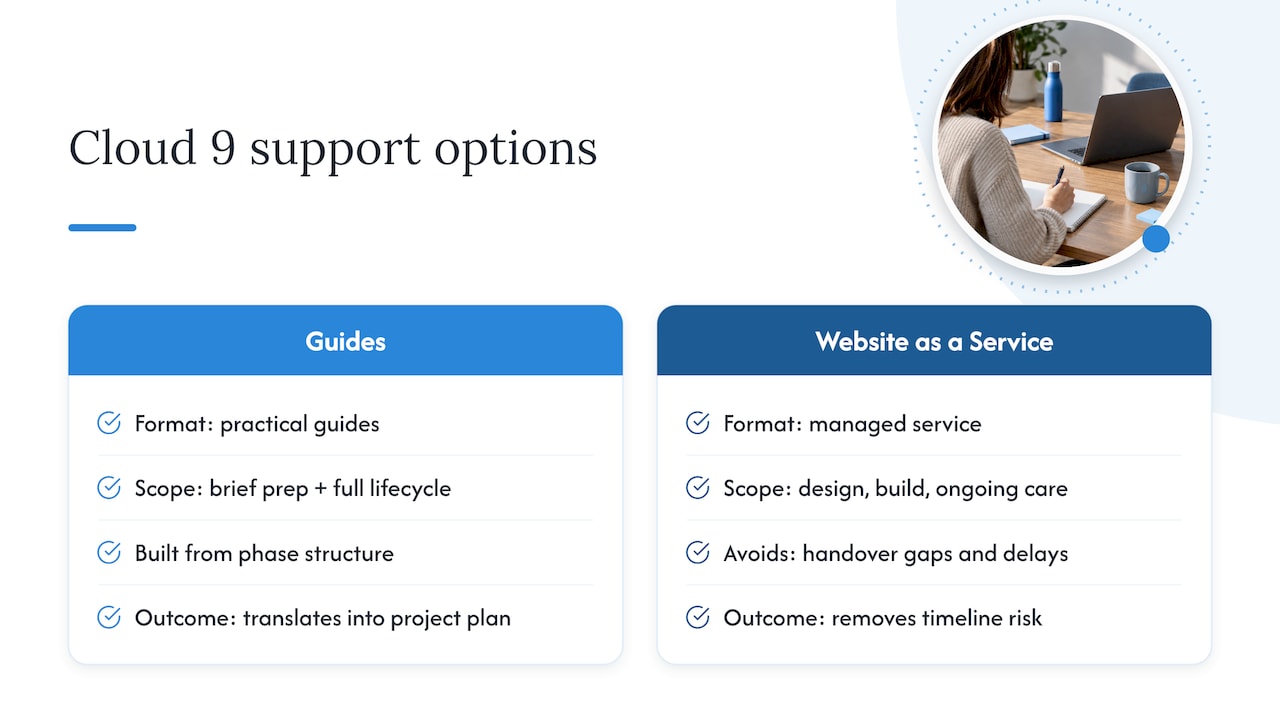
We publish practical guides to help marketing and digital managers plan redesigns realistically, including our website redesign brief preparation steps and our broader guide to website redesign covering the full lifecycle from discovery to launch. These are built from the same phase structure outlined above, so they translate directly into a working project plan.
For organisations wanting to remove timeline risk entirely, a Website as a Service model can combine design, build and ongoing care under one managed arrangement, which avoids the handover gaps that often cause delays between phases.
When to build in phases versus launch everything at once
Phased delivery suits organisations with continuous lead flow, live integrations, or limited risk appetite: launch the core site first, then layer in features. A single big-bang launch suits a complete rebrand paired with simultaneous product or pricing changes, where a split launch would send mixed signals. If your integrations are complex or your traffic can’t absorb downtime, phase it; if your brand and product are both changing at once, launch together.
— Rob
Keeping your redesign timeline predictable
Most redesign delays come from fragmented delivery: a design agency, a separate developer and an in-house team all handing work between each other, with gaps at every handover. Design, build, hosting and ongoing care can be brought together under one managed service, so the same team that plans your timeline is accountable for keeping it.

Our Website as a Service model is built specifically to reduce that handover risk, covering design, development and the managed hosting and support that follows launch. If you would rather see the full range of options first, our services overview covers web design, managed cloud and digital marketing support. Get in touch for a tailored timeline estimate based on your actual content readiness and integration needs.
FAQ
How long should a website redesign take?
A focused redesign typically takes several weeks, a typical full B2B redesign requires a few months, and a comprehensive replatform takes several months. The right figure depends on content readiness, integration complexity and how many stakeholders need to approve each stage, as covered in the timeline shapes above.
How often should a website be redesigned?
There’s no fixed rule, but most established businesses revisit their site every few years as content, branding or underlying technology ages. A better trigger than a calendar date is a drop in engagement, rising technical debt, or a brand shift that the current site no longer reflects.
What is the 3 second rule in website design?
There is no formally defined “3 second rule”, but it reflects the broader finding that visitors decide quickly whether a page is worth their attention. NN/g’s research points to roughly the first 10 seconds as the critical window, which is why homepage clarity is scheduled early in the content phase rather than left until design sign-off.
What are the 7 stages of web development?
Definitions vary across agencies, but a common version covers discovery, content and information architecture, design, development, quality assurance, launch, and post-launch monitoring, matching the phase breakdown above. Some versions split design or testing into two steps, which is why the count differs between sources.
Why do redirects need to stay live for so long after a redesign?
Search engines need time to recrawl and re-evaluate moved pages, and Google’s own guidance recommends keeping 301 redirects active for at least 180 days after a site move. Removing redirects early risks losing the search visibility the original pages had built up.