

Sales and marketing alignment means both teams share revenue responsibility, agree what counts as a sales-ready lead, and work from a single source of truth instead of separate spreadsheets. The single highest-impact move is to set shared revenue goals, write a clear MQL-to-SQL service level agreement with named owners, and anchor everything in one CRM. What follows covers the evidence, the common failure points, the plays, and a pilot model you can run in 60 to 90 days.
TL;DR:
- Establish shared revenue goals and a unified KPI set to align marketing and sales with measurable objectives for pipeline and revenue outcomes.
- Create explicit lead qualification rules and an SLA with named owners, response times, and clear disposition rules to streamline handoffs and reduce disputes.
- Prioritize cleaning CRM data, capturing accurate contact roles, and reducing duplicates to improve trust and visibility across both teams.
- Run a 60 to 90 day pilot with focused objectives, minimal tech changes, and clear success metrics, reinforced by joint review and governance.
- Cultivate a KPI-oriented culture with recurring joint rituals, shared incentives, and visible leadership support to sustain long-term alignment.
Table of Contents
- Why alignment matters: the business case and key outcomes
- Common alignment failures and root causes
- A focused playbook: high-impact steps to align sales and marketing
- How to define a sales-ready lead and write an SLA that works
- Technology and data: what to use, what to avoid, and realistic limits
- Measurement: shared KPIs and a minimal reporting set for alignment
- Sustaining alignment: governance, incentives and culture work
- Practical pilot case: how a 60 to 90 day strategy-first pilot proves alignment
- A practical leadership checklist for the first 90 days
- How Cloud 9 can help you align sales and marketing
- FAQ
- Sources
Why alignment matters: the business case and key outcomes
Misalignment is not a soft problem. It shows up as leads that marketing counts as wins and sales ignores, pipeline that stalls at handoff, and two teams reporting different numbers to the same board.
Coverage from a Pipeline360 survey found that alignment is directly linked to materially better marketing goal attainment and lead quality, with aligned teams reporting stronger reach and higher lead satisfaction than their peers.
Pipeline360 survey coverage reports that aligned sales and marketing teams are more likely to meet marketing goals and see better lead quality. Read the coverage. That single data point is worth building a business case around, because it ties a cultural shift directly to a commercial outcome boards already track.
Alignment changes the buyer’s experience too. A prospect who gets consistent messaging from a marketing email through to a sales call perceives one organisation, not two departments working from different scripts. That consistency reduces duplicated effort: fewer re-qualification calls, fewer leads chased twice, fewer prospects asked the same discovery questions by two different people.
The commercial outcomes worth prioritising, in order, are:
- Revenue contribution: track pipeline and closed-won value against shared targets, not separate marketing and sales quotas.
- Conversion rate: measure how many marketing-sourced leads actually become qualified opportunities.
- Cost efficiency: reduce wasted spend on leads that sales never acts on and marketing never learns from.
Forrester’s analysis of the future of marketing and sales alignment argues that converging technology and more empowered buyers are already blurring the line between the two functions, which makes clear ownership more urgent, not less.
Common alignment failures and root causes
Most alignment problems trace back to a handful of root causes, and diagnosing the right one determines which fix actually works.
- Conflicting KPIs: marketing is measured on lead volume while sales is measured on closed revenue, so each team optimises for a different outcome.
- Broken handoffs: leads move from marketing to sales with no agreed disposition rule, so they sit untouched or get rejected without feedback.
- Data silos and poor CRM hygiene: duplicate records, missing contact roles, and inconsistent fields mean neither team trusts the data enough to act on it.
- Cultural barriers: no shared view of the buyer, and no agreed process for resolving disputes when a lead gets rejected.
Esade’s guidance on sales strategy makes a point worth sitting with: culture, not tooling, is the primary driver of alignment, and organisations with a KPI-oriented culture tend to integrate functions more successfully regardless of which platforms they run.
A separate pattern worth flagging is how thin the actual collaboration tends to be. Many organisations find that marketing and sales jointly own only a small slice of the full buyer journey, leaving most of it unshared and uncoordinated. That gap is often where the easiest wins sit, because mapping even one additional shared activity, such as a joint lead-scoring review, can close a visible hole fast.
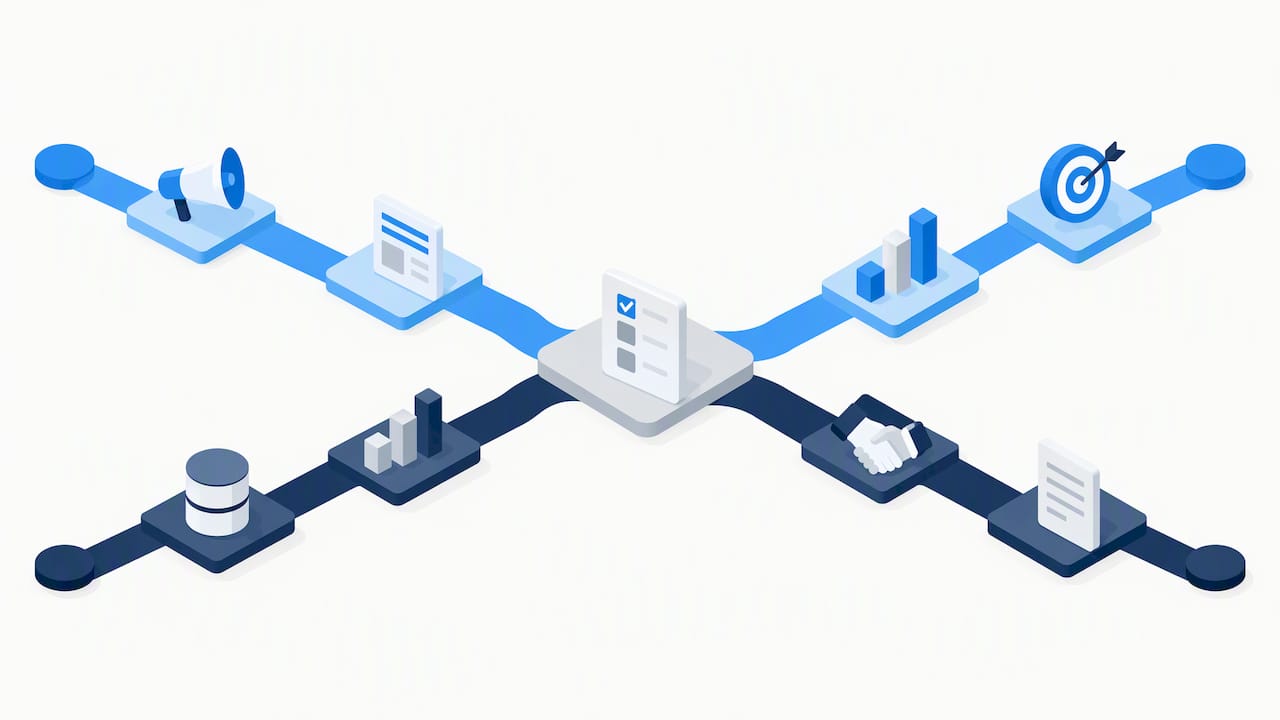
Pro Tip: Before buying any new tool, audit which parts of the buyer journey your teams currently own jointly versus separately. The gaps usually point directly to your next fix.
A focused playbook: high-impact steps to align sales and marketing
Alignment improves fastest when the work is sequenced rather than attempted all at once. The following order reflects what tends to unblock the most downstream friction first.
- Set shared revenue goals and a minimal KPI set. Agree one scorecard both teams report against, so marketing is not rewarded for volume while sales is rewarded for closed deals alone.
- Co-create the ideal customer profile and buyer journey map. Assign a named owner from each side and document the profile on a single page that both teams actually use, not a slide deck that gets filed away.
- Agree explicit MQL-to-SQL rules and a written SLA. Define response times, who owns each stage, and what happens when a lead is rejected.
- Anchor systems on a CRM backbone. Build only the integrations the pilot needs rather than connecting every tool in both stacks on day one.
- Build enablement collateral sellers will actually use. Short, specific battlecards and call scripts beat long decks nobody reads.
- Create a closed-won and closed-lost feedback loop. Feed sales outcomes back into marketing’s targeting and messaging on a fixed schedule, not ad hoc.
- Run a 60 to 90 day pilot with clear success criteria. Set the metrics before you start, not after you see the results.
Each step depends on the one before it. A shared KPI set without an agreed SLA just moves the argument from “whose numbers count” to “whose lead was this.” A CRM backbone without clean ICP definitions just automates confusion faster.
The pilot step deserves particular attention because it is where most alignment efforts either prove their worth or quietly stall. A good pilot has a fixed window, a named owner on each side, and a review date already on the calendar before it starts. Zendesk’s guidance on sales strategy notes that unifying communication channels and centralising data support alignment, but is careful to point out that the systems only work when governance decides how they are used, not the other way round.
Pro Tip: Write your pilot’s success criteria on one page before any integration work starts. If you cannot state what “working” looks like in a single sentence, the pilot is not ready to launch.
A practitioner pattern worth building into every pilot: broken handoffs persist even where an SLA exists, usually because the CRM record does not show who the real decision-maker is. Capturing contact roles properly, so a senior buyer is not misfiled as a junior researcher, removes a disproportionate share of handoff disputes for very little extra effort.
How to define a sales-ready lead and write an SLA that works
A sales-ready lead combines behavioural signals with firmographic fit. Behavioural signals include content downloads, demo requests, repeat site visits, and other intent signals. Firmographic fit includes company size, industry, and the role of the person engaging.
A simple scoring rule-set might look like this:
- A lead scores as marketing-qualified when it hits a minimum behavioural threshold, such as a demo request or a pricing page visit.
- A lead scores as sales-qualified only when it also matches the agreed firmographic profile, such as company size and buying role.
- Leads that meet behavioural thresholds but fail the firmographic check route to nurture, not to sales.
The SLA itself needs four components to avoid the disputes that undermine most handoff processes:
- Named owners on both sides, not a team inbox.
- Response time commitments, typically measured in hours, not days.
- Disposition rules that specify exactly when and why a lead is accepted, rejected, or returned.
- A return and nurture path so rejected leads do not simply disappear.
Operationalising returns matters as much as the initial handoff. Every returned lead should feed a short review so the criteria get refined over time rather than argued over repeatedly. Automated nurture sequences can keep returned leads warm while the sales team focuses on the ones that meet the bar today.
Technology and data: what to use, what to avoid, and realistic limits
A CRM backbone is a precondition for alignment, not a substitute for it. Buying a platform does not fix conflicting KPIs or undefined handoff rules, it just gives both teams a shared place to disagree faster.
The integrations and signals worth prioritising are narrow: contact roles, intent signals, and campaign source data. These three fields answer the questions that cause most disputes, namely who is this person, how engaged are they, and where did they come from.
Common pitfalls include:
- Duplicate records that split a single buyer’s activity across two profiles, hiding their true engagement level.
- Missing contact roles, which routinely hides senior decision-makers behind generic “contact” labels.
- Unshared activity logs, where sales cannot see marketing touches and marketing cannot see sales call notes.
Governance steps that address these pitfalls directly include making contact role a mandatory field at the point of capture, assigning clear data ownership for each CRM object, and documenting an escalation rule for when a record looks wrong. None of this requires new software: it requires someone with the authority to enforce it. CRM and marketing automation support built around these governance rules tends to outperform a bigger platform with none.
Measurement: shared KPIs and a minimal reporting set for alignment
A minimal shared KPI set keeps both teams reporting the same numbers instead of two competing versions of the truth. Five metrics cover most of what matters:
- Shared pipeline value: the total opportunity value both teams are accountable for.
- Lead-to-opportunity rate: the percentage of qualified leads that become real opportunities.
- Lead response time: how quickly a sales rep acts on a newly qualified lead.
- Lead quality score: a simple rating applied at the point of disposition.
- Closed-won by source: revenue attributed back to the original marketing channel.
Pipeline360 survey coverage links alignment with stronger lead quality and reach outcomes, which is a reasonable benchmark to set pilot targets against. See the survey coverage.
A falling lead-to-opportunity rate alongside a rising lead volume is a red flag: it usually means the top of the funnel is growing faster than lead quality, not that sales is underperforming. A shortening lead response time paired with a steady or rising lead quality score is the clearest green signal that alignment work is paying off.
Dashboards that both teams can see in real time remove a lot of the argument about whose numbers are right. Guidance on building shared KPI dashboards covers practical approaches to surfacing these metrics without building a reporting project of its own.
Once the minimal set is stable, consider upgrading to account-based or multi-touch attribution reporting, but only once the basics are trusted. A monthly joint review, owned jointly by marketing and sales leadership, is usually enough cadence to keep the numbers honest without turning reporting into a full-time job.
Sustaining alignment: governance, incentives and culture work
A pilot proves alignment can work. Governance is what keeps it working after the pilot ends and the novelty wears off.
- Recurring joint rituals: a shared pipeline review, a closed-loop session on recent wins and losses, and a quarterly joint planning meeting.
- Named dispute owners: someone on each side with the authority to resolve an SLA breach without escalating to a director every time.
- Shared incentives: reward structures that include cross-functional KPIs, not just team-specific targets.
- Visible leadership sponsorship: leaders who show up to joint reviews and make decisions quickly when disputes arise.
Pro Tip: Put the first joint pipeline review on the calendar before the pilot even starts. Alignment that depends on someone remembering to schedule a meeting rarely survives the first busy quarter.
Esade’s guidance on sales strategy reinforces this point directly: a KPI-oriented culture sustains integration far better than any single tool or process redesign, because culture is what survives staff turnover and quarterly priority shifts.
Practical pilot case: how a 60 to 90 day strategy-first pilot proves alignment
Alignment pilots run on a strategy-first basis: defining the KPI set, the MQL-to-SQL rules, and the data cleansing tasks before touching any integration work. A typical scope covers:
- Objectives: one or two commercial outcomes to move within the pilot window, agreed before kickoff.
- Minimal tech changes: only the CRM fields and integrations the pilot actually needs.
- Data cleansing: contact role capture and duplicate record resolution as a first step, not an afterthought.
- Enablement priorities: one or two pieces of sales collateral built from the agreed ICP, not a full library.
Our 60 to 90 day pilot model for B2B marketing automation sets success metrics up front and reviews them against the agreed cadence, with decisions made jointly by the named owners on both sides rather than deferred to a steering committee. Deliverables typically include the shared KPI dashboard, the written SLA, and a documented escalation path, so the governance outlasts the pilot itself.
A practical leadership checklist for the first 90 days
I would tell any leader starting this work to set three decision gates: at three weeks, confirm the KPI set and SLA are signed by both sides. At six weeks, check the CRM data is clean enough that nobody is disputing the numbers. At 90 days, review the pilot against the success criteria you wrote down on day one, not the ones that feel comfortable in hindsight.
The clearest red flag is a dispute about whose lead it was. The clearest green signal is a joint review where both teams quote the same number without checking two different reports first.
— Rob
How Cloud 9 can help you align sales and marketing
Expertise in CRM and marketing automation is combined with the integration and measurement work alignment actually depends on, rather than leaving system stitching to clients themselves. Commissioning a specialist pilot shortens the time it takes to get from agreed KPIs to working governance, because the strategy and the technical setup happen in parallel rather than one waiting on the other.
If you want a structured way to test alignment without a long commitment, our 60 to 90 day pilot for B2B marketing automation is built around exactly this strategy-first approach, and our CRM and marketing automation services cover the ongoing setup once the pilot proves the model works.
FAQ
How do you align sales and marketing?
Start with shared revenue goals, a written MQL-to-SQL SLA with named owners, and a single CRM both teams trust. Add joint rituals such as pipeline reviews and closed-loop feedback sessions to keep the agreement alive beyond the initial setup.
What is the 3-3-3 rule in sales?
The 3-3-3 rule is not a formally established standard across sales methodology, and definitions vary depending on the source. Where it appears, it generally refers to structuring prospecting or onboarding activity into three-part time blocks, so treat any specific version with caution rather than as an industry-wide rule.
What are the 5 P’s in sales and marketing?
Like the 3-3-3 rule, the “5 P’s” is used inconsistently across sources, with different versions covering factors such as product, price, place, promotion and people. Rather than relying on a single fixed framework, focus on the shared KPI set and SLA structure covered in this article, which is better supported by the available evidence.
What are the 5 C’s of sales?
The “5 C’s of sales” also varies by source, with no single authoritative definition in general use. Business leaders are better served by the concrete alignment steps in this article, such as shared goals, agreed lead definitions, and a documented SLA.
Does sales and marketing alignment actually improve results?
Coverage from a Pipeline360 survey links alignment with materially better marketing goal attainment and lead quality. Aligned teams in that survey reported stronger reach and higher lead satisfaction than teams working separately.
Sources
- Pipeline360 survey finds sales-marketing alignment and branded demand help B2B marketing meet goals
- The future of marketing and sales alignment | Forrester
- Sales strategies (Esade)