

Managed services are defined as a proactive operating model where specialist providers take ongoing responsibility for technology and business processes under formal service-level agreements (SLAs). The role of managed services has shifted decisively from reactive break/fix support to a strategic partnership that drives cost control, operational efficiency, and continuous improvement. Bodies such as the Technology Services Industry Association (TSIA) recognise this shift as a defining feature of modern IT governance. For business owners and managers, the practical result is a model that replaces fragmented, unpredictable IT spending with structured, outcome-focused delivery.
What is the role of managed services in operational efficiency?
Managed services reduce the operational burden on internal teams by placing routine and complex IT tasks under expert oversight. This matters because most organisations carry hidden costs in their IT function: expensive niche hires, slow incident response, and technology decisions made without sufficient expertise.

The efficiency gains are concrete. Only 25% of companies achieve their desired return from SaaS and cloud investments before engaging a managed services provider. That figure tells you most businesses are paying for technology they are not fully using. A managed services provider closes that gap by actively managing performance and costs rather than waiting for problems to surface.
The core efficiency benefits break down as follows:
- Predictable costs. Subscription-based pricing replaces unpredictable capital expenditure on IT infrastructure and emergency support calls.
- Specialist talent on demand. Providers supply skills in areas such as cloud architecture, cybersecurity, and compliance without the cost of permanent hires.
- Faster issue resolution. Standardised runbooks and dedicated monitoring tools reduce the time between a problem appearing and being fixed.
- Freed internal capacity. When internal teams offload operational noise, they focus on strategic priorities rather than day-to-day IT firefighting.
- Reduced decision latency. Managed service providers handle risk and compliance monitoring, which means your leadership team receives cleaner, faster information for decisions.
Pro Tip: Map your current IT spending against actual business outcomes before approaching a managed services provider. Providers who see your baseline data can build a more targeted service agreement from day one.
The importance of managed services to operational efficiency is not theoretical. Businesses that treat IT management as a core operational function, rather than a support cost, consistently outperform those that do not.
What IT functions do managed service providers deliver?
Managed IT services cover a defined and expanding set of functions, all governed by SLAs that specify availability, response times, resolution targets, and customer satisfaction measures. This is what separates managed services from traditional outsourcing, which typically covers a fixed project or a narrow support function.
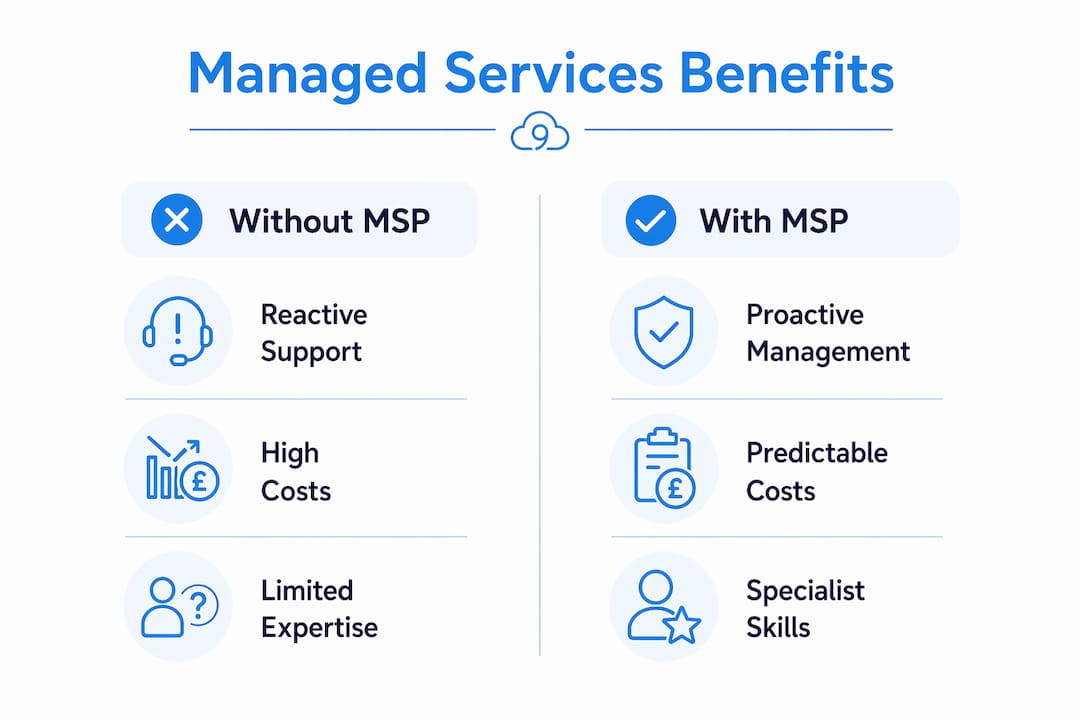
Providers continuously monitor, manage, and support IT environments using standardised tooling and documented runbooks. The goal is to reduce incidents before they occur, not simply to fix them after the fact. That proactive stance is the defining characteristic of the managed services model.
The core IT functions delivered by a managed services provider typically include:
- Continuous monitoring and alerting. Systems are watched around the clock, with automated alerts triggering responses before users notice a problem.
- Patch management and updates. Operating systems, applications, and security tools are kept current without requiring internal resource.
- Backup and disaster recovery. Data is protected and recovery processes are tested regularly, reducing business risk from outages or data loss. Cloud9’s backup and security services follow this model for UK businesses.
- Cloud management. Providers manage cloud environments, including cost governance, performance tuning, and architecture reviews.
- Compliance and risk management. Regulatory requirements such as GDPR and ISO 27001 are tracked and managed as part of the service.
The table below shows how managed IT services differ from traditional outsourcing across key dimensions:
| Dimension | Traditional outsourcing | Managed IT services |
|---|---|---|
| Engagement model | Project-based or reactive | Ongoing, proactive |
| Accountability | Task completion | Business outcomes under SLA |
| Governance | Periodic reviews | Regular cadence with shared metrics |
| Technology scope | Fixed at contract start | Evolves with business needs |
| Innovation input | Limited | Active advisory and AI/cloud adoption |
The evolution of managed services now extends into AI operations, edge computing, and cloud-native architectures. Providers who once managed servers now manage the entire digital operating environment.
How do you get the most from a managed services partnership?
The managed services model only delivers its full value when business managers treat providers as partners rather than vendors. Successful partnerships tailor plans to specific business objectives and scale to seasonal fluctuations and shifting demands. A generic contract built around uptime statistics will not move the needle on business performance.
Getting the relationship right requires deliberate effort on both sides. The most common failure point is a mismatch between what the provider measures and what the business actually cares about. Uptime percentages mean little if the systems being kept online are not the ones driving revenue.
Practical steps for managing the relationship effectively:
- Define business-relevant metrics. Move beyond uptime and response times. Agree on metrics tied to business outcomes, such as order processing speed or customer-facing system availability during peak trading.
- Integrate the provider into your operational stack. Organisations that integrate MSPs with documented runbooks and internal tooling avoid the operational friction that undermines service quality.
- Establish a governance cadence. Monthly or quarterly reviews should cover performance against business metrics, not just technical statistics.
- Plan for capacity changes. Build scaling provisions into the agreement so that demand spikes, new product launches, or seasonal peaks do not catch the provider unprepared.
- Communicate strategic direction. Providers who understand your growth plans can anticipate technology needs rather than reacting to them.
Pro Tip: Ask your provider to present their performance data in business language at every governance review. If they can only report in technical metrics, that is a signal the relationship needs reframing.
Formal governance and shared accountability for business outcomes are what separate high-performing managed services relationships from those that drift into transactional mediocrity.
How do managed services drive innovation and digital transformation?
Managed services providers are not just operational support. They are one of the most practical routes to enterprise-wide digital transformation for businesses that lack the internal capacity to run change programmes at scale.
MSPs bring advisory capabilities and advanced automation to deliver ongoing transformation assistance and continuous optimisation. This means a business can pilot an AI tool or a new cloud workflow with its provider, then rely on that provider to roll it out consistently across teams and locations. The internal team does not need to build the capability from scratch.
Operationalising AI pilots enterprise-wide is one of the clearest examples of this. Many organisations run successful small-scale AI experiments that never reach production because internal teams cannot manage the scaling complexity. A managed services provider with cross-industry experience handles that transition as a standard part of the service.
| Business challenge | Without managed services | With managed services |
|---|---|---|
| AI pilot to production | Stalls at internal capacity limits | Provider operationalises across teams |
| Cloud cost management | Overspend on unused capacity | Active governance keeps costs aligned |
| Compliance changes | Reactive, resource-intensive | Monitored and managed proactively |
| New market entry | Delayed by IT infrastructure gaps | Provider scales environment to match |
Modern managed services are strategy-led partnerships where providers bring deep industry expertise to ensure technology enables transformation rather than impedes it. For business owners managing growth, that expertise is often the difference between a digital initiative that delivers and one that stalls.
Key takeaways
Managed services deliver the most value when treated as a strategic partnership with shared accountability, not as a reactive IT support contract.
| Point | Details |
|---|---|
| Proactive model, not reactive | Managed services prevent problems rather than fixing them, governed by formal SLAs. |
| Cost predictability | Subscription-based pricing replaces unpredictable IT spend and emergency support costs. |
| Business-relevant governance | Review performance against business outcomes, not just uptime or technical metrics. |
| Integration drives results | Embedding providers into your operational stack with shared tooling removes friction. |
| Innovation at scale | Providers operationalise AI and cloud initiatives that internal teams cannot scale alone. |
Why the MSP relationship is the part most businesses get wrong
I have worked with enough business owners to know that the managed services conversation almost always starts in the wrong place. The first question is usually about price or response times. Those matter, but they are not the question that determines whether the relationship succeeds.
The real question is whether your provider is embedded in how your business actually operates. I have seen organisations sign technically sound managed services agreements and then treat the provider like a helpdesk. The provider fixes tickets. The internal team ignores the monthly report. Nothing changes strategically. That is not a managed services failure. That is a governance failure.
The businesses that get genuine value from managed services are the ones that bring their provider into planning conversations. When a provider knows you are launching a new product line in six months, they can prepare the infrastructure, the security posture, and the support capacity in advance. When they find out on the day of launch, they are firefighting.
The shift to AI and cloud-native operations has made this even more critical. MSPs have a unique ability to operationalise AI pilots across diverse teams, but only if they understand the business context. A provider managing your cloud environment in isolation cannot do that. A provider embedded in your operational planning can.
My honest advice: treat your first governance review as the most important meeting of the relationship. Set the tone that you expect business outcomes, not just technical reports. That single conversation shapes everything that follows.
— Rob
How Cloud9 supports UK businesses with managed services
Cloud9 works with established UK businesses that need more than a helpdesk. The managed cloud services Cloud9 provides cover proactive monitoring, cloud management, backup, security, and ongoing digital support, all under a single partnership model that replaces the need for multiple fragmented suppliers.

Cloud9’s approach is built around your business objectives, not a generic service catalogue. Whether you need cloud migration support, Microsoft 365 management, or a fully integrated digital operation covering your website, marketing, and CRM, Cloud9 brings the expertise and governance structure to make it work. If you want a managed services partner that measures success in business outcomes, speak to the Cloud9 team about a service plan built around your goals.
FAQ
What is the role of managed services in IT?
Managed services in IT means a specialist provider takes ongoing responsibility for monitoring, managing, and supporting your technology environment under a formal SLA. The provider acts proactively to prevent issues rather than waiting for problems to be reported.
How do managed services differ from traditional IT outsourcing?
Traditional outsourcing covers fixed projects or reactive support. Managed services deliver continuous, proactive management with shared accountability for business outcomes, governed by regular performance reviews.
What are the main managed services benefits for businesses?
The main benefits are predictable costs, access to specialist skills, faster issue resolution, and freed internal capacity to focus on growth. Businesses also gain proactive compliance and risk management as part of the service.
How do managed service providers support digital transformation?
Providers operationalise AI pilots, manage cloud environments, and bring cross-industry expertise to scale digital initiatives that internal teams cannot deliver alone. This turns isolated technology experiments into enterprise-wide capabilities.
How should a business manage its MSP relationship effectively?
Define business-relevant performance metrics, integrate the provider into your operational planning, and hold regular governance reviews focused on outcomes rather than technical statistics. Treating the provider as a strategic partner rather than a vendor produces consistently better results.