

Personalised email campaigns are the single most direct way to turn a contact list into a revenue engine. Rather than sending the same message to thousands of people and hoping it lands, personalisation uses behavioural data, purchase history, and lifecycle stage to shape every email around the individual receiving it. The result is a communication that feels timely and relevant, not like another generic blast to be deleted unread.
The shift from mass email to targeted messaging is not just a tactical upgrade. It changes the entire relationship between a brand and its audience. When someone receives an email that references what they actually browsed, bought, or abandoned, they are far more likely to engage. That relevance is what drives the measurable gains in open rates, click-throughs, and conversions that make personalised campaigns worth the investment.
At its core, personalised email marketing relies on:
- Behavioural data such as pages visited, products viewed, and emails previously opened
- Demographic and firmographic data drawn from CRM records and sign-up forms
- Purchase and engagement history to identify where each contact sits in their journey
- Dynamic content that changes automatically based on who is reading the email
- AI and automation to apply all of the above at scale, without manual effort for every send
Why personalised email campaigns outperform generic sends
The performance gap between personalised and generic emails is not marginal. Personalised subject lines can significantly increase open rates, and personalised calls to action can greatly improve conversion rates. Those are not incremental gains; they represent a fundamentally different level of engagement.
Gartner research confirms that active personalisation increases purchase confidence substantially, boosting both customer satisfaction and marketing ROI. The mechanism is straightforward: when an email speaks to something a recipient actually did or cares about, it removes friction from the decision-making process.
The benefits stack up across the full customer lifecycle:
- Higher open rates when subject lines reference real behaviour, such as an abandoned cart or a recently viewed product
- Better click-through rates when content matches demonstrated interests rather than assumed ones
- Improved conversion rates when calls to action match the recipient’s stage in the buying journey
- Stronger customer retention because relevant post-purchase emails drive repeat purchases
- Lower acquisition costs because higher conversion rates mean fewer emails needed to close a deal
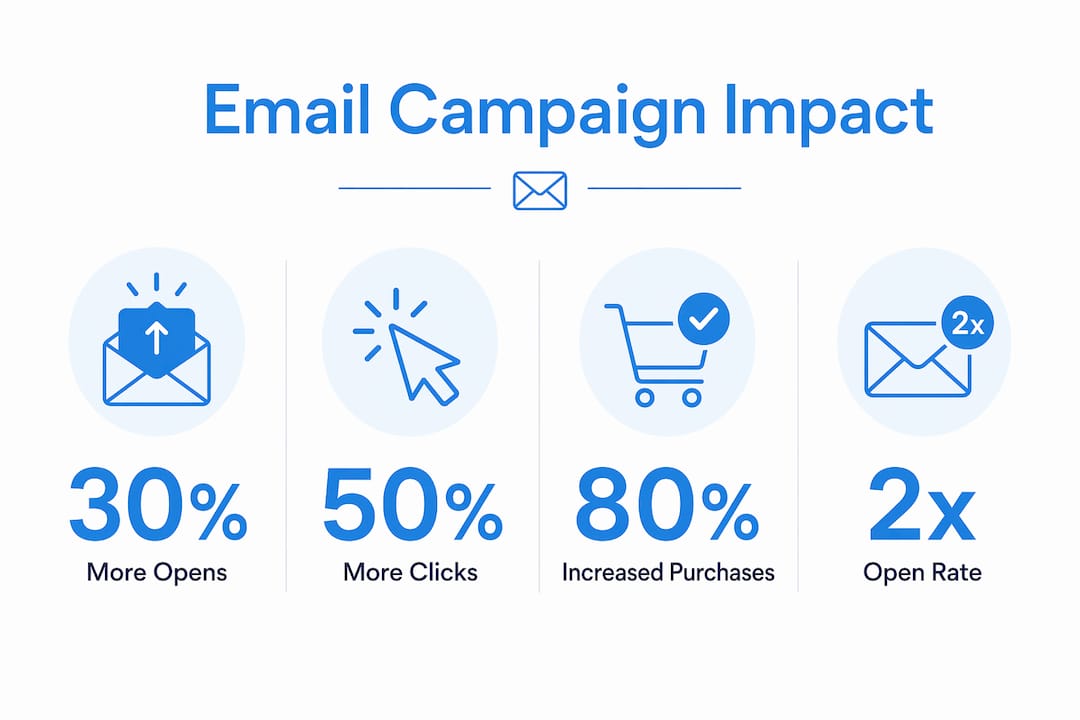
Over 80% of consumers are willing to purchase more when offered tailored recommendations based on prior behaviour. That figure alone makes a compelling case for moving beyond first-name merge tags.
Segmented emails generate 30% more opens and 50% more click-throughs than unsegmented ones. Segmentation is the foundation; personalisation is the layer on top that makes each message feel individual rather than group-addressed.
How to gather the data that makes personalisation work
Good personalisation starts with good data, and good data rarely lives in one place. The most effective approach integrates multiple sources into a single, unified view of each contact.
The key data sources to connect are:
- CRM records covering contact details, company size, industry, and lifecycle stage
- Website behaviour including pages visited, time on site, and content downloaded
- Email engagement history such as which campaigns a contact opened, clicked, or ignored
- Purchase and transaction data showing what someone bought, when, and how often
- Support and service interactions that reveal pain points and satisfaction levels
Without data integration, campaigns risk being generic even when they appear personalised on the surface. A welcome email that addresses someone by name but ignores everything else known about them is still a generic email wearing a thin disguise.
Real-time behavioural triggers are particularly valuable because they act on intent signals as they happen. When someone visits a pricing page three times in a week, that is a buying signal. An email sent within hours of that behaviour will always outperform one sent on a fixed weekly schedule.
Pro Tip: Focus on three to five high-impact data points rather than trying to use every field in your CRM. Recency of last purchase, current lifecycle stage, and last email interaction are often enough to drive meaningful personalisation without overcomplicating your segmentation logic.
Key strategies for implementing personalised email campaigns
The most effective personalisation strategies combine dynamic content, behavioural triggers, and automation into a system that runs largely without manual intervention once it is set up.
Dynamic content and modular templates allow a single email to show different images, copy, or product recommendations depending on who is opening it. A retailer might show winter coats to contacts in Scotland and lightweight jackets to those in the South of England, all from the same send. This approach scales personalisation without multiplying the number of campaigns to manage.
Behavioural triggers fire emails in response to specific actions: a cart abandonment, a pricing page visit, a lapsed subscription, or a completed purchase. Behavioural triggers improve marketing efficiency by reducing wasted spend and ensuring messages arrive when intent is highest.

AI-driven content generation handles the heavy lifting of writing subject lines, body copy, and product recommendations at scale. Rather than crafting individual messages, marketers set the parameters and let AI generate variations that match each recipient’s profile.
Automated lifecycle sequences move contacts through a predefined journey: welcome series, onboarding, upsell, re-engagement, and win-back. Each stage triggers automatically based on what the contact does or fails to do.
The results from well-executed automation are striking. By deploying dynamic email modules with AI moderation, The Warehouse Group increased click rates by 14% while saving 28 operational hours a week. That combination of performance gain and time saving is what makes scalable personalisation genuinely attractive for marketing teams with limited resource.
Personalisation should be approached as the start of a long-term conversation rather than a mere sales tactic. When it is done well, it reduces churn, builds loyalty, and turns one-time buyers into advocates. The brands that get this right treat every email as a chance to add value, not just to close a transaction.
For UK businesses looking to connect CRM data with marketing automation, the infrastructure question is often the first barrier. Getting the data flowing between systems is the prerequisite for everything else.
Common types of personalised email campaigns
Personalised campaigns take many forms, and the most effective ones tend to be the simplest: the right message, sent at the right moment, to someone who was already thinking about the topic.
Welcome and onboarding series are the highest-leverage entry point. A new subscriber or customer is at peak engagement, and a personalised welcome sequence that reflects how they signed up, what they expressed interest in, or which product they first purchased sets the tone for the entire relationship. Generic “thanks for joining” emails squander that moment.
Abandoned cart emails remain one of the highest-converting campaign types in e-commerce. Sending a reminder within an hour of abandonment, referencing the specific items left behind, consistently outperforms any promotional email sent to the full list. The trigger is the personalisation; no additional data is needed beyond what the contact just did.
Post-purchase recommendations extend the value of a transaction. Automated personalised lifecycle emails such as these nurture customers effectively with minimal manual effort, suggesting complementary products or content based on what was just bought.
Re-engagement campaigns target contacts who have gone quiet, typically defined as no opens or clicks within a set window. The personalisation here comes from acknowledging the gap directly and offering something relevant to bring them back, rather than sending the same promotional email that failed to engage them in the first place.
Loyalty and reward emails that reference a contact’s specific history, such as their anniversary with the brand or their points balance, perform well because they demonstrate that the brand is paying attention. That recognition, however small, builds the kind of affinity that generic discount emails cannot.
The most effective personalised campaigns are not the most technically complex ones. They are the ones that arrive at the right moment with content that feels genuinely relevant. Timing and relevance beat sophistication every time.
Tools that support cold email automation can also play a role in top-of-funnel outreach, particularly for B2B teams building personalised prospecting sequences before contacts enter the main CRM workflow.
Balancing personalisation with consumer privacy
Personalisation has a paradox at its centre. The more precisely you target someone, the more effective the email, but push too far and the same precision starts to feel intrusive. Excessive personalisation can trigger consumer reactance, where recipients feel surveilled rather than understood, and disengage or unsubscribe as a result.

The line between helpful and creepy is not always obvious, but a practical rule holds: use only data that provides immediate, clear value to the recipient. Referencing a product someone viewed yesterday is helpful. Referencing that they spent 47 minutes on a specific page at 11pm on a Tuesday is unsettling.
UK businesses must also operate within the UK GDPR framework, which governs how personal data is collected, stored, and used for marketing purposes. The key obligations are:
- Lawful basis for processing: most email marketing relies on consent or legitimate interest, both of which must be documented
- Transparency: contacts must know what data you hold and how you use it
- Data minimisation: collect only what you genuinely need for the stated purpose
- Right to erasure: contacts can request deletion of their data, and you must be able to comply
- Opt-out mechanisms: every marketing email must include a clear, functional unsubscribe option
Human oversight of AI-driven personalisation is not optional. AI can identify patterns and generate content at scale, but it cannot judge whether a particular message crosses a line for a particular audience. Marketing teams need to review AI outputs, set guardrails on what data feeds into personalisation logic, and monitor for signals that campaigns are generating negative sentiment.
Pro Tip: Run a simple sense-check before any personalised campaign goes live: would you be comfortable if the recipient knew exactly what data triggered this email? If the answer is no, the personalisation is too invasive.
AI automation services that are built with human oversight baked in tend to produce better long-term results than fully autonomous systems, precisely because they maintain the trust that makes personalisation effective in the first place.
Which metrics tell you if personalised campaigns are actually working?
Measuring the effectiveness of personalised email campaigns requires looking beyond vanity metrics. Open rate alone tells you whether the subject line worked; it says nothing about whether the email drove any value.
The metrics that matter most, and what they reveal:
| Metric | What it measures | Why it matters |
|---|---|---|
| Open rate | Subject line and sender relevance | Indicates whether personalisation at the envelope level is working |
| Click-through rate | Content relevance and CTA alignment | Shows whether the email body matched recipient intent |
| Conversion rate | Revenue or goal completion per send | The clearest measure of campaign effectiveness |
| Revenue per email | Direct commercial output | Ties personalisation directly to business outcomes |
| Unsubscribe rate | Audience fatigue or irrelevance | A rising rate signals over-sending or poor targeting |
| List growth rate | Net audience health | Tracks whether acquisition outpaces attrition |
| Customer lifetime value | Long-term loyalty impact | Reveals whether personalisation is building lasting relationships |
Comparing personalised sends against non-personalised control groups is the most reliable way to isolate the impact of personalisation itself. Without a control, it is difficult to know whether a performance improvement came from better targeting or simply from sending at a better time.
Email automation platforms that integrate with CRM data make it straightforward to track these metrics at the individual campaign and segment level, rather than only at the aggregate list level.
Common pitfalls in personalised email marketing and how to avoid them
Most personalisation failures come down to one of three problems: bad data, over-complexity, or a mismatch between what the marketer thinks is relevant and what the recipient actually finds useful.
Relying on stale or incomplete data is the most common issue. A contact who bought a product two years ago and has since churned does not need an upsell email. Dynamic segmentation that updates in real time, rather than static lists built once and forgotten, prevents this kind of misfire.
Personalising the wrong things wastes effort. Adding a first name to a subject line while sending irrelevant content is not personalisation; it is the appearance of personalisation. The content, timing, and offer all need to reflect what is actually known about the recipient.
Over-segmenting to the point of paralysis is a real trap for teams with access to rich data. When every possible variable becomes a segmentation criterion, the number of campaign variants multiplies beyond what any team can manage or test properly. Start with three to five meaningful segments and build from there.
Ignoring deliverability undermines everything else. An email that lands in spam is personalised to no one. Maintaining a clean list, monitoring sender reputation, and following authentication standards such as DMARC, DKIM, and SPF are prerequisites for any personalisation strategy to function.
Failing to test means never knowing what actually drives performance. A/B testing subject lines, send times, and content variations is the only way to build genuine knowledge about what works for a specific audience. AI-driven personalisation platforms unify segmentation, dynamic content, and send-time optimisation, but the testing discipline still needs to come from the marketing team.
For UK businesses building out their digital marketing services, personalised email is most effective when it sits within a broader strategy that connects website behaviour, CRM data, and campaign performance in a single view. Fragmented tools produce fragmented results.
Pro Tip: Before scaling any personalisation programme, audit your data quality first. A campaign built on inaccurate or outdated records will underperform a simpler, well-targeted send every time.
Key takeaways
Personalised email campaigns consistently outperform generic sends because they deliver relevance at the individual level, and relevance is what drives opens, clicks, and conversions.
| Point | Details |
|---|---|
| Personalisation doubles open rates | Personalised subject lines can double open rates; personalised CTAs can improve conversions by over 200%. |
| Unified data is the foundation | Integrating CRM, website behaviour, and engagement history is what makes genuine personalisation possible. |
| Behavioural triggers beat schedules | Emails sent in response to real actions consistently outperform fixed-schedule sends. |
| Privacy balance protects performance | Excessive personalisation triggers consumer resistance; UK GDPR compliance and human oversight are both required. |
| Measure beyond open rate | Conversion rate, revenue per email, and customer lifetime value reveal whether personalisation is driving real business outcomes. |
FAQ
What is the role of personalisation in email marketing?
Personalisation makes email marketing relevant to the individual recipient by tailoring content, timing, and offers to their behaviour and preferences. It transforms a broadcast channel into a one-to-one conversation that drives higher engagement and conversion.
What is the purpose of a personalised email campaign?
The purpose is to deliver the right message to the right person at the right moment, using data to remove the irrelevance that causes most marketing emails to be ignored. Done well, it builds loyalty and increases revenue per contact.
How do you personalise email campaigns effectively?
Start with a unified data foundation that connects CRM records, website behaviour, and purchase history. Layer in dynamic content and behavioural triggers, then use automation to scale the approach without manual effort for every send.
What are the main benefits of personalised emails?
Segmented and personalised emails generate 30% more opens and 50% more click-throughs than unsegmented ones, while active personalisation increases purchase confidence by 2.3 times according to Gartner research.
How does GDPR affect personalised email campaigns in the UK?
UK GDPR requires a lawful basis for processing personal data, transparency about how data is used, and a clear opt-out mechanism in every marketing email. Consent or legitimate interest must be documented before any personalisation data is collected or applied.