
Post-purchase automation protects the sale and converts it into repeat revenue. It does this by handling every informational task automatically — order confirmations, shipping updates, delivery notifications, review requests — while routing sensitive judgement calls to a human. For UK SMEs and professional firms, that split is the difference between a customer who buys again and one who quietly disappears.
The short version:
- Immediate reassurance: automated order and shipping messages reduce buyer anxiety before it becomes a support ticket
- The 72-hour window: the period after delivery is your highest-leverage moment for reviews, referrals, and loyalty invites
- Support cost savings: branded tracking cuts “where is my order?” (WISMO) enquiries by around 72% when implemented proactively
- GDPR/ICO guardrails: transactional flows must stay separate from marketing to preserve deliverability and regulatory compliance
- Cloud9 as integration partner: CRM automation, webhook orchestration, and managed services in one place
When implemented with CRM-connected, delivery-aware triggers, post-purchase automation measurably increases repeat purchase rates, reduces support costs, and improves customer lifetime value.
Table of Contents
- Why does post-purchase automation matter for UK SMEs?
- What should you automate, and what needs a human?
- What are the highest-impact workflows and when should you send them?
- What technology do you need to run post-purchase automation?
- How do you implement post-purchase automation in six steps?
- Which KPIs tell you whether it is working?
- What mistakes damage trust, and how do you prevent them?
- Key takeaways
- What Cloud9 clients typically see when this is done right
- Cloud9 can build and run this for your business
- Useful sources
- FAQ
Why does post-purchase automation matter for UK SMEs?
Post-purchase emails see open rates higher than the average automation. That is not a coincidence. The customer just handed over money and is actively watching their inbox. Most SMEs send two messages — order confirmation and shipping notification — then go silent. That silence is where repeat revenue dies.

The economics are stark. Acquiring a new customer costs five to seven times more than retaining an existing one. Every pound spent on post-purchase engagement earns back multiples by driving reorders from people who have already converted. For smaller UK businesses with tighter margins, that arithmetic matters more, not less.
Zac Fromson of Lilo Social frames it well: the post-purchase period is the crossroads where brands either win long-term loyalty or lose it. Done well, it reduces customer acquisition cost and builds the kind of trust customers associate with the largest, most reliable retailers. Done badly — or not at all — it erodes confidence fast.
Pro Tip: Measure your WISMO ticket volume before you build anything. That number is your baseline ROI case. If 30% of your support queries are “where is my order?”, branded tracking alone justifies the investment.
What should you automate, and what needs a human?
The practical split is between the informational layer and the judgement layer. Most post-purchase moments that go wrong do so because someone automated a judgement call.
Automate freely:
- Order confirmation (immediate)
- Shipping notification and branded tracking updates
- Out-for-delivery and delivery confirmation messages
- Standard WISMO responses with live tracking links
- Review and referral requests (triggered by confirmed delivery)
- Onboarding and usage tips (days 1–7)
- Replenishment prompts for consumables
Route to a human:
- Refund and exception handling beyond standard policy
- Negative sentiment detected in survey responses
- Repeated delivery failures or carrier disputes
- Complex complaints or emotionally charged messages
- Any case where the automated response would feel tone-deaf
Escalation rules need to be explicit. When automation hands off to a human, pass the order ID, the reason for escalation, and the channel the customer used. That metadata cuts the time a support agent spends reconstructing context, and it prevents the customer from having to repeat themselves.
Pro Tip: Set a sentiment-check condition before your review request fires. If a customer rated satisfaction below 3/5 in a delivery survey, suppress the public review ask and route to a recovery flow instead.
What are the highest-impact workflows and when should you send them?
Timing wins. The 72-hour earned-attention window after delivery is the highest-leverage period in the entire customer relationship. Satisfaction peaks, the product is fresh, and the customer is still paying attention to your brand. Miss it, and you are competing with everything else in their inbox a week later.
Critical event timeline:
- Order placed → immediate confirmation email (set expectations, reduce anxiety)
- Shipped → branded tracking notification with live link
- Out for delivery → brief heads-up via SMS or push
- Delivered → confirmation message; start the 72-hour clock
- 0–24 hours post-delivery → satisfaction check; referral or review ask for happy customers
- 24–72 hours → usage tip or onboarding email (day 1 of product education)
- Day 7–14 → deeper product education, loyalty programme invite
- Day 30–45 → replenishment prompt (for consumables) or cross-sell based on purchase history
Referral asks triggered by delivery convert significantly better than delayed email asks. SMS and push notifications outperform email for time-sensitive asks in this window. For professional services firms, the same logic applies to client onboarding: a structured day-1 welcome and day-7 check-in, triggered by contract signature, replaces the awkward silence that follows a sale.
What technology do you need to run post-purchase automation?
Three capabilities are non-negotiable: reliable order and delivery event data, an automation engine or CRM with lifecycle triggers, and channel delivery optimisation across email, SMS, and push.
Minimum stack for a UK SME:
- Order system hooks: webhooks from your ecommerce platform (Shopify, WooCommerce) or order management system that fire on status changes
- CRM with lifecycle capability: platforms such as Klaviyo, HubSpot, or ActiveCampaign handle trigger-based flows and segmentation
- Logistics integration: carrier webhooks or a tracking API that fires a “delivered” event — this is what enables delivery-triggered messages rather than fixed time delays
- Consent and preference store: a record of each contact’s marketing consent, separate from transactional permissions
- Analytics: flow-level revenue per recipient, open and click rates, and WISMO ticket volume
Syncing automations to actual delivery events yields materially better results than fixed time delays. A “delivered” webhook fires the review request at peak satisfaction; a 5-day delay from order date might fire before the parcel arrives.
For UK compliance, keep transactional flows separate from marketing flows. Transactional messages — order confirmations, shipping updates — do not require marketing consent and must reach the customer regardless. Mixing marketing content into those messages risks both deliverability and ICO accountability. Log consent flags and keep audit records.
Professional services firms automating consultant client communication face the same architecture: a CRM trigger on contract status, a separate consent record for newsletters, and clear escalation paths for sensitive client moments.
How do you implement post-purchase automation in six steps?
A pragmatic plan beats a perfect one that never ships. Budget 6–12 weeks for a first working version, depending on integration complexity.
- Audit (weeks 1–2): map every message your customers currently receive after purchase. Note gaps, wrong timing, and missing triggers. Record your baseline WISMO ticket volume and repeat purchase rate.
- Map and design (weeks 1–2, overlapping): sketch the ideal sequence for your top two customer journeys. Define the informational layer vs. judgement layer split. Write the message catalogue and tone guide.
- Prioritise and build (weeks 2–6): start with order confirmation, shipping notification, and delivery confirmation. Add the 72-hour review/referral ask next. Replenishment and cross-sell come after the core flow is stable.
- Pilot and QA (weeks 6–8): test every trigger with real orders. Check that delivery events fire correctly, that consent flags suppress marketing content where required, and that escalation rules route correctly.
- Roll out incrementally: start with one product line or customer segment. Measure revenue per recipient and WISMO volume for four weeks before expanding.
- Iterate continuously: review flow performance monthly. Suppress review asks from unhappy customers. Refresh copy quarterly.
Resourcing for SMEs: a realistic team is one owner or Head of Operations, one developer or managed partner for integrations, and a CRM or marketing lead for copy and flow logic. When direct webhook integrations are costly or technically complex, a managed services partner handles the infrastructure layer so your team focuses on the customer experience.
Which KPIs tell you whether it is working?
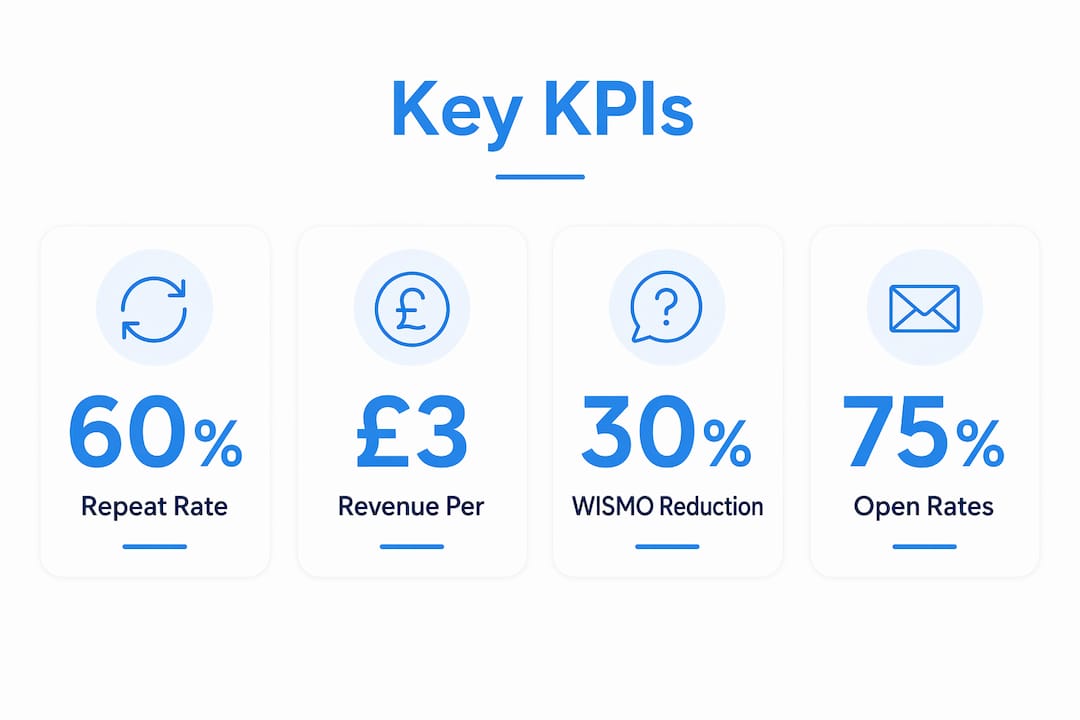
Pick a small set and measure before and after. Post-purchase flows generate revenue per recipient higher than many other automated flows. That single metric, revenue per recipient, tells you whether the sequence is pulling its weight.
| Metric | Why it matters | Benchmark range |
|---|---|---|
| Repeat purchase rate (60 days) is a core retention signal and varies widely for DTC SMEs. | ||
| Revenue per recipient (flow) is an important metric for direct flow performance. | ||
| WISMO ticket volume serves as a support cost proxy. Implementing branded tracking can reduce WISMO enquiries by around 72%. | ||
| Email open rate (post-purchase) indicates engagement health and typically is in a moderate range. | ||
| CSAT / NPS post-delivery measures experience quality, with higher scores indicating stronger retention. |
A simple ROI case: if your post-purchase flow generates £3 per recipient and you send it to 500 customers per month, that is £1,500 in incremental monthly revenue. Reduce WISMO tickets by half and you recover further support hours. Neither figure requires a large team or expensive tooling to achieve.
What mistakes damage trust, and how do you prevent them?
Over-automating judgement calls is the greatest risk. Sending a cheerful review request to a customer whose parcel arrived damaged is not a minor error — it is a brand moment that gets screenshotted.
Red flags to eliminate:
- Review requests sent before confirmed delivery
- Marketing content mixed into transactional emails
- Unchecked exception handling (refund triggers that fire on the wrong conditions)
- Inconsistent tone between automated messages and human replies
- Consent not recorded for any marketing content in post-purchase flows
Governance checklist:
- Assign ownership of the post-purchase journey to one named person
- Maintain a message catalogue with approved copy and tone notes
- Set escalation SLAs (e.g. negative sentiment routed to human within 2 hours)
- Run a QA check on every trigger after any platform update
- Keep rollback procedures documented for each flow
For GDPR and ICO accountability, transactional and marketing automations must be separate. If a post-purchase email includes a discount code or product recommendation, it carries marketing content and requires consent. Log it. Subscription-based SMEs managing churn intervention outreach face the same consent architecture — the retention message and the transactional update are different flows with different legal bases.
Pro Tip: Build a “do not automate” suppression list: customers with open complaints, active refund requests, or negative survey scores. Check against it before every non-transactional message fires.
Key takeaways
Post-purchase automation delivers measurable retention gains when you automate the informational layer, protect human judgement, and anchor every trigger to actual delivery events rather than fixed time delays.
| Point | Details |
|---|---|
| Automate the informational layer | Order, shipping, and delivery messages should fire automatically on real events, not fixed delays. |
| Protect the 72-hour window | Referral and review asks triggered within 72 hours of delivery convert 3–5x better than delayed sends. |
| Separate transactional from marketing | Keep consent-free transactional flows distinct from marketing flows to satisfy ICO requirements. |
| Measure revenue per recipient | £3+ per recipient is the benchmark for a healthy post-purchase flow; track it before and after changes. |
| Cloud9 for implementation | Cloud9 provides CRM integration, webhook orchestration, and managed services to build and run these flows for UK SMEs. |
What Cloud9 clients typically see when this is done right
Cloud9 sees post-purchase automation deliver rapid support cost reductions and measurable second-order increases for UK SMEs when the implementation is grounded in real delivery events and a clear informational/judgement split. The most common starting point is a business sending two post-purchase messages and fielding a high volume of WISMO tickets. Within eight to twelve weeks of a structured build, WISMO volume drops, revenue per recipient becomes visible in the analytics, and the team spends less time on reactive support.
The capability that makes the difference is integration depth: connecting the CRM to the order system and logistics layer so triggers fire on real events, not guesses. Cloud9’s CRM and automation work, combined with managed cloud infrastructure and AI-assisted personalisation, means clients get a joined-up system rather than a patchwork of disconnected tools. For professional firms, the same architecture handles client onboarding and retention flows with the same rigour applied to product businesses.
Cloud9 can build and run this for your business
Fewer WISMO tickets, a measurable lift in second orders, and a post-purchase system that runs without your team babysitting it — that is the practical outcome Cloud9 delivers for UK SMEs and professional firms.
Cloud9 handles the full build: CRM and marketing automation integration, webhook and delivery event orchestration, consent management, and ongoing optimisation. You get one partner instead of three separate agencies arguing over whose platform caused the problem. The starting point is a lightweight technical audit that maps your current post-purchase gaps and scopes a realistic build timeline. Most SME implementations reach a working first version in 6–8 weeks.
Get a scoped plan from Cloud9 and find out what your post-purchase sequence should look like.
Useful sources
Timing and growth strategy:
- Post-Purchase Is the Most Under-Automated Moment in E-Commerce — practitioner analysis of the opportunity gap; best for strategy and prioritisation
- The Complete Guide to Winning at Post-Purchase Growth in 2026 – D2C Times — covers the 72-hour window, referral mechanics, and the five structural components of scalable post-purchase systems
Email sequences and engagement:
- Post-purchase email guide: examples + expert advice – Klaviyo — open rate benchmarks, sequence structure, and expert commentary
- Post-Purchase Email Sequence Guide – ConversionStudio — revenue-per-recipient benchmarks and a practical seven-email sequence framework
- Post-Purchase Engagement: Strategies, Benefits & Metrics – LateShipment.com — platform comparisons and WISMO reduction data
Measurement and analytics:
- Post-Purchase Communications That Drive Loyalty – Shopify — KPI guidance and communication examples
- The Post-Purchase Workflow: Using Analytics to Drive Repeat Revenue – Kissmetrics — holdout testing methodology and repeat-purchase analytics
UK compliance and deliverability:
- Transactional vs marketing emails – Klaviyo Help — definitive guidance on separating flows for consent and deliverability; essential for ICO accountability
FAQ
What is the role of post-purchase automation?
Post-purchase automation handles every informational task after a sale — confirmations, shipping updates, review requests, replenishment prompts — automatically, freeing your team to focus on judgement-heavy exceptions. Its core role is converting a one-time buyer into a repeat customer while reducing support costs.
How long does it take a UK SME to build a post-purchase sequence?
A working first version typically takes 6–8 weeks, covering order confirmation through delivery-triggered review requests. More complex builds with custom webhook integrations can run to 12 weeks.
What is the 72-hour earned-attention window?
The 72 hours after confirmed delivery is the period when customer satisfaction peaks and attention is highest. Review and referral asks sent in this window convert 3–5x better than delayed email asks sent days later.
How do GDPR and ICO rules affect post-purchase emails?
Transactional messages — order confirmations, shipping updates — do not require marketing consent and must be kept in a separate flow. Any post-purchase email containing promotional content, such as a discount code, requires explicit consent and must be logged for ICO accountability.
How do you measure whether a post-purchase flow is working?
Track revenue per recipient at the flow level (benchmark: £3+ per recipient), repeat purchase rate within 60 days, and WISMO ticket volume. A reduction in support tickets combined with a lift in revenue per recipient confirms the flow is delivering.