A lead scoring model assigns each prospect a number that predicts how likely they are to buy, replacing gut instinct with a rule your whole revenue team can act on. The single biggest mistake teams make is blending fit (do they match your ideal customer profile?) and intent (are they behaving like a buyer right now?) into one score. Keep the two axes separate and multiply them together, so a huge intent spike from someone who will never buy can’t outrank a perfectly matched account that’s just started looking.
That’s the theory. Here’s what to do with it this week:
- Pull your last 12 months of closed-won and closed-lost deals and note what those leads looked like when they first entered your pipeline.
- Pick 5 to 7 signals, split roughly evenly between fit and intent, rather than the 20-field monsters most CRMs default to.
- Build a simple points-based rule, write the score straight into your CRM, and set routing thresholds before you touch anything predictive.
Pro Tip: If you can’t explain why a lead scored 85 instead of 60 in one sentence, the model is already too complicated for your sales team to trust.
Key Takeaways
Effective lead scoring models separate fit and intent, weight signals from real closed-deal history rather than guesswork, and stay accurate only through quarterly validation.
| Point | Details |
|---|---|
| Separate fit and intent | Score them independently and multiply, so one strong axis can’t mask a weak one. |
| Start with 5 to 7 signals | A small, validated signal set outperforms a sprawling one nobody can explain. |
| Validate against real deals | Replay closed-won and closed-lost leads through the model before trusting its weights. |
| Automate the writeback | A score reps can’t see in the CRM changes nothing about how they prioritise leads. |
| Review on a fixed cadence | Quarterly re-weighting with monthly spot checks catches drift before it costs pipeline. |
| Get it built and maintained | Cloud 9 runs the full audit, build, automate, review cycle as part of ongoing CRM support. |
Table of Contents
- What are lead scoring models and why does fit vs intent matter?
- How do you build a lead scoring model step by step?
- How do you know if your lead scoring model is working?
- Which tools and integrations make scoring stick?
- Why do lead scoring models fail, and how do you fix them?
- How Cloud 9 approaches lead scoring implementation
- Get lead scoring built into your CRM properly
- Sources
- FAQ
What are lead scoring models and why does fit vs intent matter?
Lead scoring exists to answer one question: out of everyone in the funnel, who should a rep call first? The scoring itself is just a numerical estimate of conversion likelihood attached to each record, but the way you construct that number determines whether reps trust it or ignore it within a month.
Demographic and firmographic scoring
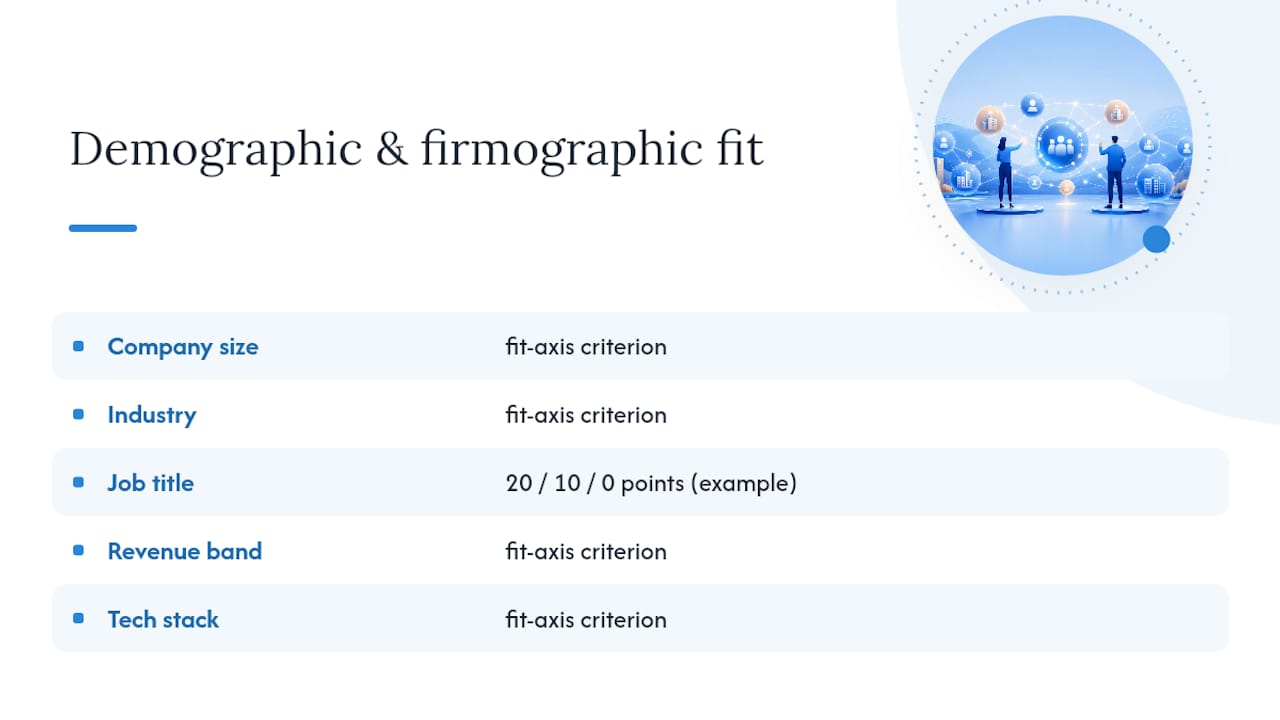
This is the fit axis: company size, industry, job title, revenue band, tech stack. It answers “could this person ever buy from us?” not “are they about to.” A B2B software vendor selling to mid-market finance teams might award 20 points for a CFO or finance director title, 10 for a manager, and zero for anyone outside finance entirely. Firmographic scoring alone is often enough for low-volume, high-touch sales motions where a rep can eyeball the rest.
Behavioural scoring
This is intent: pricing page visits, demo requests, webinar attendance, email click-through, repeat site visits within a short window. A pricing page visit inside 48 hours of a demo request is worth far more than the same visit six months earlier. A workable starting ruleset might look like:
- Demo request: +30 points
- Pricing page visited twice in one week: +15 points
- Attended a live webinar: +10 points
- Opened three consecutive emails without clicking: +2 points
- No site activity in 60 days: score decays by 20%
Predictive scoring
Predictive models use historical conversion data to weight signals automatically rather than having a marketer guess. They tend to show higher precision at the top decile than flat manual systems, and relational approaches can surface signals a spreadsheet never would, such as a colleague at the same company having converted previously, or a specific content sequence that correlates with closed deals. The trade off is explainability. When a rep asks why a lead scored 92, “the model said so” is a much harder sell than a transparent points breakdown, which is exactly why most teams start with rules and layer prediction in later.

Negative scoring and decay
Positive-only models drift towards rewarding noise. Deduct points for signals that indicate a poor match: competitor domain emails, unsubscribes, or job titles with no buying authority, such as an intern or a student researching the market. Build in decay too. A lead who scored 80 points three months ago and has gone quiet since should not still be sitting in a hot queue.

How do you build a lead scoring model step by step?
Most failed scoring projects fail at step one: nobody agreed what “conversion” actually means before the spreadsheet got built.
-
Define the conversion event that matters to revenue. For most B2B teams that’s closed-won, not “marketing qualified.” A booked demo can work as an interim event if your sales cycle is long, but tie it back to revenue eventually or you’ll optimise for the wrong outcome.
-
Select 5 to 7 core signals, split across fit and intent. Monday puts it plainly: a small set of well-chosen criteria explains the majority of conversions, and every extra field you add past that point is diminishing returns dressed up as diligence.
-
Derive weights from historical conversion rates, not opinion. Pull the deals that closed and see which signals actually appeared before they closed. If your top 20% of closed-won deals all requested a demo within their first week, that behaviour deserves real weight. If half your closed-lost deals also requested demos, that signal is weaker than everyone assumed.
-
Set thresholds and routing. A common structure: 0 to 40 stays in nurture, 41 to 70 becomes a Marketing Qualified Lead routed to a sequence, 71 and above becomes a Sales Qualified Lead that triggers an immediate rep alert. Write down exactly what a rep should do at each band, not just what the label means.
-
Automate the writeback. The score has to land inside the CRM field reps actually look at, with a trigger that fires the moment a lead crosses a threshold. A model living in a separate dashboard nobody opens changes nothing.
Pro Tip: Build your first threshold structure around three bands, not seven. Reps can act on “hot, warm, cold” instantly; they’ll ignore a scale with nine tiers because it takes longer to interpret than it does to just call the lead.
How do you know if your lead scoring model is working?
Run closed-won and closed-lost deals back through the scoring logic exactly as those leads would have scored on the day they entered your pipeline, not with the benefit of hindsight. If your highest scoring band doesn’t show a meaningfully higher conversion rate than your lowest, the weights are wrong, full stop.
Three metrics matter more than any others:
| Metric | What it tells you |
|---|---|
| Conversion rate by score band | Whether higher scores genuinely predict more closed deals |
| Precision at top decile | How many of your highest-scored leads actually convert |
| MQL to closed-won rate | Whether marketing’s definition of “qualified” holds up in sales |
If conversion rate by band comes back flat or inverted, that’s your signal to retune, not to add more fields. Common culprits are a signal that seemed intuitive but never appeared in the historical data, or a fit criterion that was set too broad to filter anything out.
Run the full replay audit quarterly. Buyer behaviour shifts, new product lines change what “fit” looks like, and a model tuned on last year’s deals quietly goes stale. Between full audits, do a monthly spot check: pull the last 20 deals and eyeball whether the score distribution still looks sane. Waiting a full quarter to catch a broken model wastes three months of misrouted leads.
Which tools and integrations make scoring stick?
Score writeback into the CRM is the single decision that determines whether reps use the model at all. Adoption depends on visibility: a score sitting in a BI dashboard nobody checks between meetings is functionally invisible to the people meant to act on it.
- Start rules based. A transparent points system is cheap to build, easy to explain, and good enough for the majority of teams before volume justifies anything heavier.
- Add predictive or relational machine learning once you have enough closed deal history and enough volume that a percentage point of precision translates into real revenue. Kumo.ai’s breakdown of scoring approaches frames this as a hybrid: deterministic rules cover the standard 80% of cases, with a predictive layer reserved for genuine edge cases.
- Behavioural tracking needs to feed the CRM cleanly. If your website analytics and CRM aren’t talking to each other, no scoring formula will fix that gap. Connecting CRM to your website properly is the groundwork most scoring projects skip.
- Data enrichment tools fill firmographic gaps automatically rather than relying on form fields prospects half-complete.
- Keep a human review step on anything AI-driven. Predictive scores should flag edge cases for a person to check, not make silent routing decisions nobody can trace back.
A data-driven approach to intent signals can also help connect scattered behavioural data into something closer to a predictable pipeline, particularly for teams still working out where their strongest intent signals actually live.
Why do lead scoring models fail, and how do you fix them?
Three patterns show up again and again in teams whose scoring stopped working: weights guessed rather than derived from real deals, no validation cadence so drift goes unnoticed for months, and models that reward vanity activity like email opens as if they meant the same as a demo request.
- Guessed weights. Fix it by rerunning the replay audit and letting historical conversion rates set the numbers, not a meeting room debate.
- No validation cadence. Fix it with a quarterly full audit and a monthly spot check, both owned by one named person.
- Vanity signals inflating scores. Fix it by adding negative scoring and decay, and by auditing which behaviours actually preceded closed-won deals versus closed-lost ones.
Pro Tip: If you only fix one thing this quarter, fix the validation cadence. A model with slightly wrong weights that gets checked quarterly will always outperform a theoretically perfect model nobody ever revisits.
How Cloud 9 approaches lead scoring implementation
Cloud 9 builds scoring models the same way this guide describes: audit historical deals first, build a simple ruleset, automate the writeback, then review it on a fixed schedule. A typical SME engagement starts with a 6-signal template, three fit criteria and three intent criteria, routed into three bands with clear rep actions at each.
- Audit: replay 12 months of closed deals against a draft ruleset before anything goes live.
- Build: configure scoring fields and routing rules directly inside the client’s CRM.
- Automate: score writeback and trigger-based alerts, so reps see changes the moment they happen.
- Review: quarterly re-weighting built into the ongoing support retainer, not left as a one-off project.
The models that survive past month three are the boring ones: five or six signals, clear thresholds, and someone whose job it is to check the numbers every quarter.
What actually matters when you build one
Fancy models lose to well-integrated ones almost every time. If reps don’t see the score where they already work, and nobody owns the quarterly review, even a statistically sound model dies quietly. Put one person in charge of it, review it on a fixed schedule, and keep routing rules simple enough to state in a sentence.
— Rob
Get lead scoring built into your CRM properly
Building the scoring logic is half the job. The harder half is getting it to live inside a CRM your sales team actually opens, with routing rules that fire automatically instead of relying on someone remembering to check a spreadsheet. That’s the gap Cloud 9 closes for established businesses that don’t have a dedicated revenue operations team to babysit the model quarter after quarter.

Cloud 9’s approach follows the same audit, build, automate, review cycle covered throughout this guide, delivered as part of an ongoing CRM and marketing automation engagement rather than a one-off spreadsheet handed over and forgotten. That includes the historical deal replay, the initial 5 to 7 signal ruleset, score writeback into whichever CRM you already run, and the quarterly re-weighting that keeps the model honest as buyer behaviour shifts. If your marketing and digital marketing efforts are already generating leads but nobody trusts the scores attached to them, get in touch about a scoring audit and see exactly where the current model is losing accuracy.
Sources
- The Complete Guide to Lead Scoring (2026) | Clay
- Kumo
- How to Build a Lead Scoring Model That Actually Predicts Conversions | Pecan AI
- Monday
FAQ
Can you give me an example of lead scoring?
A common example: +30 points for a demo request, +15 for two pricing page visits in a week, +20 for a matching job title, minus 15 for a competitor email domain. Leads scoring above 70 route straight to a rep.
How is a lead score calculated?
Scores are typically calculated by adding points for fit signals (industry, title, company size) and intent signals (page visits, demo requests, email engagement), often weighted by how strongly each signal correlated with past closed-won deals.
What are the best lead scoring tools?
The right tool depends on your CRM and data maturity: most teams start with rules-based scoring built directly into their existing CRM, then add predictive scoring once they have enough historical conversion data to train it reliably. Cloud 9 builds these directly into a client’s existing CRM through its CRM and marketing automation service rather than bolting on a separate platform.
What are scoring models?
A scoring model is a defined set of rules or a trained algorithm that assigns numerical values to leads based on how closely their attributes and behaviour match your historical customers who actually converted.