For UK association planners, the shortlist comes down to six platforms, each with a clear lane. Cvent is the enterprise choice for large congresses and multi-event programmes where sponsor management and continuing education tracking are non-negotiable. Eventbrite handles quick public ticketing for smaller association events with minimal setup. Whova wins on attendee networking and matchmaking for mid-size conferences. Bizzabo suits data-driven associations that need deep CRM integration and event analytics. vFairs is the strongest pick for immersive virtual and hybrid trade fairs. Webex Events (Cisco) covers hybrid webinars and sessions where the audience is already inside a Microsoft or Cisco ecosystem.
The fastest way to shortlist is to pick your two hardest requirements — matchmaking, continuing education credits, sponsor portals, multilingual registration, or virtual exhibition halls — and eliminate any platform that cannot demonstrate those in a live demo. Book vendor calls with two finalists, bring your IT lead and your membership manager, and ask for a reference from an association of similar size.
Table of Contents
- How these platforms compare at a glance
- Profiles of the six leading platforms for associations
- How to choose the right platform for your association
- What to expect from rollout timelines and costs
- UK GDPR and data handling: what to check before you sign
- How these platforms were selected and weighted
- Key takeaways
- Why integration is the part associations consistently underestimate
- Cloud 9 can help your association connect the pieces
- Useful sources
- FAQ
How these platforms compare at a glance
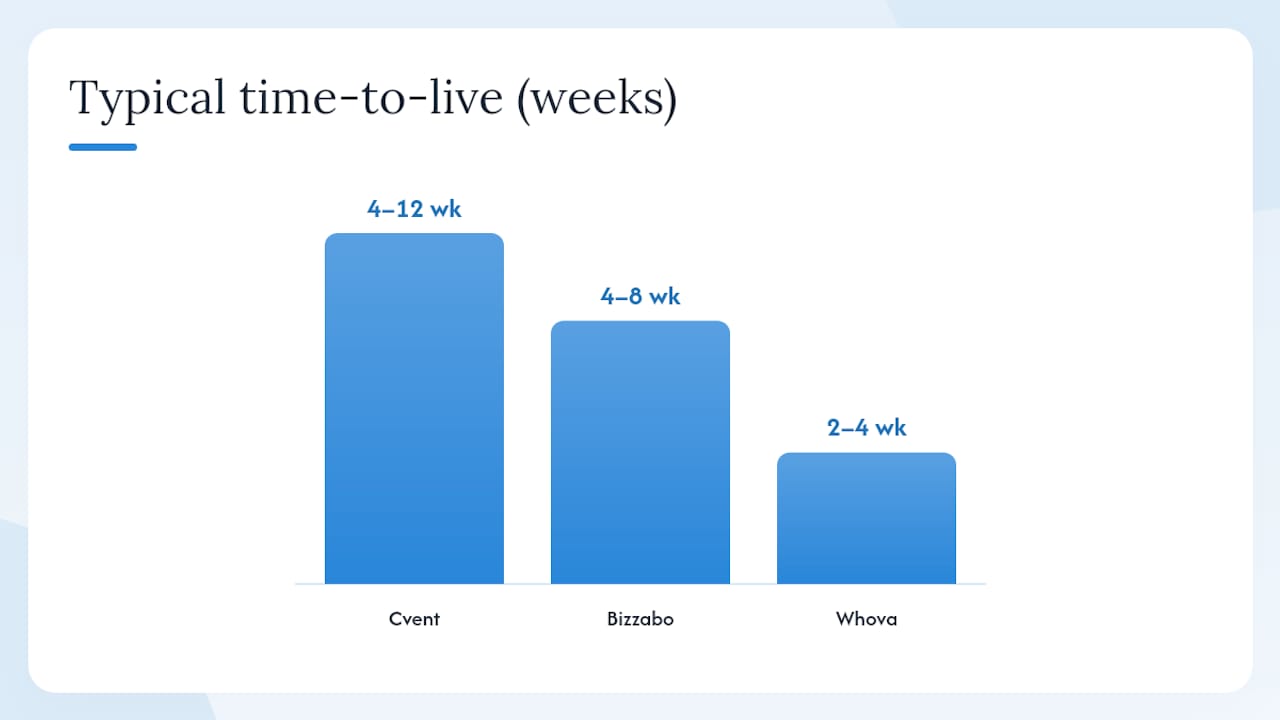
The table below covers the dimensions that matter most to associations: use case fit, core features, how quickly you can go live, integrations, support model, and pricing shape. G2’s evaluation of the six best event management platforms provides the reviewer-satisfaction signals used as trust anchors here.
| Platform | Best for | Core features | Ease of use / time-to-live | Key integrations | Support model | Pricing shape / UK notes |
|---|---|---|---|---|---|---|
| Cvent | Enterprise congresses, multi-event programmes | Registration, agenda, sponsor/exhibitor portal, CE tracking, virtual | Moderate; 4–12 weeks with dedicated PM | Salesforce, Marketo, HubSpot, SSO | Dedicated account manager + PM | Annual licence; custom quote; UK VAT applicable |
| Eventbrite | Quick public ticketing, smaller association events | Ticketing, basic registration, event discovery | Fast; live in days | Mailchimp, Zapier, basic CRM | Self-serve; email support | Per-ticket fee (% + fixed); UK payment processing; VAT on fees |
| Whova | Networking-first mid-size conferences | Matchmaking, agenda, community board, exhibitor listings | Low to moderate; 2–4 weeks | Salesforce, Zoom, Stripe | Self-serve + onboarding calls | Annual licence; custom quote |
| Bizzabo | Data-driven associations, hybrid events | Registration, agenda, analytics, sponsor hub, virtual | Moderate; 4–8 weeks | Salesforce, HubSpot, Marketo, Zapier | Dedicated CSM | Annual licence; custom quote; UK support available |
| vFairs | Virtual and hybrid trade fairs, exhibitions | 3D virtual halls, exhibitor booths, webinars, networking | Moderate; 4–8 weeks with PM | Salesforce, HubSpot, Zoom | Dedicated PM per event | Per-event or annual; custom quote |
| Webex Events | Hybrid webinars, sessions-heavy conferences | Live sessions, Q&A, polling (Slido built-in), registration | Low to moderate; integrates with Cisco/MS stack | Microsoft 365, Salesforce, Webex Suite | Enterprise support tiers | Seat-based or event-based; UK billing available |
Pro Tip: Of all the dimensions above, sponsor portal maturity tends to predict association event ROI more reliably than the headline registration feature set. A platform with a self-service sponsor dashboard, measurable lead-capture tools, and post-event reporting reduces manual fulfilment work and gives sponsors a reason to renew. Ask vendors to demo the sponsor portal specifically, not just the attendee registration flow.
Profiles of the six leading platforms for associations
Cvent
Best for: Large associations running multi-event annual programmes, congresses with CE credit requirements, and events with complex sponsor and exhibitor tiers.
Cvent’s association solution is purpose-built for membership organisations. It handles membership authentication at registration (so member pricing applies automatically), multi-track agendas, sponsor and exhibitor portals with lead retrieval, and continuing education tracking with certificate generation. The reporting suite covers board-level dashboards and finance reconciliation, which matters when you are accountable to a committee.
- Membership authentication and tiered pricing rules
- Sponsor and exhibitor portal with lead capture and post-event analytics
- Continuing education and CME credit tracking
- Multi-event account structure for annual programme management
- Virtual and hybrid event capability within the same platform
Time-to-live is typically several weeks, depending on integration complexity. Cvent connects natively with Salesforce, Marketo, and HubSpot, and supports SSO for member login. Pricing is annual licence, custom-quoted; UK VAT applies to the subscription. G2 reviewers consistently rate Cvent highly for feature depth, though some note the configuration learning curve.
Pros: Unmatched feature depth for associations; strong CE tracking; enterprise integrations.
Cons: High cost; significant onboarding effort; overkill for associations running fewer than three events per year.
Eventbrite
Best for: Associations needing fast, low-cost public ticketing for seminars, networking evenings, or regional branch events.
Eventbrite is the fastest platform to go live on. You can publish a ticketed event in under an hour, accept card payments in GBP, and benefit from Eventbrite’s own discovery network, which can surface your event to non-members. It is not built for complex association workflows — there is no sponsor portal, no CE tracking, and member-tier pricing requires workarounds — but for straightforward ticketed events it is hard to beat on speed and cost.
- Public event discovery and promotion
- GBP payment processing; UK VAT handled on Eventbrite’s fees
- Basic registration forms and attendee management
- Integrations with Mailchimp and Zapier for post-event follow-up
Pricing is per-ticket: a percentage fee plus a fixed amount per ticket, charged to the attendee or absorbed by the organiser. No annual commitment required. G2 reviewers flag the limited customisation as a constraint for associations with complex pricing rules.
Pros: Instant setup; no annual contract; strong public reach.
Cons: No sponsor management; no CE tracking; limited member-tier logic.
Whova
Best for: Mid-size association conferences where attendee networking and matchmaking are the primary value proposition.
Whova’s community board and AI-powered matchmaking are genuinely differentiated. Attendees can set meeting requests, join interest-based groups, and browse a shared community feed before the event even opens. For associations where peer connection is the membership benefit, that pre-event engagement is worth more than a polished registration page.
- AI-powered attendee matchmaking and meeting scheduler
- Community board and interest groups
- Agenda builder with session check-in
- Exhibitor listings and lead capture
- Mobile app included
Time-to-live is typically a few weeks. Whova integrates with Salesforce, Zoom, and Stripe. Pricing is annual licence, custom-quoted. G2 reviewers rate Whova highly for ease of use and attendee satisfaction scores.
Pros: Strong networking tools; good mobile experience; relatively quick to configure.
Cons: Sponsor portal is lighter than Cvent or Bizzabo; less suited to large virtual exhibitions.
Bizzabo
Best for: Associations that treat event data as a strategic asset and need tight CRM integration to map attendance to membership renewal and sponsor ROI.
Bizzabo on Capterra shows strong reviewer scores for its analytics and integration capabilities. The platform’s event intelligence layer pulls registration, session attendance, and engagement data into dashboards that can feed directly into Salesforce or HubSpot, making it straightforward to connect event participation to renewal likelihood or sponsor lead quality.
- Registration and agenda management
- Sponsor hub with measurable engagement metrics
- Event intelligence and analytics dashboards
- Virtual and hybrid session delivery
- Native integrations with Salesforce, HubSpot, Marketo, and Zapier
Time-to-live is typically several weeks with a dedicated Customer Success Manager. UK support is available. Pricing is annual licence, custom-quoted.
Pros: Best-in-class analytics; strong CRM integration; good hybrid capability.
Cons: Premium pricing; some reviewers note the UI has a steeper learning curve than Whova.
vFairs
Best for: Associations running virtual trade fairs, annual exhibitions, or hybrid events where the exhibitor experience is central.
vFairs builds immersive virtual environments: 3D exhibition halls, branded exhibitor booths, live webinar stages, and networking lounges. For associations whose annual conference doubles as a trade show, the exhibitor booth experience is far more engaging than a simple sponsor logo placement. A dedicated project manager is assigned per event, which reduces internal resource pressure significantly.
- 3D virtual exhibition halls and branded booths
- Webinar and live session delivery
- Networking lounges and one-to-one video meetings
- Exhibitor lead capture and analytics
- Hybrid event support
Time-to-live is typically several weeks. vFairs integrates with Salesforce, HubSpot, and Zoom. Pricing is per-event or annual, custom-quoted. G2 reviewers highlight the exhibitor experience and dedicated PM model as standout strengths.
Pros: Best virtual exhibition environment; strong exhibitor tools; dedicated PM reduces internal load.
Cons: Higher cost per event; less suited to simple registration-only events.
Webex Events (Cisco)
Best for: Associations already using Microsoft 365 or the Cisco/Webex ecosystem for internal operations, running hybrid sessions-heavy conferences or webinar series.
Webex Events integrates Slido’s live polling, Q&A, and word cloud tools natively, which removes the need for a separate engagement layer. If your association already pays for Webex or Microsoft 365, the licensing overlap can reduce total cost. The platform handles registration, session management, and attendee engagement in one place, though its exhibitor and sponsor tools are lighter than Cvent or vFairs.
- Live sessions with Slido polling and Q&A built in
- Registration and agenda management
- Hybrid event delivery
- Integration with Microsoft 365, Salesforce, and the Webex Suite
- UK billing available
Time-to-live is low to moderate, particularly for organisations already on the Cisco stack. Support tiers range from self-serve to enterprise. Pricing is seat-based or event-based, custom-quoted.
Pros: Strong session engagement tools; natural fit for Cisco/Microsoft shops; Slido integration adds real value.
Cons: Lighter sponsor and exhibitor tools; less suited to trade-show-style events.
How to choose the right platform for your association
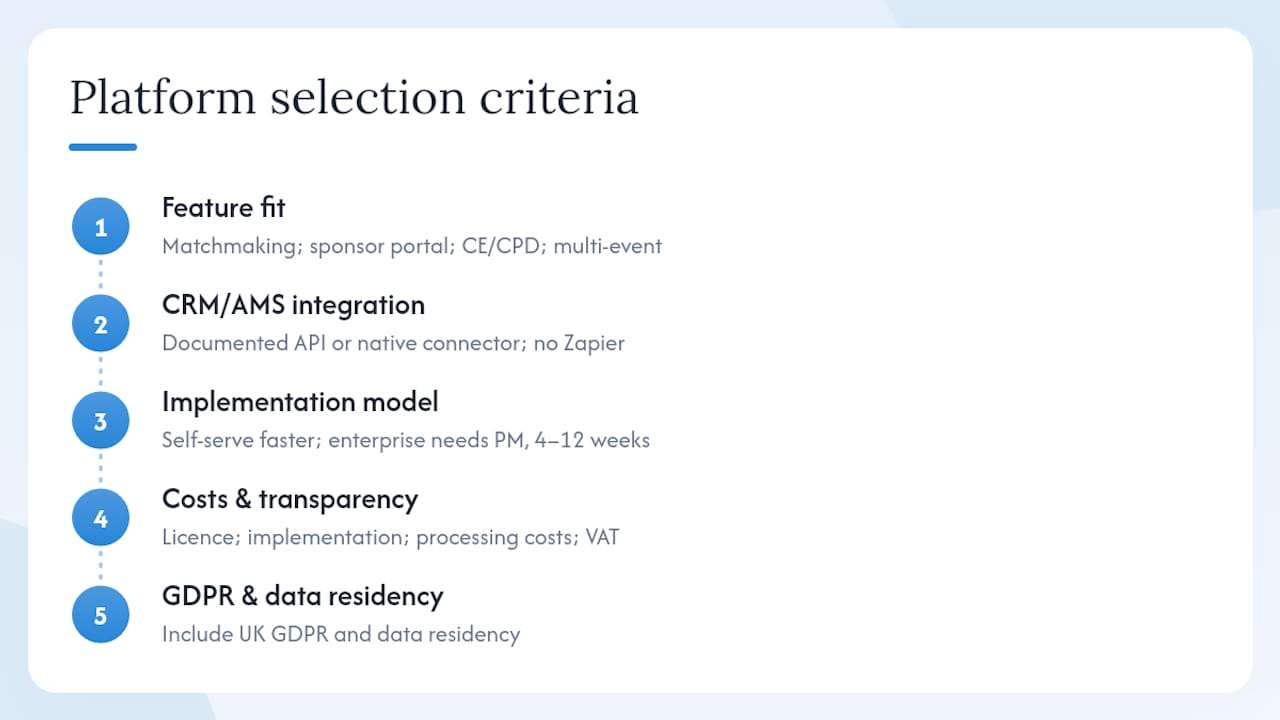
Selection criteria for associations differ from those for corporate event teams. The dimensions below are ordered by the weight they carry in practice.
1. Feature fit for your specific event type. Registration and ticketing are table stakes. The differentiators are matchmaking quality, sponsor portal depth, CE/CPD credit tracking, multilingual registration, and multi-event account structure. Platforms like Eventtia support unlimited events per licence and directional matchmaking rules, which matters for federations running national congresses across multiple chapters.
2. Integration with your association management system (AMS) or CRM. If your member records live in Salesforce, Microsoft Dynamics, or a specialist AMS, the event platform must sync attendance data back without a manual export. Integrating your CRM with your web platforms is where most associations lose time post-event. Ask vendors for a documented API or native connector, not a Zapier workaround.
3. Implementation model and internal resource. Self-serve platforms (Eventbrite, Whova) go live faster but require your team to configure and troubleshoot. Enterprise platforms (Cvent, vFairs) assign a project manager but need 4–12 weeks and internal stakeholder time for discovery and testing. Be honest about your team’s capacity.
4. Pricing transparency and total cost of ownership. Most enterprise platforms do not publish pricing. Budget for the licence, implementation fees, payment processing costs, and any UK VAT on the subscription. Ask for a multi-year discount and a pilot-event clause.
5. UK GDPR and data residency. Covered in detail below, but it belongs in your scoring matrix from day one.
Vendor questions to ask before signing
Additional questions worth putting in writing:
- Do you offer UK-based support hours, and what are your SLA response times?
- Can we export all event and attendee data in a portable format at contract end?
- How does your pricing model work for multi-event licences, and is there a cap on events or registrations?
- Do you handle UK VAT on ticket sales, or does that sit with us?
- What is the API/webhook availability for connecting to our AMS?
A simple scoring matrix
| Criterion | Weight | Score (1–5) | Weighted score |
|---|---|---|---|
| Feature fit for association event type | 35% | ||
| Implementation & support model | 25% | ||
| Integration with AMS/CRM | 15% | ||
| Pricing transparency & TCO | 15% | ||
| Third-party ratings (G2/Capterra) | 10% |
Score each shortlisted platform, multiply by the weight, and sum. The weights above reflect what associations consistently report as their highest-friction points: feature gaps and implementation surprises account for the majority of failed deployments.
What to expect from rollout timelines and costs
Implementation timelines split cleanly by platform type.
- Mid-market platforms (Bizzabo, Webex Events): — Typically 4–8 weeks from contract to go-live. Expect a kick-off call, a configuration phase, a test event, and a training session. Budget 30–60 internal hours across your events, IT, and membership teams.
| Phase | Self-serve | Mid-market | Enterprise |
|---|---|---|---|
| Discovery & scoping | 1–3 days | 1–2 weeks | 2–3 weeks |
| Configuration & build | 3–7 days | 2–4 weeks | 4–6 weeks |
| Test event | 1 day | 3–5 days | 1–2 weeks |
| Training | Self-directed | 1–2 sessions | 2–4 sessions |
| Go-live | Days 5–10 | Week 4–8 | Week 8–12 |
Common pricing models: Per-ticket percentage (Eventbrite), annual licence for unlimited events (Whova, Cvent, Bizzabo), per-event fee (vFairs), or seat-based (Webex Events). UK VAT at the standard rate applies to most SaaS subscriptions billed to UK organisations; confirm with the vendor whether they issue a VAT invoice and whether ticket-sale VAT is handled by the platform or by you as the organiser.
Budget tip: Ask for a pilot-event clause in the contract. Many enterprise vendors will agree to a single-event pilot at a reduced fee before you commit to an annual licence. This is the single most effective way to validate integration complexity and internal resource requirements before signing a multi-year deal.
UK GDPR and data handling: what to check before you sign
Association events collect personal data from members, non-members, sponsors, and speakers. Under the UK GDPR, you are the data controller; the event platform is a data processor. That distinction carries legal weight.
Immediate checks to request from any vendor:
- Data residency: Where is attendee data stored? UK or EEA data centres are preferable; transfers to the US or elsewhere require Standard Contractual Clauses (SCCs) or an equivalent transfer mechanism under the UK International Data Transfer Agreement (IDTA).
- Data Processing Agreement (DPA): Request this before signing. A reputable vendor will have a standard DPA ready; if they hesitate, that is a procurement red flag.
- Sub-processor list: You are entitled to know which third parties process your attendees’ data (payment processors, email delivery services, analytics tools).
- Data export and deletion: Confirm you can export all attendee data in a portable format and that the vendor will delete it on request at contract end.
Operational checks:
- Consent capture at registration: does the platform support granular consent options (marketing, session recording, data sharing with sponsors)?
- Retention policies: can you configure automatic deletion of attendee records after a defined period?
- Continuing education credits: if you issue CPD or CME certificates, confirm how long the platform retains those records and whether you can export them.
Pro Tip: During procurement, ask the vendor for their most recent penetration test summary or ISO 27001 certificate. Vendors who cannot produce either within 48 hours of the request are unlikely to meet the security standards your association’s data governance policy requires.
The Information Commissioner’s Office (ICO) publishes guidance on data processors and controllers that is worth sharing with your legal or compliance team before finalising any DPA.
How these platforms were selected and weighted
The shortlist above is built on seven evaluation signals, applied consistently across all six platforms.
- Third-party ratings — (10%): G2 and Capterra reviewer scores, weighted by review volume and recency.
Feature fit carries the highest weight because associations consistently report that the wrong feature set — not price or ease of use — is the primary cause of platform regret. Implementation and support comes second because the gap between a platform’s capability and an association’s ability to configure it is where most projects stall.
Limitations: Pricing data for enterprise platforms is not publicly listed, so cost comparisons are directional. Platform features change with product releases; always validate the feature list in a live demo. The Swoogo Capterra listing is included as a mid-market reference point for associations evaluating flexible registration workflows outside the primary six.
Recommended next step: Shortlist two platforms, run a pilot event on each, and conduct a structured reference check with at least one association of similar membership size.
Key takeaways
The strongest event management platforms for associations are those that match your specific event type, integrate with your existing member data systems, and come with an implementation model your team can realistically manage.
| Point | Details |
|---|---|
| Match platform to event type | Enterprise congresses need Cvent; networking-first conferences suit Whova; virtual fairs belong on vFairs. |
| Sponsor portal maturity drives ROI | Platforms with self-service sponsor dashboards reduce manual fulfilment and improve sponsor retention. |
| Request a DPA before signing | Always obtain a Data Processing Agreement and sub-processor list; this is a UK GDPR legal requirement. |
| Pilot before committing | Ask for a single-event pilot clause in any enterprise contract to validate integration complexity first. |
| Cloud 9 for integration support | Cloud 9 connects event platforms to your CRM, website, and finance systems, reducing post-event data gaps. |
Why integration is the part associations consistently underestimate
The platform decision gets most of the attention. The integration work gets most of the pain.
Every association I have seen evaluate event software spends weeks comparing registration flows and mobile app ratings, then discovers six months later that attendance data never made it back into the membership database. Renewal reminders go out to people who attended three events that year. Sponsors ask for lead data that was never captured in a usable format. The platform worked fine; the connections around it did not.
The most operationally mature associations treat their event platform as one node in a wider system: attendance feeds into the AMS, which triggers renewal workflows; sponsor engagement scores feed into the account management CRM; post-event surveys trigger automated email follow-up sequences segmented by session attendance. That is not a fantasy — it is what the right integration architecture makes possible. The difference between an association that retains 80% of its sponsors year-on-year and one that renegotiates from scratch every cycle is usually not the event itself. It is whether the data from that event is usable the week after it ends.
Cloud 9 can help your association connect the pieces
Choosing the right event platform is only half the job. The harder work is connecting it to your CRM, your website, and your finance systems so that the data your events generate actually drives membership and sponsorship outcomes.

Cloud 9 works with UK membership organisations and professional associations to integrate event platforms with CRM and marketing automation systems, build or rebuild association websites that work alongside those platforms, and manage the cloud infrastructure that keeps everything running reliably. If your association is evaluating Cvent, Bizzabo, or any of the platforms above, Cloud 9 can run a 20-minute configuration audit to map your current systems, identify the integration gaps, and give you a clear picture of what implementation will actually involve before you sign anything.
Get in touch with Cloud 9 to book your configuration audit or request an exploratory call.
Useful sources
- My Evaluation of the 6 Best Event Management Platforms for 2026 | G2 Learn
- Association Event Management Software | Cvent
- Event Management Software for Associations | Eventtia
- Event management software for Associations | idloom
- Bizzabo on Capterra
- Swoogo on Capterra
- Slido on Capterra
- Cloud 9 Creative
Always request a DPA, sub-processor list, and at least one association-sector case study from any vendor before signing. Reference checks with organisations of comparable size are worth the two weeks they take.
FAQ
What are the best event management tools for associations?
Cvent, Whova, Bizzabo, vFairs, and Webex Events are the strongest options for associations in the UK, each suited to a different event type and scale. Eventbrite works well for straightforward public ticketing but lacks the sponsor and member-tier features most associations need.
What is the best association management software?
The answer depends on whether you mean event management or full AMS functionality. For events specifically, Cvent is the most feature-complete platform for large associations; for smaller organisations, Whova or Bizzabo offer a better balance of capability and cost.
How do I choose event management software for my association?
Score shortlisted platforms against five criteria: feature fit for your event type, integration with your AMS or CRM, implementation model, pricing transparency, and third-party ratings. Prioritise feature fit and implementation support, as these are the most common sources of platform regret.
What are the 5 P’s of event management?
The five P’s commonly referenced in event planning are Purpose, People, Place, Process, and Promotion. They provide a framework for scoping an event before selecting the technology to support it.
Do event management platforms handle UK VAT on ticket sales?
It varies by platform. Eventbrite handles VAT on its own fees, but VAT on ticket sales is typically the organiser’s responsibility. Enterprise platforms such as Cvent issue VAT invoices for their subscriptions; confirm the VAT treatment of both the licence and ticket revenue with your vendor and your finance team before going live.