

Digital integration is defined as the strategic connection of disparate digital systems, applications, and data repositories into a unified technological environment. This foundation makes AI, cloud computing, and real-time analytics work together rather than in isolation. Without it, your business operates through disconnected tools that duplicate effort, fragment data, and slow decisions. Cloud9 works with established UK businesses to replace that fragmentation with connected, coherent digital operations. Understanding digital integration is the first step towards building an organisation that responds faster, wastes less, and grows with confidence.
What is digital integration and how does it work?
Digital integration is the process of linking separate software systems, databases, and applications so they share data and trigger actions across one another automatically. The industry term for this discipline is “systems integration,” though digital integration has become the standard phrase in business strategy contexts. Both terms describe the same goal: making your technology work as a single, coordinated system rather than a collection of independent tools.
The process works through three core mechanisms. First, APIs connect applications by exposing specific functions that other systems can call in real time. Second, middleware acts as a translation layer, converting data formats between systems that would otherwise be incompatible. Third, cloud platforms provide the shared infrastructure that makes these connections persistent, reliable, and accessible across locations and devices.

A practical example: a professional services firm connects its CRM, project management tool, and finance system. When a deal closes in the CRM, the project system creates a new job automatically, and the finance system raises a deposit invoice without anyone typing a single field. That is digital integration working as intended.
The two main types of integration
Data integration focuses on consolidating information from multiple sources into a single source of truth. It cleans, standardises, and deduplicates records so every team works from the same accurate picture. Application integration focuses on connecting the workflows between systems, so actions in one platform trigger responses in another. Most organisations need both, and the distinction matters when you are planning where to start.
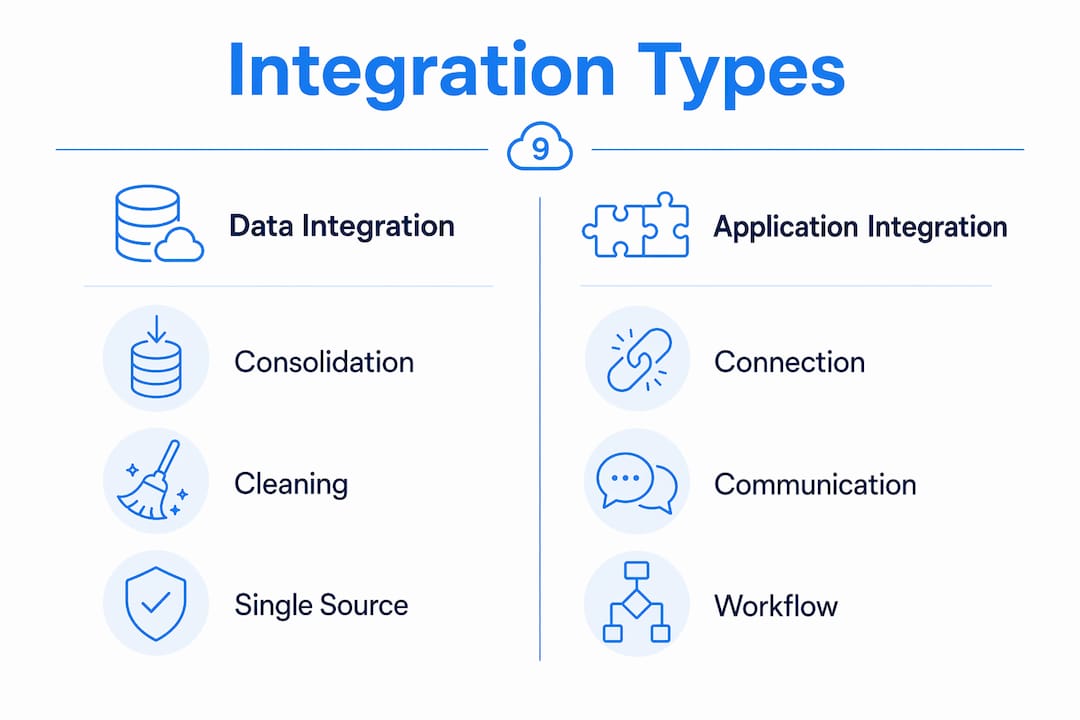
| Integration type | Primary focus | Typical tools |
|---|---|---|
| Data integration | Consolidating and cleaning data across sources | Data warehouses, ETL pipelines |
| Application integration | Connecting workflows between live systems | APIs, middleware, connector libraries |
| Cloud integration | Linking cloud and on-premise environments | Cloud platforms, managed services |
How does digital integration improve operational efficiency?
Digital integration increases data consistency and quality by eliminating the duplicates and errors that accumulate when teams re-enter information manually across separate systems. That improvement alone reduces wasted time and the cost of fixing mistakes downstream. The operational benefits compound quickly once integration is in place.
The four most significant efficiency gains are:
- Automated data sharing. Information flows between systems without manual intervention, freeing staff from repetitive data entry and reducing human error at the point of transfer.
- A single source of truth. Every team accesses the same up-to-date records, which removes the version-control arguments that slow decisions in fragmented environments.
- Faster reporting. Integrated systems feed dashboards and reports automatically, cutting the time between an event occurring and a leader seeing it in a report from days to minutes.
- Stronger cross-team collaboration. When sales, operations, and finance all read from the same data, handoffs between departments become cleaner and disputes about figures disappear.
The decision-making benefit is particularly significant. A business that waits two days for a consolidated report makes slower strategic choices than one that sees live data at 9 AM every morning. Integration does not just save time. It changes the quality of the decisions you make.
Pro Tip: Before selecting any integration platform, map every system your business currently uses and identify the three data flows that cause the most manual effort or errors. Fix those first. Early wins build internal confidence and reveal the integration architecture you actually need.
Why is external integration with partners and customers critical in 2026?
Most businesses start digital integration by connecting their internal systems. That is the right first step, but stopping there is a strategic mistake. Modern digital integration extends beyond internal systems to include real-time connections with external customers, suppliers, and partners. Firms that ignore this dimension lose competitive ground in their value chains.
The shift matters because value is increasingly created at the boundaries between organisations, not just within them. When your system can read a supplier’s stock levels in real time, you stop ordering blind. When a customer’s platform connects directly to your fulfilment system, you remove the email chains and phone calls that slow delivery and erode trust.
APIs are the primary mechanism for this external connectivity. APIs reduce collaboration costs by enabling organisations to distribute complex workflows across entities in real time, without the overhead of manual coordination. The cost reduction is not just financial. It is also measured in speed, accuracy, and the capacity to scale relationships without adding headcount.
Digital integration is not just an IT initiative. It is a strategic enabler that transforms value chains by linking workflows with external partners in real time. Businesses that treat it as infrastructure rather than strategy will always be playing catch-up with those that do not.
The practical implication for business leaders is clear. When evaluating an integration investment, ask not only “which internal systems does this connect?” but also “which customer and supplier relationships does this make faster and cheaper to manage?”
What are the common challenges and best practices for digital integration?
The most common failure in digital integration is focusing solely on internal systems while neglecting the external APIs and partner connections that deliver the greatest competitive value. That narrow focus produces a technically functional but strategically limited result. Other frequent pitfalls include poor data quality at the point of integration, insufficient API governance, and attempting to connect everything at once rather than phasing the work.
Best practices that consistently produce better outcomes:
- Define the strategy before selecting tools. Identify the business outcomes you need, then choose the integration approach that supports them. Technology decisions made in reverse order create expensive rework.
- Phase the implementation. Start with the highest-impact connections, prove value, then expand. A phased approach reduces risk and builds the internal capability to manage complexity over time.
- Invest in API governance. Robust API management requires clear policies covering versioning, access control, and monitoring. Without governance, APIs become a security liability and a maintenance burden.
- Prioritise data quality. Integration amplifies whatever data quality exists in your source systems. Clean data before connecting systems, not after.
- Engage stakeholders early. Integration projects that involve finance, operations, and IT from the outset encounter fewer objections at deployment and achieve adoption faster.
Pro Tip: Treat your API catalogue as a living business asset, not a technical document. Review it quarterly, retire unused connections, and document every external integration with the same rigour you apply to internal systems. This discipline prevents the “integration sprawl” that quietly undermines the efficiency gains you built.
How does digital integration power real-time analytics and smarter decisions?
Cloud computing and real-time analytics are only as useful as the data fed into them. Digital integration creates the unified, up-to-date data views that make analytics genuinely actionable rather than retrospective. Without integration, analytics tools report on fragments of reality. With it, they report on the whole picture.
The connection to smarter decision-making is direct. When your CRM, website, finance system, and operations platform all feed a single business intelligence layer, you can answer questions like “which customer segment is most profitable this quarter?” in minutes rather than days. That speed changes how leaders respond to market shifts, operational problems, and growth opportunities.
| Decision type | Without integration | With integration |
|---|---|---|
| Sales forecasting | Manual spreadsheet consolidation | Live pipeline data from CRM |
| Operational reporting | Weekly batch reports | Real-time dashboards |
| Customer insight | Siloed data per channel | Unified customer view across touchpoints |
| Financial performance | Month-end reconciliation | Continuous, automated reporting |
The organisations that benefit most from integrated analytics are those that combine CRM and marketing automation with their operational data. That combination surfaces patterns that no single system can reveal alone.
Key takeaways
Digital integration is the single most important infrastructure investment a business leader can make to improve data quality, decision speed, and external collaboration simultaneously.
| Point | Details |
|---|---|
| Core definition | Digital integration connects disparate systems, applications, and data into one unified environment. |
| External integration matters | Connecting supplier and customer systems reduces collaboration costs and builds competitive advantage. |
| Data quality is foundational | Integration amplifies existing data quality, so clean your data before connecting systems. |
| APIs require governance | Without clear API management policies, integrations become a security and maintenance risk. |
| Analytics depend on integration | Real-time business intelligence is only possible when all data sources feed a single, unified layer. |
Why I think most businesses are still thinking about integration too narrowly
The businesses I see struggling with digital integration are not failing because they chose the wrong tools. They are failing because they defined the problem too small. They connected their CRM to their email platform, called it done, and moved on. Three years later, they are still manually exporting spreadsheets to share data with their accountant, their key supplier, and their largest customer.
The insight from Harvard Business Review’s 2025 analysis of value chains is the one I keep returning to: integration is not an IT project. It is a strategic decision about where your organisation’s boundaries sit and how permeable you want them to be. The businesses winning in their sectors right now are the ones that have made their workflows genuinely accessible to the partners and customers who depend on them.
The practical advice I give to every business leader who asks me about integration is this: stop asking “what systems do we need to connect internally?” and start asking “what would our best customer or supplier pay us to make easier for them?” The answer to that second question is almost always an integration opportunity that your competitors have not yet spotted.
Integration also does not require a large enterprise budget. A phased approach, starting with the two or three connections that cause the most friction, delivers measurable returns quickly. The technology has matured to the point where managed cloud services make reliable integration accessible to mid-sized businesses without a dedicated IT department. The barrier is not cost or complexity. It is clarity of thinking about what you actually want to achieve.
— Rob
How Cloud9 helps businesses build connected digital operations
Cloud9 works with established UK businesses that are tired of managing a patchwork of disconnected digital tools. The starting point is always the same: understanding which systems, data flows, and external connections matter most to your operations.
Cloud9’s managed cloud services provide the infrastructure that makes reliable integration possible, while AI automation services extend that integration into intelligent, self-managing workflows. For businesses whose website sits outside their operational systems, Cloud9’s web design and development work ensures your digital front door connects properly to the systems behind it. If you want a clearer picture of how connected your operations could be, Cloud9 is the right conversation to start.
FAQ
What is the digital integration meaning in simple terms?
Digital integration is the process of connecting separate software systems and data sources so they share information automatically. The goal is a single, unified environment where every tool works together rather than in isolation.
What are the main benefits of digital integration for businesses?
The primary benefits are improved data accuracy, faster decision-making, reduced manual effort, and lower collaboration costs with external partners and suppliers.
How does digital integration differ from data integration?
Data integration is a subset of digital integration focused specifically on consolidating and cleaning data from multiple sources. Digital integration is the broader discipline that also covers connecting application workflows and external partner systems.
Why is API governance important in a digital integration strategy?
Without clear API management policies covering access, versioning, and monitoring, integrations become a security risk and a maintenance burden that grows harder to manage over time.
How long does a digital integration project typically take?
Timescales vary by scope and complexity and are not publicly standardised. A phased approach starting with the highest-impact connections typically delivers measurable results within the first phase before expanding further.