

The fastest way to outsource digital operations without losing control is to define clear outcomes, keep visibility over vendor performance and retain an internal “intelligent client” function that oversees delivery. Before signing anything, convene your stakeholders and agree one or two measurable outcome objectives plus a single dashboard metric you will track weekly. Providers such as some managed service providers build services around this governance-first model.
TL;DR:
- Clearly define measurable outcomes, attach success metrics, and establish system control boundaries to prevent scope vagueness and unnecessary rework costs.
- Maintain visibility over vendor performance using shared dashboards, regular reviews, and a single escalation channel, rather than approving every action.
- Choose the appropriate delivery model based on work predictability, favoring outcome-based contracts for well-defined, repeatable services.
- Require explicit AI use case definitions, transparent models, and joint governance to ensure automation delivers meaningful productivity gains.
- Conduct a phased pilot during the first 90 to 180 days, with formal reviews, to validate scope, outcomes, and vendor fit before increasing scope.
Table of Contents
- Why organisations outsource digital operations
- What to define before you outsource: scope, outcomes and roles
- Governance and operating model: keep visibility, not approval
- Choosing a delivery model and contract shape
- Embedding AI and automation into outsourced services
- Data protection and security: UK-specific considerations
- Implementation checklist for the first 90 to 180 days
- How Cloud 9 delivers governed managed digital operations
- Author view: when to outsource, when to build internally
- Cloud 9: a governed managed-service option and next steps
- Sources
- FAQ
Why organisations outsource digital operations
Outsourcing works best when it solves a specific capacity, continuity or skills problem rather than acting as a blanket cost-cutting move. Businesses turn to external partners when internal teams cannot flex fast enough for seasonal demand, when a key specialist leaves and leaves a gap, or when a skill such as cloud architecture or marketing automation simply does not exist in-house.
Speed and cost savings show up when the scope is well defined and the vendor already has the relevant playbook. They disappear when the brief is vague, because unclear scope creates rework, and rework costs more than doing it internally would have.
- Capacity smoothing lets a business handle peaks (a product launch, a compliance deadline) without permanent headcount.
- Continuity planning benefits from a supplier’s bench of specialists, reducing the risk of a single point of failure.
- Access to scarce digital skills, such as CRM automation or applied AI, often costs less through a specialist provider than through recruitment.
Executives increasingly expect this to include artificial intelligence: Deloitte’s 2024 global outsourcing survey found that the vast majority of surveyed executives expect third-party vendors to bring AI capabilities into their delivery, and organisations report higher satisfaction when AI is effectively integrated.
What to define before you outsource: scope, outcomes and roles
Handovers fail most often because nobody wrote down what “done” looks like. Before you approach any supplier, work through this sequence with your own team.
- Write outcome statements in plain language: not “improve the website” but “reduce quote-to-response time to under four hours”.
- Attach a measurable success criterion to each outcome, with a baseline figure and a review date.
- Decide which systems, data sets and processes stay under internal control and which transfer to the supplier.
- Map decision rights using a RACI-style structure: who is consulted, who approves, who is simply informed.
- Agree an escalation channel for when something goes wrong, before it goes wrong.
This exercise usually takes a single workshop day. Skipping it is the most common reason outsourced arrangements drift.
Governance and operating model: keep visibility, not approval
The mistake most decision-makers make is trying to approve every vendor action, which slows delivery without actually improving oversight. Visibility, structured reporting that lets you see what is happening and intervene when needed, achieves more control with far less friction than sign-off gates on routine work.
- Require a shared dashboard covering the agreed KPIs, updated on a fixed cadence rather than on request.
- Hold a joint operational review (weekly or fortnightly, depending on scope) with a standing agenda.
- Agree a runbook that documents standard procedures and who owns each one.
- Set change-control gates only for decisions with financial, legal or reputational weight, not for day-to-day tasks.
Internally, retain what the public sector calls “intelligent client” capability: someone who understands the technical landscape well enough to interpret vendor reports, challenge assumptions and manage the relationship rather than simply receiving invoices. The DDaT Playbook treats this as essential for outcome-based procurement rather than as an optional extra.
Pro Tip: Put the visibility dashboard in place before the contract starts, not after the first review meeting flags a problem.
Choosing a delivery model and contract shape
The right structure depends on how predictable the work is. Resource-based agreements (paying for hours or headcount) suit exploratory or fast-changing work. Outcome-based pricing suits well-defined, repeatable services, because it ties the supplier’s incentives to your results rather than their utilisation.
- A single managed-service supplier reduces coordination overhead but concentrates risk with one vendor.
- Multisourcing spreads risk but needs a service integrator role to stop responsibility falling through the gaps.
- Business-process-as-a-service (BPaaS) arrangements bundle technology and process together, which suits standardised functions.
- Whatever the model, the contract needs clear SLAs, a should-cost baseline calculated before negotiation, audit rights, and an exit clause that specifies data return and knowledge transfer.
The DDaT Playbook recommends should-cost modelling precisely because it stops vendors pricing on assumed inefficiency rather than actual delivery cost.
Embedding AI and automation into outsourced services
Vendors now routinely claim AI-enabled delivery. The credible ones can point to specific use cases, defined metrics and a rollback plan; the rest are relabelling existing automation. Ask for both before signing.
- Require a written definition of each AI use case, including what decision or task it supports and how success is measured.
- Establish joint governance for any digital worker or automated process, covering ownership, monitoring and a manual fallback.
- Insist on transparency about which models are used, what data they access and how outputs can be explained if challenged.
Deloitte’s survey work notes that treating AI as plug-and-play tends to produce lower-than-expected productivity gains. TechMarketView’s 2025 research into the UK business process services market found increasing demand for suppliers that combine people with automation rather than offering solely one or the other. Cloud 9’s AI automation services follow this governance-first pattern.
Data protection and security: UK-specific considerations
Any supplier handling personal data needs a legal gateway identified in the contract, not assumed. UK GDPR requires an adequacy decision, standard contractual clauses or the International Data Transfer Agreement (IDTA) for transfers outside the UK, and government guidance on this is explicit that the mechanism must be named, not implied.
- Require flow-down clauses so subcontractors are bound by the same data protection terms.
- Build in audit rights and a defined incident-reporting timescale.
- Specify deletion or return of data on contract termination.
- Ask for evidence of security testing, such as penetration testing or an IT Health Check (ITHC), before go-live.
The government’s PPN_020 guidance sets out these gateway requirements in detail, and Cloud 9’s backup, security and recovery services cover the resilience side of this.
Implementation checklist for the first 90 to 180 days
Treat the opening months as a controlled pilot rather than a full switch-over.
- Run a pilot on a bounded, low-risk process first, with success criteria agreed in advance.
- Set three to five KPIs that map directly to your outcome statements, and report on a fixed weekly or fortnightly cadence.
- Document a handover checklist: system access, process documentation, contact escalation and knowledge transfer sessions.
- Hold a formal review at the 90-day mark and again at 180 days to decide whether to scale up, adjust scope or bring the work back in-house.
Pro Tip: Book the 90-day review into the calendar on day one, so it happens whether or not the relationship feels like it needs it.
How Cloud 9 delivers governed managed digital operations
Cloud 9 replaces the fragmented supplier model, one firm for the website, another for hosting, another for marketing, with a single managed service covering website design, managed cloud services, CRM automation and practical AI automation. That structure removes the coordination overhead of managing several contracts and gives one point of accountability for outcomes rather than several partial ones.
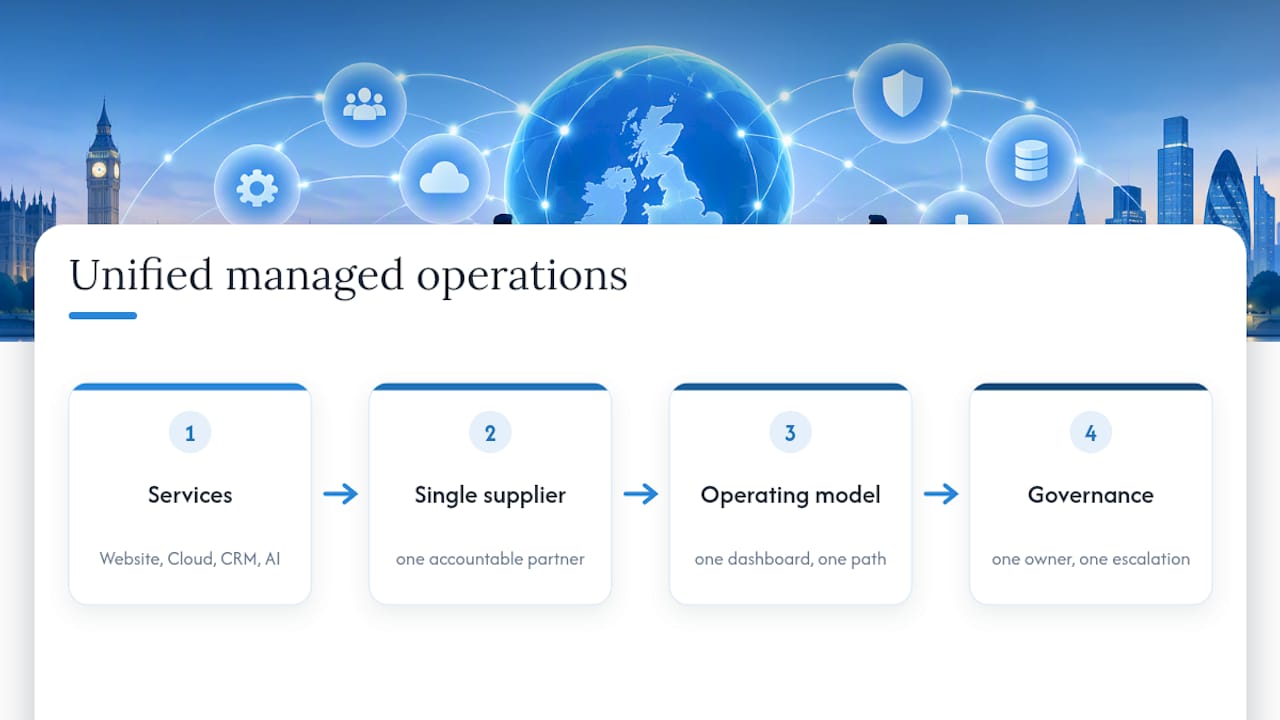
For certain organisations, this approach means clearer reporting lines and a single relationship to govern instead of multiple. It fits the operating model outlined above: one dashboard, one escalation path, one supplier accountable for the whole outcome.
Author view: when to outsource, when to build internally
Building internal capability makes sense when the function is core to your competitive position; outsourcing makes sense everywhere else. The clearest signal that outsourcing is worth piloting is a repeated, well-defined task that nobody wants to own internally. My practical advice: spend more time on governance design than on vendor selection. A mediocre supplier with strong oversight outperforms a brilliant one left unmanaged. Run a small pilot before committing to anything larger.
— Rob
Cloud 9: a governed managed-service option and next steps
If the governance model above sounds right but you would rather not build it from scratch, Cloud 9 already operates this way. Its Systems, Finance & Workflow Integration work and Website as a Service model are both structured around defined outcomes and ongoing reporting rather than one-off delivery and disappearance.
A 90 to 180 day pilot gives you a full review cycle to test outcomes, reporting and vendor fit before committing to a longer contract, matching the phased approach recommended earlier in this guide.
For AI-specific vendor evaluation, NEXTmsp’s AI transformation consulting is worth a look if you are assessing multiple suppliers’ AI claims side by side.
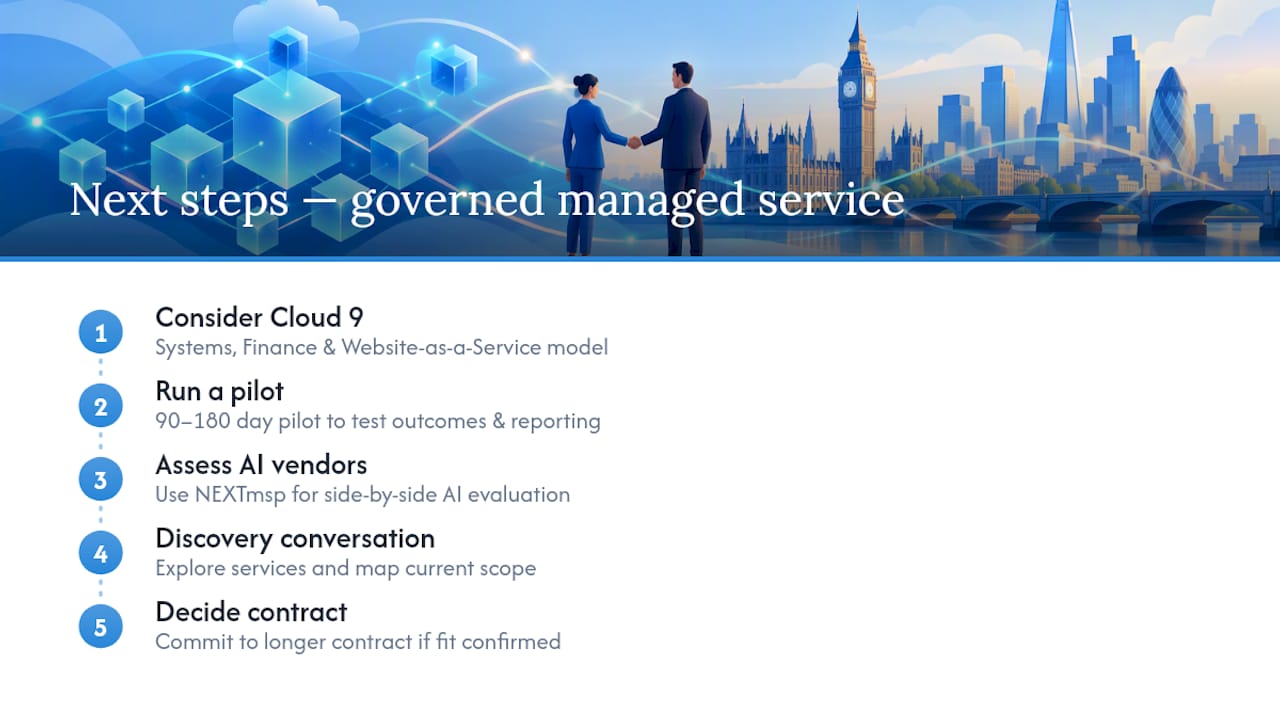
The practical next step is a discovery conversation: explore Cloud 9’s services and book a short workshop to map your current scope against the outcome-based model set out here.
Sources
- Global outsourcing survey 2024 | Deloitte
- Digital, Data and Technology Playbook (Central Digital and Data Office)
- UK Business Process Services Operations: Suppliers, Trends and Forecasts 2025 | TechMarketView
FAQ
Is outsourcing a dying concept?
No, outsourcing is not disappearing, though its shape is changing. Market research shows some organisations reducing spend with providers while others increase it for transformation and scale, suggesting a shift toward more selective, outcome-based use rather than a decline in outsourcing overall.
What is an example of BPO?
Business process outsourcing typically covers functions such as customer service, payroll processing or IT helpdesk support handled by an external provider. In digital operations, this extends to website management, CRM administration and marketing execution delivered by a managed-service partner rather than an in-house team.
What is operations outsourcing?
Operations outsourcing means contracting an external provider to run defined business processes, such as IT support, digital marketing or cloud administration, while the client retains oversight of outcomes and decision rights. It differs from simple staffing because the supplier owns delivery of a defined service, not just hours worked.
What does digital operations mean?
Digital operations covers the technology, systems and processes that keep a business running day to day: websites, cloud infrastructure, CRM systems, marketing automation and the security and backup measures around them. When these are outsourced, the aim is to keep the outcomes and governance internal while the delivery work sits with a specialist partner.