
Use chatbots for scale and routine enquiries, live chat for complex or emotionally sensitive cases, and expect most mature support operations to run both together. Businesses deploying AI agents must also stay transparent about their use, in line with Gov, which keeps a human in the loop for anything that affects a customer’s rights.
TL;DR:
- AI chatbots are most effective for handling high-volume, routine inquiries with immediate response times, especially outside normal business hours.
- Live chat provides superior support for complex, sensitive, or high-value issues that require human judgment, empathy, and discretion.
- Hybrid models that combine bots for triage and escalation to humans offer the best balance of speed, accuracy, and customer satisfaction.
- Proper deployment involves pilot testing within your own content, ongoing knowledge base tuning, and strict transparency and data ownership practices.
- Clear escalation triggers, such as negative sentiment or repeated failed matches, are essential for maintaining quality and compliance in hybrid support systems.
Table of Contents
- What do we mean by chatbot and live chat?
- How chatbots and live chat compare on the metrics that matter
- Weighing the pros and cons for your business
- How to choose: a checklist for procurement and operations teams
- Hybrid models and handover patterns that actually work
- What deploying this in practice actually involves
- Why hybrid, done properly, beats picking a side
- Getting a hybrid chat setup built properly
- Where to check the detail
- Sources
- FAQ
What do we mean by chatbot and live chat?
A chatbot is software that answers customer messages without a person typing the reply in real time. There are two broad types still in wide use. Rule-based chatbots follow scripted decision trees: they work well for narrow, predictable tasks like checking an order status or resetting a password, but they break down the moment a query strays off script. AI or NLP-based chatbots use natural language processing to interpret intent more flexibly, and many now pull answers from a knowledge base using retrieval methods rather than fixed scripts, which makes them more adaptable but also more prone to confidently wrong answers if the underlying content is thin.
Live chat, by contrast, puts a real person on the other end of the conversation, usually through agent tooling that shows conversation history, canned responses, and sometimes a view of the customer’s CRM record. The quality of live chat depends heavily on that tooling and on how well agents are trained, because a human with no context performs little better than a poorly built bot.
Many organisations now run a hybrid setup: a bot handles the opening exchange, gathers intent and basic account details, then hands over to an agent when the query gets complicated. The strengths of each channel show up clearly once you separate them:
- Rule-based chatbots: predictable, cheap to run, limited to scripted scenarios.
- AI-driven chatbots: flexible language handling, wider coverage, higher risk of inaccurate answers without good grounding.
- Live chat: human judgement and empathy, higher cost per conversation, bound by staffing hours.
- Hybrid handover: bot triage followed by agent escalation, aiming to combine speed with accuracy.
The rest of this guide treats “chatbot” as shorthand for both rule-based and AI-driven variants unless the distinction matters, and “live chat” as any support channel where a human agent is typing the response.
How chatbots and live chat compare on the metrics that matter
Decision makers rarely choose a channel on gut feel. They weigh it against a handful of concrete dimensions, and the two channels pull apart sharply on most of them.
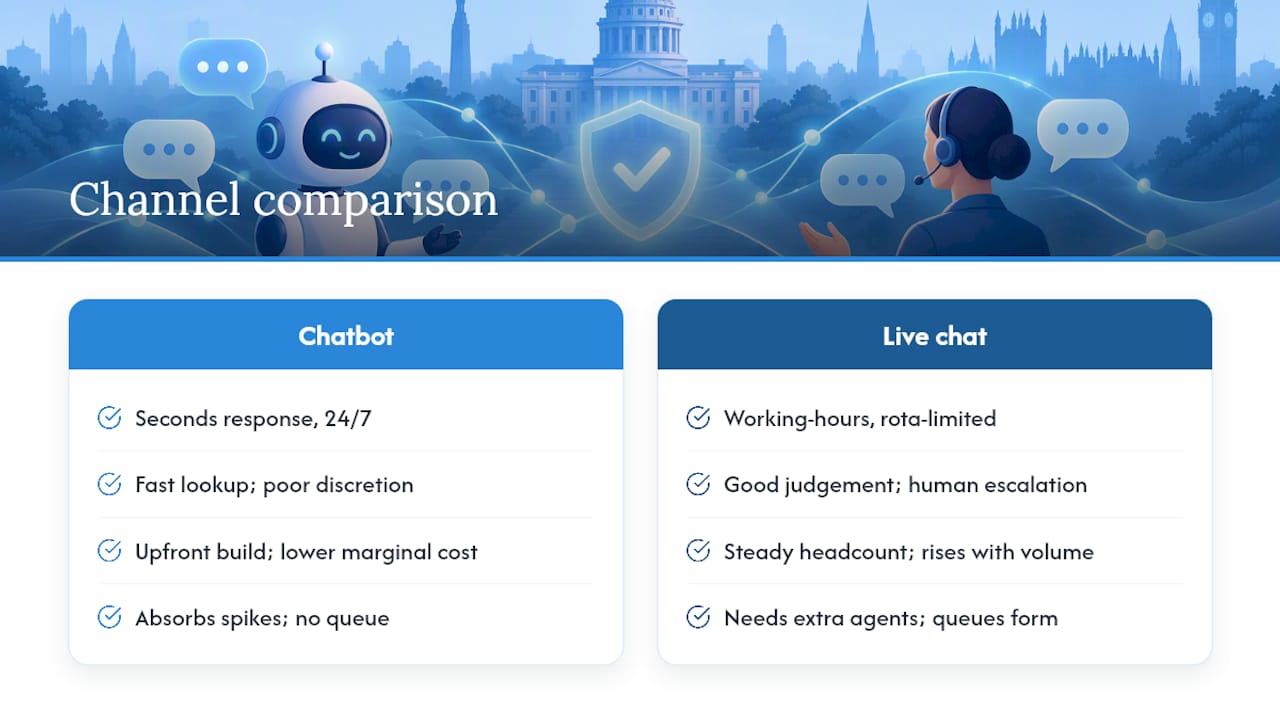
Response time and availability is the clearest split. A chatbot can respond in seconds, around the clock, with no queue and no time zone problem. Live chat is only as available as your rota allows, so a query at 11pm either waits until morning or gets routed to an overnight team you have to pay for. Customers have come to expect fast, chat-based responses as a default, and Forrester’s research on customer service expectations points to a widening gap between what customers expect and what most support operations actually deliver. That gap is exactly where 24/7 bot coverage earns its keep.
Handling complexity and escalation flips the advantage. A bot can look up an order number in seconds but has no judgement when a customer is disputing a charge, describing a bereavement affecting their account, or asking a question that touches on a refund entitlement. Anything involving discretion, distress, or a legal or contractual grey area needs a human, and the routing logic should treat that as a rule rather than an exception.
Cost and staffing follow a different shape for each channel. A chatbot carries an upfront build cost and then an ongoing tuning cost that never really stops, while live chat carries a steady, headcount-linked cost that rises in a straight line with volume. The practical implication: bots get cheaper per conversation as volume grows, live chat does not.
Scalability and peak handling is where bots show their real value. A product recall, a billing error, or a seasonal spike can multiply contact volume overnight, and a bot absorbs that without a queue forming, while a live chat team facing the same spike either drafts in extra agents or leaves customers waiting. Gartner’s analysis of conversational AI trends suggests conversational AI is set to materially reduce contact centre volumes over time, which changes how support teams should plan staffing and routing rather than just adding headcount to cope with growth.
Personalisation and empathy still favour humans. An agent can read tone, adjust pace, and acknowledge frustration in a way that feels genuine, whereas a bot can only simulate warmth through scripted phrasing. That simulation is good enough for routine queries but thin when a customer is upset.
Integration and measurement decide whether either channel actually performs well in practice. Both need to sit inside your CRM and knowledge base, and both should be judged on the same core metrics: customer satisfaction (CSAT), first contact resolution (FCR), containment or deflection rate, and cost per contact.
Statistic: Industry adoption trends tracked by Forrester show customers increasingly favour chat-based channels for rapid, low-effort tasks, which is why containment rate on simple queries has become a standard KPI for support leaders assessing bot performance.
Pro Tip: Track containment rate and CSAT side by side, not separately: a bot can post a high containment rate while quietly dragging CSAT down if it is resolving queries the customer didn’t actually want resolved that way.
Weighing the pros and cons for your business
Each channel earns its place for different reasons, and the weaknesses are just as instructive as the strengths.
- Chatbot advantages: instant answers at any hour, no queueing during spikes, and a much lower cost per conversation once the bot is trained and stable.
- Chatbot drawbacks: a risk of confidently wrong answers when the bot lacks good grounding, a real ongoing maintenance burden, and a ceiling on how much genuine empathy it can convey.
- Live chat advantages: agents can reason through unusual problems, de-escalate frustrated customers, and build the kind of trust that matters on sensitive or high-value matters.
- Live chat drawbacks: cost per conversation stays high regardless of volume, quality depends entirely on staffing and training, and coverage outside contracted hours means either paying for a rota extension or leaving customers waiting.
- Sector patterns worth noting: ecommerce sites often see a lift in conversion when live chat is available at the point of purchase, as covered in Cloud 9’s guide to live chat in ecommerce; utility providers lean on chatbots to automate high-volume, repetitive FAQs; and B2B SaaS support tends to need live chat or a hybrid model because the queries are technical and account-specific rather than generic.
The pattern across sectors is consistent: routine, high-volume, low-stakes queries suit bots, and anything technical, emotional, or high-value suits humans.
How to choose: a checklist for procurement and operations teams
Choosing between chatbot and live chat, or deciding how to blend them, comes down to matching your goals to measurable targets before you sign anything.
Start by mapping your business goals to the metrics that will tell you whether the channel is working: CSAT, containment rate, deflection rate, average handling time (AHT), and cost per contact. A bot that lowers cost per contact but tanks CSAT has not solved your problem, it has moved it.
On the technical side, a handful of requirements are non-negotiable. The system needs proper CRM integration so agents and bots see the same customer history, conversation persistence so a customer never has to repeat themselves, secure handling of any personal or payment data, and clear handover rules with full logging of what the bot said and why it escalated.
Operationally, someone has to own the bot. That means allocating tuning hours every month, agreeing an SLA for how fast a stuck conversation reaches a human, and keeping the knowledge base current, because a bot trained on last year’s policies will confidently give last year’s answers.
- Watch for vendor “black box” models that won’t explain how an answer was generated or let you audit a transcript.
- Be wary of unclear data ownership: know exactly where conversation data lives and who can access it.
- Insist on human-in-the-loop escalation and a rapid rollback option if the bot starts underperforming.
- Confirm the deployment meets GOV.UK transparency expectations for AI agents, including clear disclosure that the customer is talking to an AI agent.
Pro Tip: Before you sign anything, ask the vendor to show you a real transcript where the bot escalated badly. How they answer tells you more about the product than any demo will.
Hybrid models and handover patterns that actually work
The pattern that tends to work in practice is bot-first triage: the bot greets the customer, confirms intent, authenticates them if needed, and either answers directly or escalates with full context attached.
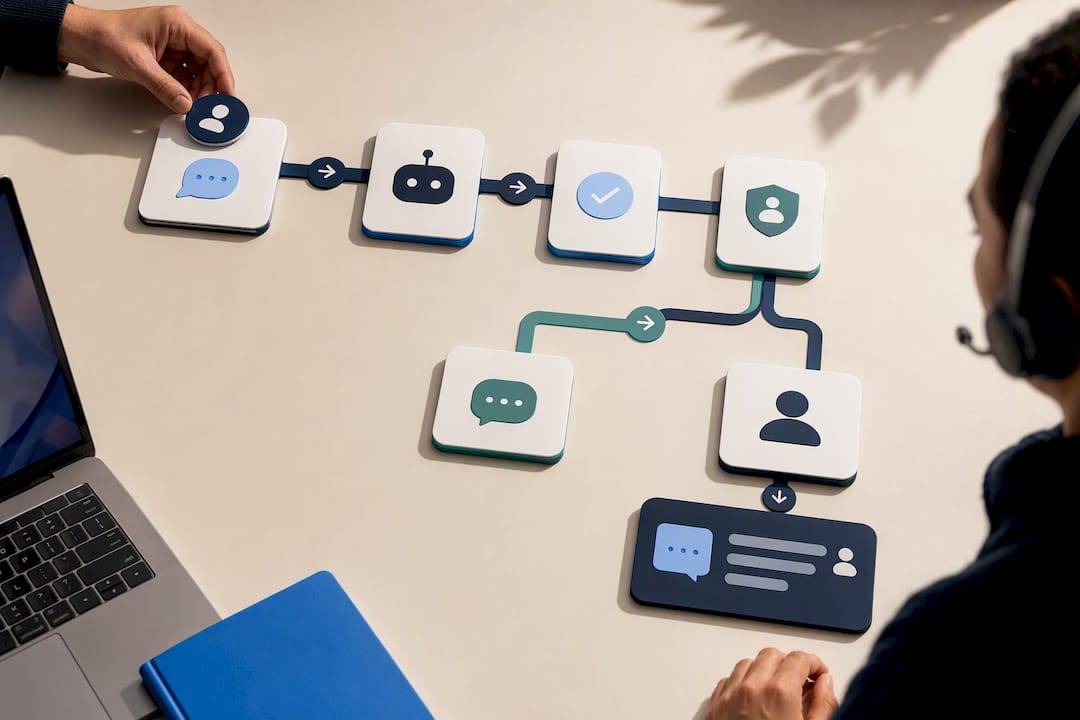
Certain signals should trigger an automatic handover rather than leaving it to the bot’s judgement: negative sentiment in the customer’s language, two or more failed attempts to match intent, a flagged high-value account, or any query touching legal or financial matters. Passing the full transcript, relevant metadata, and a CRM link to the agent at the point of handover removes the single biggest source of customer frustration, which is repeating information they already gave the bot.
None of this stays static. A working hybrid setup needs a feedback loop: someone reviewing a sample of transcripts regularly, tracking where the bot’s intent matching is failing, and retuning on a fixed cadence rather than waiting for complaints to force the issue. Cloud 9’s guide to AI chatbots and internal knowledge assistants covers this handover logic in more technical detail for teams building it themselves.
- Bot collects intent and authenticates before attempting an answer.
- Negative sentiment or repeated failed matches trigger immediate escalation.
- Full transcript and CRM context travel with the customer to the agent.
- Transcript review and retuning happen on a set schedule, not reactively.
What deploying this in practice actually involves
Some digital service providers build AI chatbots, internal knowledge assistants, and CRM automation as part of a wider managed digital service, with deployments typically following a phased pilot rather than a big-bang rollout. An 8 to 12 week pilot, grounding answers in retrieval-augmented generation (RAG) against your own documentation, with human oversight built in from day one, gives you a measurable result before you commit to scaling it. An 8 to 12 week ChatGPT pilot approach outlines the five stages in more detail.
The reality that catches most businesses out is maintenance. Ongoing tuning, not the initial build, is the main cost driver over the life of a chatbot, and it needs a named owner and a fixed monthly time allocation for transcript review and knowledge base updates.
- Practical AI automation and CRM integration often sit inside core service ranges, not as bolted-on extras.
- Pilots are grounded in your own content and reviewed by a human before wider rollout.
- Transparency and accuracy checks are recommended to meet GOV.UK expectations for AI agents, not treated as an afterthought.
Why hybrid, done properly, beats picking a side
Most of the argument over chatbot versus live chat is a false choice. The organisations getting real value are not the ones with the flashiest bot or the biggest agent team, they are the ones who decided early which queries a machine should never touch and enforced that boundary without exception.
Start smaller than you think you need to: automate FAQs and basic triage first, prove the containment rate holds up without dragging CSAT down, and only then extend scope. Skip the governance work and you will eventually ship a bot that gives a wrong answer to a real customer on a real financial or legal question, and the transparency obligations under GOV.UK guidance mean you cannot quietly walk that back. Measure defensibly, keep a person able to intervene at any point, and treat the bot as a colleague that needs supervision rather than a replacement that needs none.
— Rob
Getting a hybrid chat setup built properly
Some providers design and manage AI chatbots, CRM integration, and the wider systems work that sits behind them, as part of a joined-up service rather than a standalone bot with no support around it. That matters because a chatbot bolted onto a CRM nobody maintained rarely survives its first busy quarter.
Pilots follow the same grounded, human-in-the-loop approach covered above: answers rooted in your own content through RAG, a person checking accuracy before wider rollout, and compliance checks built in against GOV.UK transparency expectations rather than left for later.
- Chatbot and internal assistant builds sit alongside CRM and marketing automation, so context never gets siloed.
- Pilots run on a fixed timeline with defined KPIs, not an open-ended build.
- Ongoing tuning and knowledge base maintenance are handled as part of the managed service, not left to whoever has time.
If you are weighing chatbot against live chat for your own support operation, Cloud 9’s AI automation services page sets out how a pilot gets scoped and run.
Where to check the detail
For the legal side, read GOV.UK’s guidance on complying with consumer law when using AI agents directly rather than relying on a summary. For market context, Forrester’s commentary on customer service expectations and Gartner’s predictions on conversational AI are worth reading in full. For a practical next step, Cloud 9’s pilot guide and its chatbot optimisation partner article both cover implementation detail this piece only summarises.
Sources
- Gov
- Consumer expectations for customer service don’t match what companies deliver – Forrester
- Gartner press release on conversational AI predictions
FAQ
What is the difference between live chat and a chatbot?
Live chat connects a customer to a human agent typing in real time, while a chatbot is software that generates responses automatically, either from a fixed script or using AI to interpret intent. The practical difference shows up in availability and judgement: a chatbot is available continuously and handles routine queries at speed, while live chat depends on staffing hours, but handles complex or sensitive issues far better.
What are the four types of chatbots?
Definitions vary across the industry, but a common grouping covers rule-based (scripted, decision-tree) bots, AI or NLP-driven bots that interpret free text, voice-based assistants, and hybrid bots that combine scripted flows with AI fallback for anything the script doesn’t cover. Most customer service deployments today use either a rule-based bot for narrow tasks or an AI-driven bot for broader coverage.
How can you tell if you’re chatting with a bot rather than a person?
Under GOV.UK guidance on AI agents, businesses are expected to disclose clearly when a customer is interacting with an AI agent, so a properly compliant chat should tell you upfront. Practical signs beyond disclosure include very fast, uniformly structured replies, an inability to handle a question phrased slightly differently, and no acknowledgement of emotional tone.
Is ChatGPT a chatbot?
Yes, in the broad sense: ChatGPT is a conversational AI system that generates responses to text input, which fits the general definition of a chatbot. It differs from most customer service chatbots in that it isn’t grounded in a specific business’s knowledge base unless it’s deliberately connected to one, which is why business deployments typically use retrieval-augmented generation to ground answers in their own content.