Web analytics is the process of collecting and analysing website data to monitor performance and understand user behaviour. It answers three questions every digital marketer and business analyst needs to answer: who visits your site, what they do when they get there, and whether they complete the actions that matter to your business. The role of web analytics goes far beyond counting page views. It gives you the evidence to act with confidence rather than guesswork, and any marketing decision made without that evidence is, as analysts consistently put it, a decision made blind. This article covers the key metrics, best practices, and practical applications that make web analytics indispensable for businesses in 2026.
What role does web analytics play in measuring website performance?
Web analytics is the discipline of turning raw website data into decisions. The industry term for this practice is digital analytics, though “web analytics” remains the widely used shorthand across marketing and business analysis teams. Both terms describe the same core function: measuring what happens on your site and using that information to improve outcomes.
User behaviour tracking monitors page visits, clicks, time on site, and exit points. This data reveals where visitors lose interest, which pages hold attention, and which content drives people toward a purchase or enquiry. Conversion tracking then connects those behavioural signals to commercial outcomes, measuring the return on investment from every digital channel.

Web analytics data comes from two primary sources. Page tagging uses JavaScript snippets placed on each page to capture real-time visitor interactions. Server logs record every request made to your web server, offering a more technical view of traffic. First-party data collected directly from your own visitors is now the most reliable source, particularly as third-party tracking methods face increasing restrictions.
The distinction between on-site and off-site analytics also matters. On-site analytics covers everything that happens within your website. Off-site analytics examines your presence and reputation across the wider web, including social mentions, backlink profiles, and search visibility. Together, they give a complete picture of digital performance.
Core metrics every analyst should track
- Sessions and users: The number of visits and unique individuals arriving at your site within a given period.
- Bounce rate: The percentage of visitors who leave after viewing only one page. A high bounce rate on a landing page signals a mismatch between the ad and the content.
- Session duration: How long visitors spend on your site. Longer sessions generally indicate stronger engagement.
- Conversion rate by channel: The percentage of visitors from each traffic source who complete a target action. This metric directly links marketing spend to business results.
- Exit pages: The last pages visitors view before leaving. Persistent exit patterns on key pages often reveal friction in the user journey.
- Customer acquisition cost (CAC) and customer lifetime value (CLV): These connect web activity to financial performance and inform budget allocation decisions.
What are the best practices for web analytics in 2026?
The most important shift in web analytics practice is the move to first-party data collection. With third-party cookies now largely deprecated across major browsers, businesses that relied on cross-site tracking have lost significant visibility. First-party data, collected directly through your own website, CRM, and email systems, is now the most valuable and durable asset in any analytics strategy.
Privacy compliance is not optional. GDPR in the UK and EU, alongside CCPA in California, require that analytics strategies are built with consent and data minimisation from the outset. This means implementing clear cookie consent mechanisms, anonymising IP addresses where required, and documenting your data processing activities. Treating compliance as an afterthought creates legal exposure and erodes visitor trust.
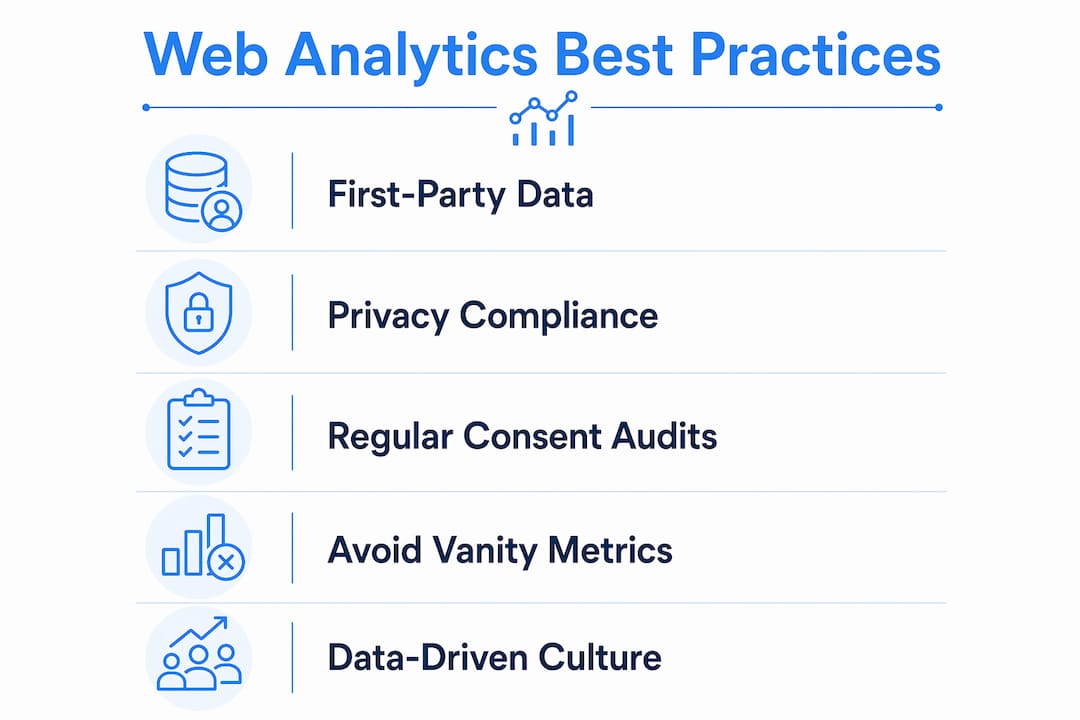
Pro Tip: Audit your consent rate regularly. If fewer than 60% of visitors accept analytics cookies, your data is materially incomplete. Consider a consent management platform to improve acceptance rates without compromising compliance.
Avoiding vanity metrics
Vanity metrics such as page views and total user counts can be misleading. They look impressive in a board report but rarely connect to revenue or growth. Conversion rate by channel, customer acquisition cost, and customer lifetime value are the metrics that actually inform strategy. Prioritise these over headline traffic figures.
Audience segmentation sharpens every insight. Rather than analysing all visitors as a single group, segment by traffic source, device type, geography, or behaviour. A visitor arriving from organic search behaves differently from one arriving via a paid social ad. Treating them identically produces averaged data that is useful to no one.
Modern attribution has also moved beyond last-click models. Multi-touch attribution models including time-decay, position-based, and data-driven approaches using machine learning assign credit across multiple touchpoints in the customer journey. This gives a far more accurate picture of which channels genuinely drive conversions, and it prevents marketers from over-investing in the final touchpoint while ignoring the channels that built awareness and intent.
Building a data-driven culture means embedding analytics thinking at every level of the organisation, not just within the marketing team. When product managers, content writers, and sales teams all understand what the data shows, decisions improve across the board.
How does web analytics support smarter decision-making?
Digital performance is inherently measurable, and that measurability is the foundation of every good marketing decision. Web analytics translates website activity into evidence that justifies or challenges assumptions about what is working.
The most direct application is identifying high-performing channels. When you can see that organic search delivers a conversion rate three times higher than paid display, you have a clear case for reallocating budget. Without that data, budget decisions default to habit or opinion.
- Conversion funnel analysis: Analytics reveals exactly where visitors drop out of a purchase or sign-up process. Fixing a single friction point in a checkout flow can produce a material lift in revenue without any increase in traffic spend.
- Content performance: Pages with high traffic but low conversion signal a content or relevance problem. Pages with low traffic but high conversion signal an opportunity to drive more visitors to what already works.
- Campaign attribution: Linking UTM parameters to specific campaigns lets you measure the precise contribution of each piece of marketing activity to pipeline and revenue.
- Resource allocation: When you know which pages, channels, and campaigns generate the most value, you can direct time and budget toward them with confidence.
Pro Tip: Connect your analytics platform to your CRM. When web behaviour data and sales data sit in the same system, you can trace a closed deal back to the first page a prospect ever visited. That connection transforms analytics from a reporting tool into a revenue intelligence system.
Real-time analytics enables immediate response to campaigns, traffic spikes, conversion drop-offs, and website errors. A sudden spike in traffic from an unexpected source, or a sharp drop in form completions, becomes visible within minutes rather than days. That speed of response is the difference between capitalising on an opportunity and missing it entirely.
What tools and dashboards help teams act on analytics data?
Analytics dashboards present key performance indicators and trends in a visual format that makes insights accessible to the whole team, not just analysts. A well-built dashboard removes the need to run manual reports and keeps decision-makers focused on the metrics that matter.
The most useful dashboards combine several data layers in one view. Traffic sources, user behaviour flows, conversion funnels, and goal completions should all be visible without switching between reports. When a campaign manager can see at a glance that a landing page is receiving traffic but converting poorly, they can act immediately rather than waiting for a weekly report.
Integration with marketing and CRM systems multiplies the value of analytics data. When your analytics platform connects to your CRM and marketing automation tools, you can track the full customer lifecycle from first visit to closed deal. This integration removes the data silos that cause marketing and sales teams to work from different versions of the truth.
Automated alerts are an underused feature in most analytics setups. Setting threshold alerts for conversion rate drops, traffic anomalies, or error spikes means your team responds to problems in real time rather than discovering them in a monthly review. This is particularly valuable for businesses running paid campaigns, where a broken landing page can waste significant budget in hours.
Visual data storytelling matters more than most analysts acknowledge. A chart that clearly shows a 40% drop in mobile conversions after a site update tells a story that a spreadsheet cannot. Teams that present analytics findings visually make faster, more confident decisions. Cloud 9 builds performance-focused websites with analytics integration built in from the start, so dashboards reflect real business goals rather than generic traffic metrics.
Key takeaways
Web analytics is the foundation of evidence-based digital marketing, and businesses that embed it into their decision-making consistently outperform those that rely on assumptions.
| Point | Details |
|---|---|
| Define the right metrics | Focus on conversion rate by channel, CAC, and CLV rather than page views alone. |
| Prioritise first-party data | Build your analytics strategy around data you collect directly, not third-party sources. |
| Use multi-touch attribution | Assign credit across the full customer journey to understand which channels genuinely drive results. |
| Connect analytics to your CRM | Linking web behaviour to sales data turns analytics into a revenue intelligence tool. |
| Act on real-time data | Set automated alerts so your team responds to conversion drops and traffic anomalies immediately. |
Why I think most businesses are still using analytics wrong
The honest truth is that most organisations have analytics installed but not implemented. They have a tracking script on the site, a dashboard nobody opens, and a monthly report that confirms what everyone already assumed. That is not analytics. That is data collection theatre.
The businesses I see getting genuine value from web analytics share one habit: they start with a question, not a report. Before opening a dashboard, they ask, “Why did enquiries drop last month?” or “Which channel is driving our best customers?” The data then serves the question rather than the other way around.
The privacy shift has also forced a useful discipline. When you can no longer rely on third-party tracking to fill in the gaps, you have to be deliberate about what you measure and why. That constraint has pushed better analysts toward cleaner, more intentional data strategies. The businesses struggling are the ones that treated third-party data as a crutch rather than a supplement.
The future of web analytics sits at the intersection of first-party data, machine learning attribution, and CRM integration. Businesses that build that infrastructure now will have a compounding advantage. Those that wait will find themselves making expensive decisions with incomplete information. The website performance audit is often the best place to start: it surfaces the gaps in your current tracking before you invest in fixing the wrong things.
— Rob
How Cloud 9 puts web analytics to work for your business
Cloud 9 works with established UK businesses to build websites and digital marketing services that are designed around measurable outcomes from day one. Analytics is not bolted on after launch. It is built into the architecture of every project, from goal configuration and conversion tracking to dashboard setup and CRM integration.
If your current website is not giving you clear data on what is working and what is not, that is a solvable problem. Cloud 9’s web design and development service integrates analytics at every stage, so you always know where your visitors come from, what they do, and whether your site is earning its place in your marketing budget. Get in touch to find out what a properly instrumented website looks like for your business.
FAQ
What is the role of web analytics in digital marketing?
Web analytics measures how visitors find and interact with your website, enabling marketers to identify which channels, campaigns, and content drive conversions. It replaces assumption-based decisions with evidence drawn directly from user behaviour.
What are the most important web analytics metrics?
Conversion rate by channel, customer acquisition cost, and customer lifetime value are the metrics most directly linked to business outcomes. Page views and total sessions are useful context but should not drive strategy on their own.
How does first-party data affect web analytics in 2026?
With third-party cookies deprecated across major browsers, first-party data collected directly from your own website and CRM has become the primary source for reliable analytics. Businesses without a first-party data strategy now have significant blind spots in their tracking.
What is multi-touch attribution and why does it matter?
Multi-touch attribution assigns conversion credit across multiple touchpoints in the customer journey rather than only the last click. It gives a more accurate picture of which channels contribute to revenue, preventing marketers from over-investing in the final interaction while ignoring earlier influences.
How do analytics dashboards improve team decision-making?
Analytics dashboards consolidate traffic, behaviour, and conversion data into a single visual view, making it faster for teams to spot problems and opportunities. Automated alerts within dashboards enable immediate responses to conversion drops or traffic anomalies rather than waiting for scheduled reports.