

Personalisation strengthens client relations by turning generic interactions into relevant, timely experiences that clients actually value. When a business remembers what a client cares about, communicates at the right moment, and tailors its offer accordingly, the result is not just a warmer feeling — it is measurably higher retention, greater lifetime value, and stronger word-of-mouth. McKinsey’s research shows that organisations leading in personalisation generate around 40% more revenue from those activities than average performers. That gap is not a coincidence — it is the commercial expression of a psychological truth: people stay loyal to businesses that treat them as individuals.
The core mechanism runs in three steps: relevance creates an emotional connection, emotional connection drives repeat engagement, and repeat engagement compounds into loyalty and lifetime value. UK GDPR shapes how you collect and use the data that powers this, but it does not prevent it — it simply requires a lawful basis and transparency.
Key benefits to expect from well-executed personalisation:
- Higher client satisfaction and Net Promoter Score (NPS)
- Improved retention and reduced churn
- Conversion uplift on targeted campaigns and renewal prompts
- Better cross-sell and upsell performance as trust deepens
- A differentiated client experience that competitors find difficult to replicate
Key takeaways
Personalisation improves client relations by making every interaction more relevant, which builds trust, increases retention, and compounds into measurably higher lifetime value over time.
| Point | Details |
|---|---|
| Revenue impact is significant | McKinsey finds personalisation leaders generate around 40% more revenue from those activities than average performers. |
| Retention comes first | Improved client retention and NPS are typically the earliest and most consistent benefits of a well-run personalisation programme. |
| Data quality is the foundation | Clean, unified, consent-compliant client data is the prerequisite for effective personalisation — fix this before investing in new tools. |
| Measure with holdout tests | A 90-day holdout experiment comparing personalised versus standard cohorts gives reliable incremental lift data for stakeholder reporting. |
| Cloud9 delivers end-to-end | Cloud9 provides CRM configuration, AI automation, and managed integration for UK businesses building personalisation programmes. |
Table of Contents
- Why personalisation improves client relations: the full picture
- Why clients respond so strongly to personalised interactions
- The measurable business benefits: satisfaction, retention, and revenue
- How to implement personalisation that actually improves client relations
- Common pitfalls and how to avoid them (including UK privacy considerations)
- How to measure the impact of personalisation on client relations
- Where personalisation is headed: trends to prepare for now
- How a UK business used personalisation to improve client relations: a Cloud9 example
- The part most businesses get wrong about personalisation
- Cloud9 helps UK businesses build personalisation that actually works
- Sources
- FAQ
Why personalisation improves client relations: the full picture
Personalisation, in a business context, means using what you know about a client to make every interaction more relevant to them specifically. That sounds obvious, but the scope is wider than most organisations initially assume.
At its simplest level, personalisation is a name in an email subject line or a product recommendation based on past purchases. Most businesses are already doing this. The more commercially significant levels involve tailoring the entire client journey: the onboarding flow a new client receives, the account review format a long-standing client gets, the support response that references their specific configuration, or the renewal offer timed to their contract anniversary.
Across functions, it looks like this:
Marketing: Segmented email campaigns with content matched to industry, lifecycle stage, or stated preference. Personalised email campaigns consistently outperform batch-and-blast sends on open rate, click-through, and conversion.
Onboarding: A new client in professional services receives a welcome sequence that references their specific goals from the discovery call, not a generic “getting started” PDF.
Customer support: A support agent (or chatbot) greets a returning client by name, sees their account history, and skips the verification questions they have already answered twice.
Account management: A quarterly business review is structured around the client’s own KPIs, not a standard template. Milestone moments — a contract anniversary, a product upgrade, a team change — trigger a personal outreach rather than silence.
The distinction between surface personalisation (a name tag) and structural personalisation (a genuinely tailored experience) is where most of the commercial value sits. Surface personalisation is table stakes in 2026. Structural personalisation is the competitive differentiator.
Why clients respond so strongly to personalised interactions
Personalisation works because it signals something that clients rarely articulate but always feel: you are seen here. That signal does real psychological work.
Research published via Wiley found that message relevance directly increases affective commitment — the emotional bond a client feels towards a company — and that perceived effort interacts with relevance to deepen both calculative and affective commitment. In plain terms: when a client believes you have put thought into what you send them, they feel more attached to you, and that attachment feeds loyalty and referral behaviour.
There is also a cognitive mechanism at work. Clients face constant information overload. A relevant message cuts through because it requires less mental effort to process — it matches what they already care about. An irrelevant one, by contrast, trains them to ignore you. Over time, that erosion is hard to reverse.
The experiential loyalty loop: SAGE research on algorithmic personalisation describes a three-stage cycle — a client has a successful personalised interaction, feels recognised, engages more, and in doing so provides richer data that makes the next interaction even more relevant. Each positive exchange deepens the relationship. The risk runs the other way too: poor personalisation (wrong name, irrelevant offer, outdated preference) triggers what the researchers call ‘depersonalisation’ — a sense of being reduced to a data point rather than treated as a person — and that accelerates churn.
University of Nebraska research adds a trust dimension: personalisation raises benevolence trust, the belief that a company genuinely has your interests at heart. In B2B and professional services contexts, this matters enormously. Clients who trust your intentions stay through difficult patches, refer colleagues, and give you the benefit of the doubt when something goes wrong.
The measurable business benefits: satisfaction, retention, and revenue
The commercial case for personalisation is well-evidenced, though the scale of benefit varies by sector, data maturity, and execution quality.
McKinsey reports that well-executed personalisation programmes typically drive revenue lifts in the 10–15% range, with company-specific outcomes spanning 5–25% depending on execution quality and data maturity. The leaders in their research generate significantly more revenue from personalisation activities than average performers — a gap that tends to widen as programmes mature and data compounds.
Engagement lift: EHL’s summary of industry research notes that around 71–72% of consumers expect personalised interactions, and that personalised calls-to-action can substantially outperform generic equivalents in engagement rate.
For UK businesses, the sequencing of benefits matters. Retention and share-of-wallet improvements tend to arrive first — clients who feel recognised renew more reliably and expand their relationship before they look elsewhere. Conversion uplift on targeted campaigns follows as segmentation sharpens. Higher-margin outcomes (bespoke offers, premium tier migration, referral-driven new business) come later, once trust and data depth are both in place.
Key commercial outcomes to plan for:
- Retention uplift: Clients who receive relevant, timely communication churn less. This is typically the earliest and most consistent benefit.
- NPS and CSAT improvement: Personalised service interactions score higher on satisfaction surveys, particularly in professional and financial services.
- Conversion rate gains: Targeted campaigns with personalised content convert at higher rates than generic outreach across email, PPC, and web.
- Cross-sell and upsell performance: Clients who trust you are more receptive to relevant recommendations. The key word is relevant — a poorly timed upsell erodes the trust it was meant to exploit.
- Referral rate: Clients who feel genuinely valued refer more. This is one of the least-tracked but highest-value outcomes of a mature personalisation programme.
In financial and professional services specifically, Jigsaw Tree’s commentary argues that technology enables but people deliver the trust that sustains relationships. Younger clients in these sectors expect digital, tailored engagement as a baseline — not a differentiator.
How to implement personalisation that actually improves client relations
Start with data before you touch technology. The most common implementation failure is buying a CRM or marketing automation platform before the underlying client data is clean, unified, and governed. Fix the data first; the tools will work far better.
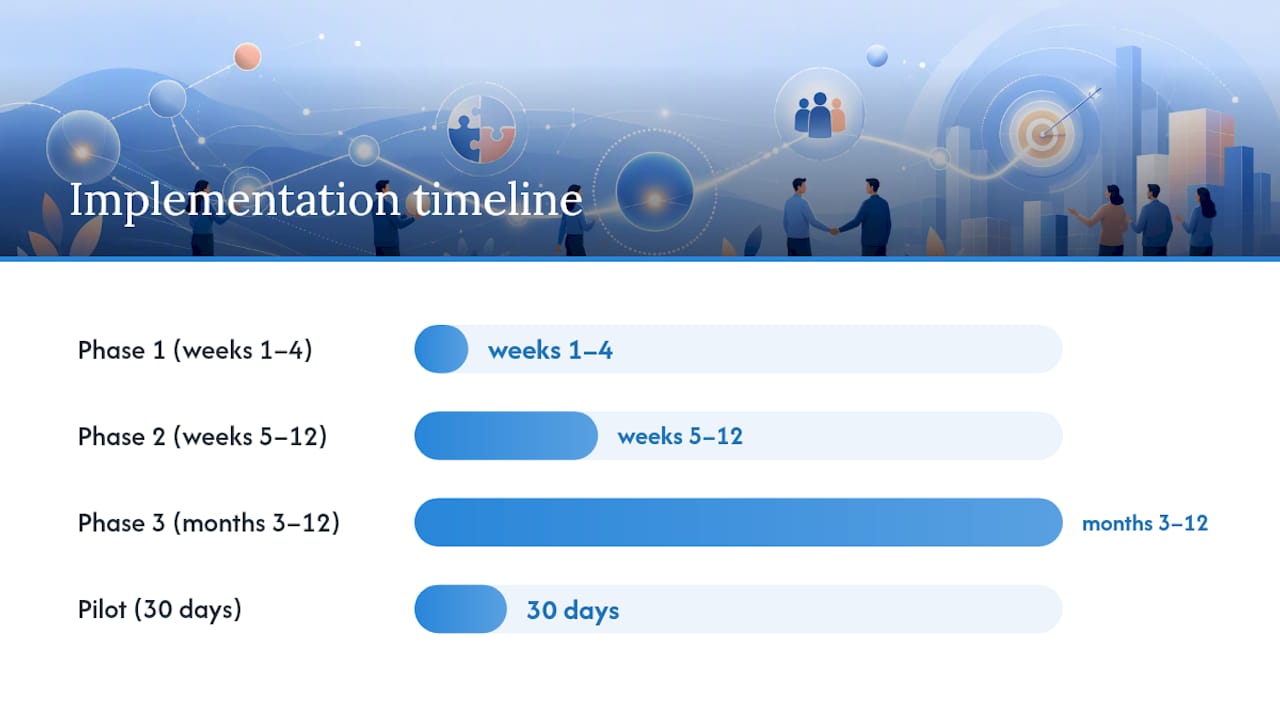
A phased approach works reliably:
Phase 1: Assess and prepare (weeks 1–4)
- Audit your current client data — what you hold, where it lives, how complete it is, and whether consent records are in order under UK GDPR.
- Identify the three or four client moments that matter most (onboarding, renewal, problem resolution, milestone outreach) — these are your highest-value personalisation opportunities.
- Map the current experience at each moment: what does a client actually receive today, and what would a personalised version look like?
Phase 2: Quick wins (weeks 5–12)
- Implement basic segmentation in your existing email or CRM tool — industry, lifecycle stage, product held, last interaction date.
- Build two or three personalised templates for your highest-priority moments (a tailored onboarding sequence, a milestone check-in, a renewal prompt that references the client’s specific usage or goals).
- Set up basic behavioural triggers: a follow-up when a client visits a pricing page, an alert when a key contact goes quiet for 60 days.
Phase 3: Scale and orchestrate (months 3–12)
- Introduce a CRM with proper pipeline and contact management if you do not already have one. Platforms with marketing automation built in allow you to connect behavioural data to outreach without manual effort.
- Consider a customer data platform or AI automation layer to unify data across your website, CRM, support desk, and finance system. Digital integration is what makes cross-channel personalisation possible at scale.
- Deploy AI chatbots for real-time personalised support interactions — these can surface account history, answer product-specific questions, and route complex queries to the right person without the client repeating themselves.
- Build a preference centre so clients can tell you how they want to be contacted, on what topics, and at what frequency. This is both a compliance asset and a personalisation signal.
Governance and cross-functional ownership
Personalisation fails when nobody owns it. Marketing typically drives the programme, but sales, customer success, support, and legal all have a role. Assign a named owner for data quality, a named owner for content and segmentation, and a named owner for compliance sign-off. Review the programme quarterly.
Pro Tip: Before building complex automation, run a manual personalisation pilot on your top 20 accounts for 30 days. Tailored check-ins, bespoke content, milestone acknowledgements — done by a person, not a platform. The response rate and feedback from that pilot will tell you exactly which moments and messages to automate first, and it costs almost nothing.
Common pitfalls and how to avoid them (including UK privacy considerations)
Most personalisation programmes stumble on execution, not strategy. The problems are predictable, and most are avoidable.
- Bad data: Outdated job titles, merged duplicate records, missing consent flags. Personalisation built on dirty data produces embarrassing errors (wrong name, wrong company, wrong product reference) that damage trust faster than no personalisation at all. Run a data audit before any campaign goes live.
- Organisational silos: Marketing sends a warm renewal email the same week support is handling an unresolved complaint for the same client. Without shared visibility, personalisation becomes incoherent. A unified CRM that all client-facing teams use is the structural fix.
- Robotic personalisation: Inserting a first name and a product name into a template does not constitute personalisation if the message is otherwise irrelevant. Clients notice. The signal that matters is relevance, not the presence of their name.
- Over-personalisation: Demonstrating that you know a client’s browsing history in granular detail can feel intrusive rather than helpful. The test is whether the personalisation serves the client or serves the business. If it feels like surveillance, pull back.
- Outdated preferences: A client’s priorities change. A preference captured at onboarding may be wrong 18 months later. Build preference refresh prompts into your annual review or renewal cycle.
UK GDPR considerations: Personalisation relies on personal data, so lawful basis matters. For most B2B personalisation, legitimate interests is the applicable basis — but you must document the balancing test, give clients a clear right to object, and keep records. Where you use cookies or tracking pixels for behavioural data, UK GDPR and the Privacy and Electronic Communications Regulations (PECR) require informed consent. Keep your privacy notice current, honour opt-outs promptly, and do not retain data longer than your stated retention period. The ICO’s guidance is the authoritative reference for UK businesses navigating this.
How to measure the impact of personalisation on client relations
The KPIs that matter most for client relations are not click-through rates. They are the metrics that reflect the health of the relationship over time.
Primary KPIs:
- Net Promoter Score (NPS): Tracks whether clients would recommend you. Segment by personalisation cohort to see whether personalised clients score higher.
- Client retention / churn rate: The clearest signal of relationship quality. Compare retention rates between clients who receive personalised treatment and those who do not.
- Customer Lifetime Value (CLV): Personalisation should increase CLV through higher retention, greater share-of-wallet, and referral. Track it at segment level.
- Conversion uplift: On targeted campaigns, compare personalised versus generic variants. Even a simple A/B test on email subject lines or landing page content gives you directional data quickly.
- Referral rate: Track how many new clients cite an existing client as their source. This is the downstream measure of relationship quality.
A simple experiment playbook:
Run a holdout test. Take a segment of 200–400 clients and randomly assign half to receive personalised outreach (tailored content, milestone triggers, bespoke renewal prompts) and half to receive your standard communication. After 90 days, compare retention, NPS, and conversion between the two groups. This incremental lift measurement is more reliable than comparing before-and-after periods, which conflate personalisation effects with seasonal or market changes.
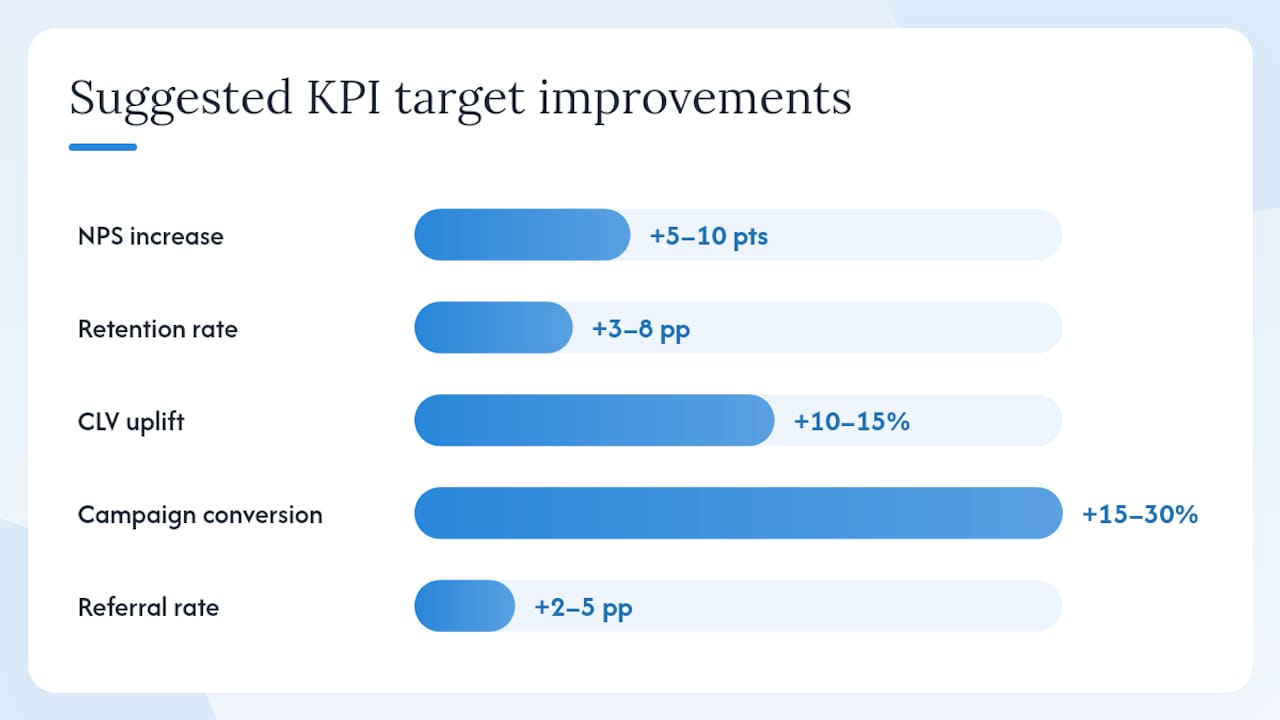
| KPI | Why it matters | Suggested cadence | Sample target improvement |
|---|---|---|---|
| NPS | Reflects overall relationship quality and referral intent | Quarterly | +5–10 points vs control |
| Retention rate | Direct measure of loyalty and churn prevention | Monthly / quarterly | +3–8 percentage points |
| CLV | Long-term commercial value of the relationship | Annually | 10–15% |
| Campaign conversion rate | Measures relevance of personalised content | Per campaign | +15–30% vs generic variant |
| Referral rate | Downstream signal of genuine client advocacy | Quarterly | +2–5 percentage points |
On attribution: Personalisation touches multiple channels simultaneously, so isolating its effect is genuinely difficult. Triangulate: if NPS rises, retention improves, and personalised campaigns outperform generic ones all at the same time, the programme is working even if you cannot attribute every pound of revenue to a single touchpoint.
Where personalisation is headed: trends to prepare for now
The direction of travel is clear: personalisation is becoming faster, more automated, and more privacy-constrained simultaneously. For UK businesses, three trends are worth acting on now.
- AI-driven real-time personalisation: Microsoft’s industry guidance outlines how AI integrated with customer data and orchestration tools can deliver relevant experiences at a scale no human team can match. The practical implication: businesses that invest in clean, unified data now will be able to activate AI personalisation far faster than those that do not. Next step this quarter: audit whether your CRM and website data are connected and exportable.
- Privacy-preserving techniques: Third-party cookies are effectively gone for most UK browsers. First-party data — what clients tell you directly, what they do on your own platforms — is the only reliable foundation. Preference centres, zero-party data collection (surveys, onboarding questions), and server-side tracking are the practical responses. For regulated UK sectors (financial services, legal, healthcare), this shift is already mandatory in spirit if not always in letter.
- Experience orchestration: The next maturity level beyond segmented email is coordinated personalisation across every touchpoint — website, email, support, sales, account management — driven by a single client profile. Businesses in financial services and professional services that get this right will find it very difficult for competitors to replicate, because the moat is the accumulated data and the trust it represents.
- Human plus AI balance: Automation handles volume; humans handle complexity and emotion. The risk of over-automating is real — a client in distress who receives a cheerful automated upsell has a worse experience than one who receives nothing. Build human escalation triggers into every automated flow.
How a UK business used personalisation to improve client relations: a Cloud9 example
A professional services firm approached Cloud9 with a familiar problem: their client communications were generic, their CRM data was fragmented across three systems, and their renewal process relied on account managers remembering to follow up manually. Retention was acceptable but not strong, and NPS scores were flat.
Cloud9’s approach followed the phased model described above:
- Data consolidation: Client records from the CRM, finance system, and support desk were unified into a single profile. Duplicate records were resolved and consent flags were audited against UK GDPR requirements.
- CRM configuration: A single CRM and marketing automation platform was configured with lifecycle stages, account health scores, and automated alerts for key signals (contract approaching renewal, support ticket unresolved beyond SLA, 60-day silence from a key contact).
- Personalised onboarding flows: New clients received a tailored welcome sequence referencing their specific goals from the sales process, with content matched to their industry and company size.
- Automation triggers: Milestone outreach (six-month review prompt, contract anniversary, product usage milestone) was automated but written to feel personal, with account manager names and client-specific references in every message.
- Measurement: NPS was tracked quarterly by cohort. Retention was measured against the prior 12-month baseline. Campaign conversion rates were compared between personalised and generic variants.
Within 12 months, the firm reported meaningful improvements across all three primary KPIs, with retention and NPS showing the earliest and most consistent gains. Attribution caveats apply — other factors (market conditions, product improvements, team changes) always play a role — but the directional signal was clear and consistent with the broader evidence base.
For businesses considering a similar path, Cloud9’s portfolio of client work illustrates how integrated digital systems support personalisation at scale.
The part most businesses get wrong about personalisation
Most organisations treat personalisation as a marketing project. It is not. It is an organisational capability — and that distinction explains why so many programmes deliver underwhelming results despite significant technology investment.
The businesses that see the strongest outcomes are not necessarily those with the most sophisticated tools. They are the ones where marketing, sales, support, and account management share a single view of the client, agree on what “relevant” means for each segment, and have clear ownership of each touchpoint. The technology is an amplifier. If the underlying coordination is poor, automation just makes the incoherence faster and louder.
There is also a tendency to over-index on acquisition personalisation (targeted ads, personalised landing pages) and under-invest in retention personalisation (milestone outreach, bespoke reviews, proactive problem resolution). The evidence consistently points the other way: the highest-value personalisation moments are the ones that happen after a client signs, not before. A client who feels genuinely looked after at month six is far more valuable than one who was impressed by a personalised ad before they bought.
The other thing worth saying plainly: personalisation does not require a large budget or a complex tech stack to start. A well-maintained CRM, a disciplined segmentation approach, and three or four thoughtfully written templates will outperform a poorly governed enterprise platform every time. Start small, prove the lift, then scale.
Cloud9 helps UK businesses build personalisation that actually works
Personalisation at scale requires connected systems, clean data, and the right automation layer. Cloud9 brings all three together for established UK businesses, replacing the fragmented supplier model with a single partner who understands how the pieces fit.
The services most directly relevant to personalisation programmes are CRM and marketing automation, AI automation (including chatbots and decisioning workflows), digital marketing, and the managed infrastructure that keeps client data available and secure. Cloud9 handles the configuration, integration, and ongoing management — so your team focuses on the client relationships, not the plumbing.
If your client communications are still generic, your CRM data is fragmented, or your renewal process depends on someone remembering to follow up, the gap between where you are and where you could be is smaller than you think. Talk to Cloud9 about a personalisation audit — a practical starting point that maps your current data, identifies your highest-value moments, and sets out a phased plan you can act on immediately.
Sources
- The value of getting personalization right—or wrong—is multiplying
- How personalisation enhances business relationships and the customer experience
- Service personalisation and loyalty (University of Nebraska)
- Algorithmic personalisation and brand loyalty: An experiential perspective
- This research investigates how personalized communications enhance customer-company relationships
- Harnessing AI to supercharge personalised marketing at scale (Microsoft)
FAQ
Why is personalisation important for client relationships?
Personalisation signals to clients that they are recognised as individuals rather than account numbers, which builds benevolence trust and affective commitment. Research consistently links this to higher satisfaction, stronger retention, and greater willingness to refer.
Why do clients respond positively to personalised interactions?
Relevant messages reduce cognitive overload and create an emotional connection, clients feel seen and valued rather than processed. Wiley research shows that perceived message relevance directly increases affective commitment, which in turn drives loyalty and word-of-mouth.
What are the main business benefits of personalisation?
The primary benefits are improved client retention, higher NPS, better conversion rates on targeted campaigns, and increased customer lifetime value.
How do you personalise client relationships without breaching UK privacy law?
Under UK GDPR, most B2B personalisation relies on legitimate interests as the lawful basis — document your balancing test, give clients a clear right to object, and keep your privacy notice current. For behavioural tracking via cookies, PECR requires informed consent. A preference centre both satisfies compliance requirements and improves the quality of your personalisation signals.