

A single customer view (SCV) is a governed, unified customer record that lets marketing, sales and service teams act on the same facts about a person, instead of three conflicting versions in three separate systems. Done properly, it cuts wasted spend on duplicate contacts, sharpens personalisation, and keeps every team compliant with UK GDPR. Getting there depends far more on sequencing and ownership than on which platform you buy.
TL;DR:
- Building an SCV requires normalizing data from multiple sources such as CRM, ecommerce, and support tools before matching records to ensure high match rates.
- Start with a single high-value use case like personalized emails or support history and expand gradually to avoid scope creep and complexity.
- Regularly update and re-match profiles as customer data changes, and establish clear ownership and governance to prevent trust and accuracy issues.
- Data quality practices such as input validation, manual review of ambiguous matches, and ongoing audits are essential to maintain a reliable and compliant SCV.
- At its core, an SCV is more an organizational discipline than just technology, with success relying on defined ownership, rules, and sequencing over hardware or software investments.
Table of Contents
- What is SCV, and how does it differ from your CRM or CDP?
- What business results does a single customer view actually deliver?
- Which systems feed an SCV, and what components does it need?
- How do you build a single customer view, step by step?
- How does UK GDPR affect single customer view projects?
- What usually goes wrong, and how do you avoid it?
- Where does SCV actually get used, and what should you measure?
- How Cloud9 approaches single customer view projects
- Does an SCV change the customer experience beyond the metrics?
- Which technologies actually build and maintain an SCV?
- What data quality practices actually keep an SCV accurate?
- What do real SCV rollouts look like in practice?
- How do you keep a single customer view accurate over time?
- Sequencing beats software, every time
- Want help turning this into a working pilot?
- Sources
- FAQ
What is SCV, and how does it differ from your CRM or CDP?
An SCV is not a dashboard. It’s a governed “golden record”: one reconciled profile per customer, built by matching and merging data from every system that touches that person, then made available for others to query.
A minimal viable profile needs a few core fields to be useful, including a persistent unique identifier, core contact details like name and email, some transaction and interaction history, consent and preference flags, and timestamps of recent interactions.
The distinction that trips people up is SCV versus CRM versus customer data platform. A CRM stores and manages relationships; a CDP activates data for marketing; an SCV is the underlying system of record both should pull from. Buy the activation tool before you’ve built the record it needs, and you’ve bought expensive software with nothing reliable to feed it.
What business results does a single customer view actually deliver?
The commercial case is stronger than most sceptics expect. Personalisation built on a reliable profile drives measurable uplift in campaign response, because messages reflect what someone actually bought or asked about, not a guess based on one channel’s partial view.
Research by Experian and EDQ into UK organisations shows many companies expect cost reductions and increased customer value once they implement a proper single customer view.
The other gains stack up quickly:
- Fewer duplicate records mean less wasted print, postage and ad spend on the same person twice
- Support teams resolve queries faster when they can see the full history in one place, cutting servicing time
- Retention and upsell improve because you can spot at risk or high value customers early
- Suppression becomes reliable, so unsubscribed or lapsed contacts genuinely stop receiving messages across every channel, not just one
None of this needs exotic technology. It needs a record everyone trusts, and consistent rules for keeping it accurate. Cloud9 has seen this play out with personalised client communications built on unified data outperform generic broadcasts by a wide margin.
Which systems feed an SCV, and what components does it need?
Before touching any tooling, inventory every system holding customer data. Most mid-sized organisations are surprised by how many they find:
- CRM and sales pipeline records
- Ecommerce and order management platforms
- Billing and finance systems
- Customer support and ticketing tools
- Web and app analytics
- Loyalty or membership databases
- Offline sources: paper forms, event sign-ups, call centre notes
Each source needs its identity fields normalised before matching can work reliably. Phone numbers should follow the E.164 international format, emails should be lowercased and trimmed, and addresses need consistent formatting rules. Skip this step and your match rates collapse.
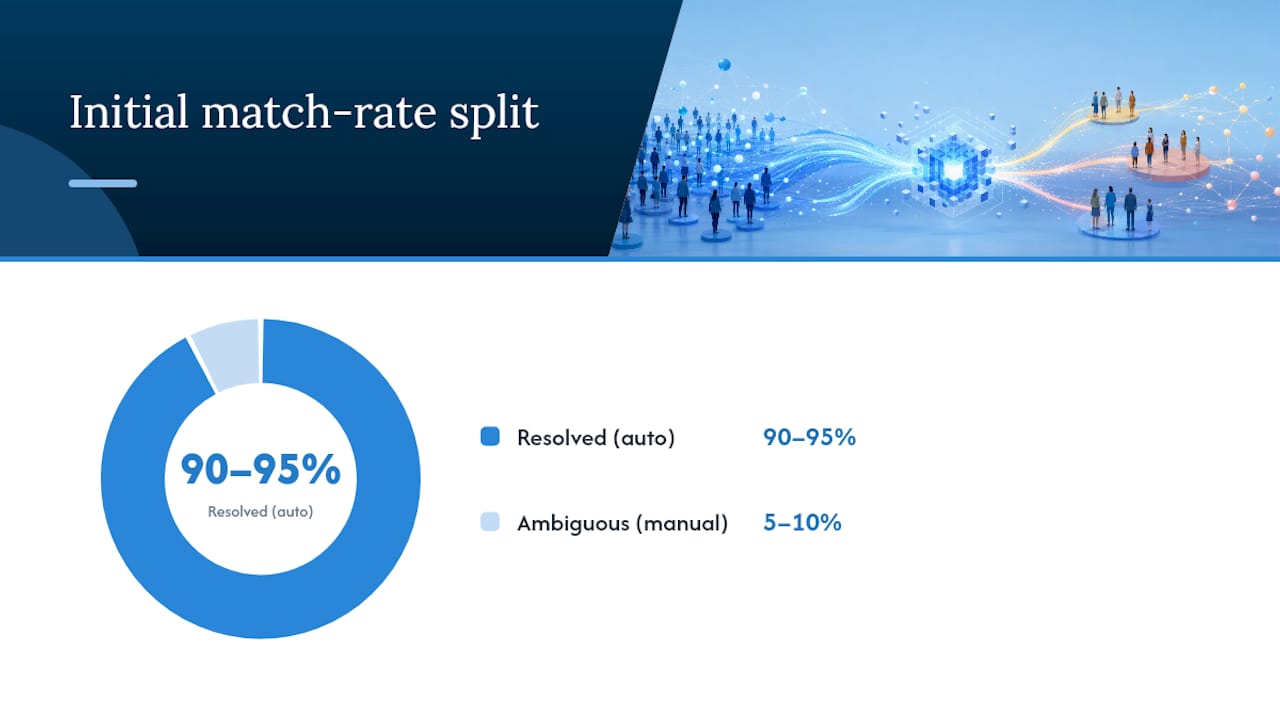
The technical architecture then breaks into four components: ingestion pipelines that pull data on a schedule, identity resolution logic that decides which records belong to the same person, a canonical store holding the reconciled golden record, and activation APIs that push profile data out to the systems your teams actually use. Set an initial match rate target, commonly somewhere in the 90 to 95 percent range for well structured data, and expect manual review for the remaining ambiguous cases.
How do you build a single customer view, step by step?
Most SCV projects that stall did so because teams bought a platform before doing the groundwork. Reverse that order and the project moves faster with far less political risk.
- Pick one high value use case. Choosing “everything” as the goal produces nothing usable. A single use case, such as personalised renewal emails, forces clarity on which fields actually matter.
- Inventory your sources and build a data dictionary. Map every field, every format, every owner across the systems identified earlier.
- Write identity resolution rules before choosing tools. Decide your tolerance for precision versus recall: would you rather miss a match or risk merging two different people into one record?
- Ingest, cleanse, match, and build the golden record. This is the technical core, but it depends entirely on the rules from step three.
- Activate the profile into frontline systems. Push it into the CRM, the support desk, the email platform, wherever the use case from step one needs it.
- Measure match rate, profile completeness, and the business KPI you targeted. Then expand to a second use case.
Pro Tip: Treat your first SCV build as a 60 to 90 day pilot rather than an enterprise rollout. A minimum viable profile with one activation can be live in that window, while full enterprise coverage typically takes six to twelve months depending on how fragmented your data is.
How does UK GDPR affect single customer view projects?
Pseudonymised data is still personal data under UK GDPR if re-identification is reasonably possible, so an SCV project cannot treat hashed or tokenised fields as automatically safe. ICO guidance on identifiability makes clear that the test is whether someone could realistically be identified, not whether the raw name is visible.
Statistic callout: UCL’s guidance on anonymisation and pseudonymisation stresses that pseudonymisation demands its own risk assessment; it is a safeguard, not an exemption from data protection law.
Build these controls in from day one:
- Record lawful basis and consent source as a queryable field on every profile, not a note buried in a spreadsheet
- Set retention timers per data element rather than one blanket policy
- Keep machine-readable consent records and a full audit trail of changes
- Run a simple test regularly: can you reconstruct exactly what consent existed and when for any given profile, on demand?
What usually goes wrong, and how do you avoid it?
Four failure modes account for most stalled SCV projects. Scope creep is the most common: trying to unify every data source at once instead of proving value on one use case first. Tooling-first thinking is a close second, where teams buy a platform before they’ve written a single identity rule, then discover the tool doesn’t fit their data.
Ownership ambiguity kills momentum quietly. If no single person is accountable for the profile’s accuracy, nobody fixes the small errors that accumulate into big trust problems. And governance bolted on late, after the architecture is built, is expensive to retrofit and often forces a rebuild.
The remedies mirror the problems directly:
- Ship a thin slice first: one use case, one activation, measurable within weeks
- Name one accountable owner for the golden record, not a committee
- Write identity resolution rules on paper before evaluating any software
- Design consent and retention fields into the schema from the outset, not as an afterthought
For board buy-in, bring a baseline: current duplicate rate, current campaign response, current average resolution time. Those numbers become your before-and-after evidence.
Where does SCV actually get used, and what should you measure?
An SCV only earns its cost once it’s activated somewhere a customer or a colleague notices. The most common starting points are personalised email built on real purchase history, suppression lists that actually stop unwanted contact across every channel, a unified view inside the support desk so agents stop asking customers to repeat themselves, and early churn signals surfaced from combined behaviour and transaction data.
Statistic callout: Data complexity and poor data quality remain the most commonly cited reasons UK SCV projects underperform, which is exactly why measurement from day one matters more than ambition.
Track these metrics from the pilot onward:
- Match rate: the percentage of records successfully linked to a single profile
- Profile completeness: how many of your minimum viable fields are populated per customer
- Campaign lift versus your pre-SCV baseline
- Duplicate reduction across your contact database
- Time-to-resolution in support, before and after the unified view
Start with one activation, prove the ROI with real numbers, then expand. Cloud9’s own work on personalised email campaigns shows this pattern repeatedly: the second and third use cases move faster once the first has already proven the record is trustworthy.
How Cloud9 approaches single customer view projects
Cloud9 builds SCV foundations as part of its wider CRM and marketing automation work with established UK businesses, connecting platforms such as HubSpot and QuickBooks so a client’s sales, finance and marketing systems reference the same customer record. A typical pilot shape mirrors the sequencing above: a minimum viable profile scoped to one priority use case, CRM integration to hold and surface it, and a single activation channel to prove value before wider rollout.
The pattern that works is deliberately unglamorous: fix the plumbing between systems first, get one activation live, then expand once the numbers justify it.
Does an SCV change the customer experience beyond the metrics?
The KPIs matter, but they don’t capture everything an SCV changes. Customers rarely notice a match rate improving. They notice when a support agent already knows what they ordered last week, or when a renewal email references the right product instead of a generic template.
That shift compounds. A customer who isn’t asked to repeat their account details for the third time trusts the business more, and that trust shows up later as fewer complaints and more forgiving behaviour when something does go wrong. Staff feel it too: sales and service teams stop working from spreadsheets and guesswork, and stop blaming each other when a customer complains that “nobody told me.”
There’s also a quieter organisational effect. Once departments share one factual profile, arguments about whose numbers are right largely disappear. Marketing and finance stop reconciling two different customer counts at the end of every quarter. That alignment rarely appears in an SCV business case, but it saves real management time.
The risk runs the other way too. A poorly maintained SCV, with stale consent flags or duplicate records that were never resolved, actively damages trust faster than having no unified view at all, because customers now get contacted based on outdated information with apparent confidence. Reliability, not sophistication, is what earns the experience benefit.
Which technologies actually build and maintain an SCV?
CRM systems remain the most common place UK businesses first attempt an SCV, largely because sales and service teams already work inside one daily. The limitation is scope: a CRM typically holds relationship data well but wasn’t built to reconcile records across ecommerce, billing and support systems simultaneously.
Data lakes and warehouses solve that reconciliation problem at scale, giving a single storage layer where ingestion pipelines can land raw data from every source before identity resolution runs. For larger organisations with many sources, this is usually where the canonical golden record actually lives, with the CRM and other frontline tools querying it via activation APIs rather than storing their own separate copy.
AI increasingly sits inside the identity resolution layer itself, used to score how likely two records represent the same person when exact matching on email or phone fails. This is genuinely useful for messy data, misspelled names, old addresses, but it needs a manual review tier for ambiguous matches rather than being trusted to merge automatically every time.
The honest answer for most established SME’s is a combination: CRM for frontline use, a data warehouse or lake for the canonical record if data volume justifies it, and identity resolution logic (increasingly AI-assisted) sitting between them. Businesses without complex data volumes can often run a lean version entirely inside a well-configured CRM with disciplined data hygiene, and shouldn’t feel pressured into infrastructure they don’t yet need.
What data quality practices actually keep an SCV accurate?
Data quality problems are cited as the leading reason SCV projects underperform in the UK, and most of that traces back to a handful of avoidable habits rather than genuinely difficult technical problems.
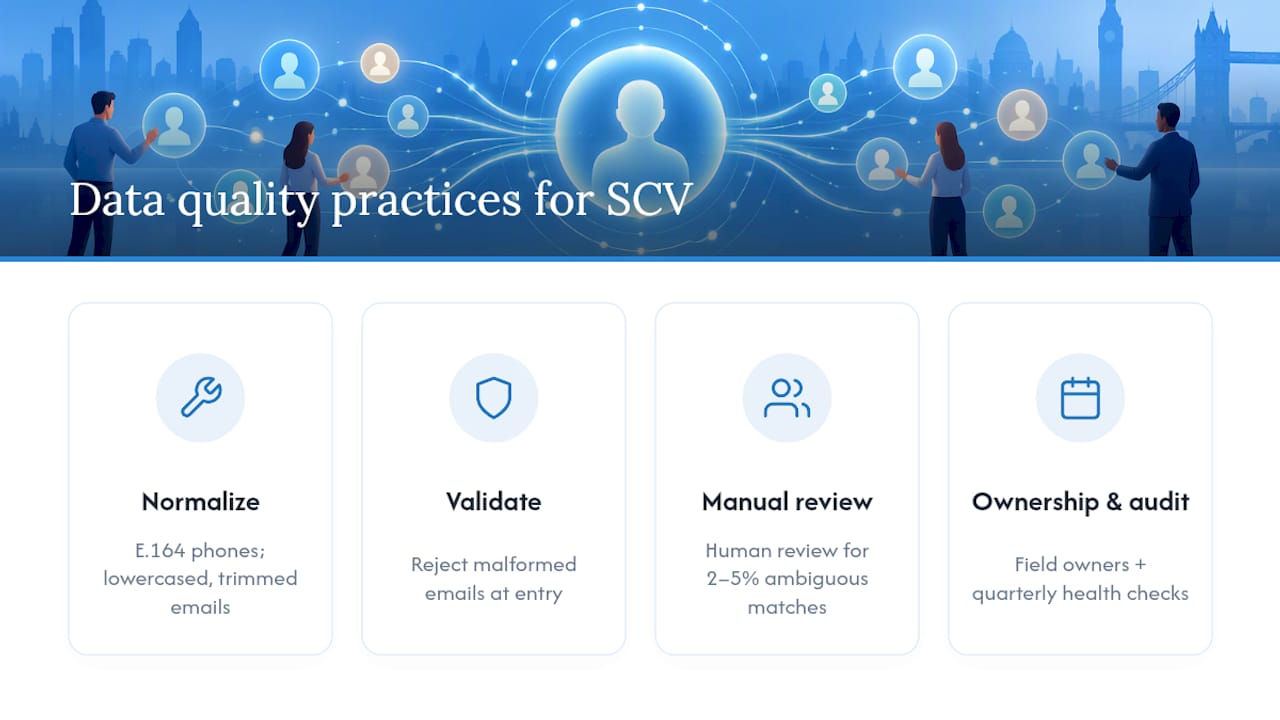
Normalise before you match, not after. Phone numbers in E.164 format and lowercased, trimmed email addresses dramatically improve match rates, because inconsistent formatting is the single biggest cause of records that should link but don’t.
Validate at the point of entry wherever you can. A web form that rejects an obviously malformed email address prevents a data quality problem before it ever reaches your golden record, which is far cheaper than cleaning it up later.
Set a manual review tier for ambiguous matches, typically somewhere between 2 and 5 percent of records depending on data quality going in, rather than forcing an automated system to make a binary call every time. Some near matches genuinely need a human eye, and pretending otherwise creates silent errors that erode trust in the whole profile.
Assign field-level ownership, not just system ownership. If marketing owns email preferences and finance owns billing address, both need a documented process for updating their piece of the shared record when a customer’s details change, or the profile drifts out of sync within months.
Finally, audit regularly rather than once at launch. A profile that was 95 percent complete at go-live degrades naturally as customers change jobs, numbers and addresses. Schedule a quarterly data health check rather than assuming the initial build holds indefinitely.
What do real SCV rollouts look like in practice?
The organisations that get SCV right rarely start with an ambitious enterprise-wide programme. They pick one measurable problem, most often duplicate contact records inflating campaign costs, or a support team unable to see a customer’s full history, and solve that first.
A membership organisation, for instance, typically holds member records in one system, event attendance in another, and payment history in a third. The practical starting point is rarely a full data platform. It’s reconciling those three sources into one profile, matched well enough that renewal reminders stop going out twice and support staff can see a member’s full history in one screen. That single change, achievable within a pilot window, tends to justify the case for expanding further.
Professional services firms follow a similar pattern with client records split across a CRM, a billing system and email. The thin slice approach documented by implementation practitioners consistently outperforms attempts to unify everything simultaneously, because each additional source multiplies the identity resolution complexity and the chance of introducing a duplicate rather than removing one.
The common thread across these examples isn’t a shared industry or company size. It’s the sequencing: audit first, define the minimum viable profile, prove value on one use case, and only then expand scope. Projects that reverse that order, buying a platform and hoping the data problem resolves itself, are the ones that stall.
How do you keep a single customer view accurate over time?
An SCV built once and never touched again degrades faster than most teams expect. Customers change email addresses, move house, switch jobs and update preferences constantly, and a static profile quickly becomes a source of embarrassing errors rather than a trusted asset.
Schedule re-matching runs regularly, not just at initial build. As new records enter from any source system, they need to run back through your identity resolution logic to catch new duplicates and update existing profiles, ideally on a near real time or daily basis for high change fields like contact preferences.
Review your manual review queue as a standing task, not a one-off cleanup. The 2 to 5 percent of records flagged as ambiguous matches accumulate continuously, and letting that queue grow unchecked slowly poisons overall match rate and profile trust.
Revisit consent and retention rules whenever your business adds a new marketing channel or data source. A retention timer written for email consent doesn’t automatically cover a new SMS channel, and assuming it does creates a compliance gap that only surfaces during an audit.
Finally, treat the data dictionary as a living document. New fields get added, old ones get deprecated, and if the documentation doesn’t keep pace, new team members inherit a system nobody fully understands. A brief quarterly review, checking who owns each field and whether it’s still accurate, keeps the whole record maintainable rather than becoming technical debt that eventually forces a costly rebuild.
Sequencing beats software, every time
The biggest misconception about SCV projects is that they’re primarily a technology purchase. They’re an organisational discipline problem wearing technology’s clothes. Every stalled project traced back to the same root cause: someone bought a platform before writing down what “the same customer” actually means for their business.
Get the owner and the identity rules right first. The tooling genuinely becomes the easy part.
— Rob
Want help turning this into a working pilot?
Most SME’s don’t need a data platform overhaul to get real value from a unified customer record, they need someone to connect the systems they already run and make the data behave. Cloud9 builds this as part of its CRM and marketing automation work, joining up your CRM, website, and finance tools into one coherent setup rather than leaving you to stitch fragmented suppliers together yourself.

A typical engagement follows the same sequencing covered above: a minimum viable profile scoped to one priority use case, CRM integration to hold it, and one activation channel proving the return before anything expands. Cloud9’s 60 to 90 day pilot approach is built for exactly this, a defined scope, measurable outcomes, and no assumption that you need to rebuild every system at once. If duplicate records, disconnected platforms, or inconsistent customer data are costing time or campaign performance, consider scoping what a pilot would look like for your setup.
Sources
For the original guidance behind this article, consult the ICO’s page on identifiability and personal data for legal certainty, and EDQ’s business case whitepaper for the underlying research figures. When in doubt on compliance specifics, the ICO remains the authoritative source.
FAQ
What is a single customer view?
A single customer view is one governed, reconciled record of a customer built by matching data from every system that holds information about them, from CRM to billing to support. It replaces fragmented, inconsistent versions of the same person with one factual profile that marketing, sales and service can all trust.
What is meant by “single view” in a business context?
“Single view” refers to seeing all relevant information about an entity, most often a customer, in one place rather than scattered across disconnected systems. In practice it means an agent, marketer or analyst can pull up one profile and see the complete picture rather than piecing it together from several logins.
What does the acronym SCV stand for?
SCV stands for single customer view, the standard industry term for a unified, governed customer record built from multiple data sources. It’s sometimes used interchangeably with “golden record,” though SCV specifically refers to the customer-facing application of that concept.
How long does building a single customer view take?
A minimum viable profile with one activation can go live within 60 to 90 days, while enterprise-wide coverage across many data sources typically takes six to twelve months. The timeline depends heavily on how fragmented and inconsistent your existing data is before the project starts.
Does a single customer view have to be UK GDPR compliant?
Yes. An SCV holds personal data by definition, and pseudonymised fields still count as personal data under UK GDPR if re-identification is reasonably possible, according to ICO guidance. Every profile needs a recorded lawful basis, documented consent, and defined retention periods built into the data model from the start.