

Cross-border ecommerce is the sale of goods or services through an online channel where the buyer and seller are in different countries. For a UK business, that means a customer in Germany, Australia, or Canada completing a purchase on your website or marketplace listing, with payment, fulfilment, and customs clearance all happening across national borders.
Three things every UK seller should know before going further:
- The market is substantial. 59% of global shoppers already buy from retailers outside their home country, and 35% do so at least once a month.
- The operational gaps are predictable. Landed-cost errors, missing customs documentation, and fragmented back-end systems are the most common failure points, according to Stripe’s cross-border ecommerce guidance.
- The first compliance step is your EORI number. You cannot export goods commercially from the UK without one. Register via Gov before anything else.
Key takeaways
Cross-border ecommerce requires correct customs documentation, accurate landed-cost calculation, and integrated back-end systems to scale profitably for UK businesses.
| Point | Details |
|---|---|
| EORI and VAT first | Register for an EORI number and assess your VAT position before your first international shipment. |
| Landed cost at checkout | Display duty and destination VAT estimates at checkout to prevent delivery refusals and unexpected refunds. |
| 59% of shoppers buy cross-border | Global demand is established; 64% of businesses already conduct or plan cross-border ecommerce. |
| Localisation drives conversion | Language, local currency, and local payment methods reduce abandonment and build trust in new markets. |
| Integration prevents margin erosion | Connecting payments, fulfilment, and finance into one system removes the manual steps that cause costly errors. |
Table of Contents
- How does cross-border ecommerce actually work, from order to delivery?
- What business models drive cross-border online sales?
- Why sell cross-border? The commercial opportunity for UK sellers
- What are the main risks and challenges in cross-border selling?
- A practical checklist for UK businesses starting cross-border sales
- Which platforms, payment providers, and carriers do UK sellers use?
- When do integrated systems make the difference for cross-border operations?
- The part most guides get wrong about cross-border ecommerce
- Sources
- FAQ
How does cross-border ecommerce actually work, from order to delivery?
The process looks simple from the customer’s side: they click, pay, and wait. Behind that, five distinct stages each carry their own friction.
1. Customer decision and checkout. The buyer selects a product and reaches the payment screen. If your checkout shows prices only in GBP, or lacks their preferred local payment method, a significant share will abandon before completing the purchase.
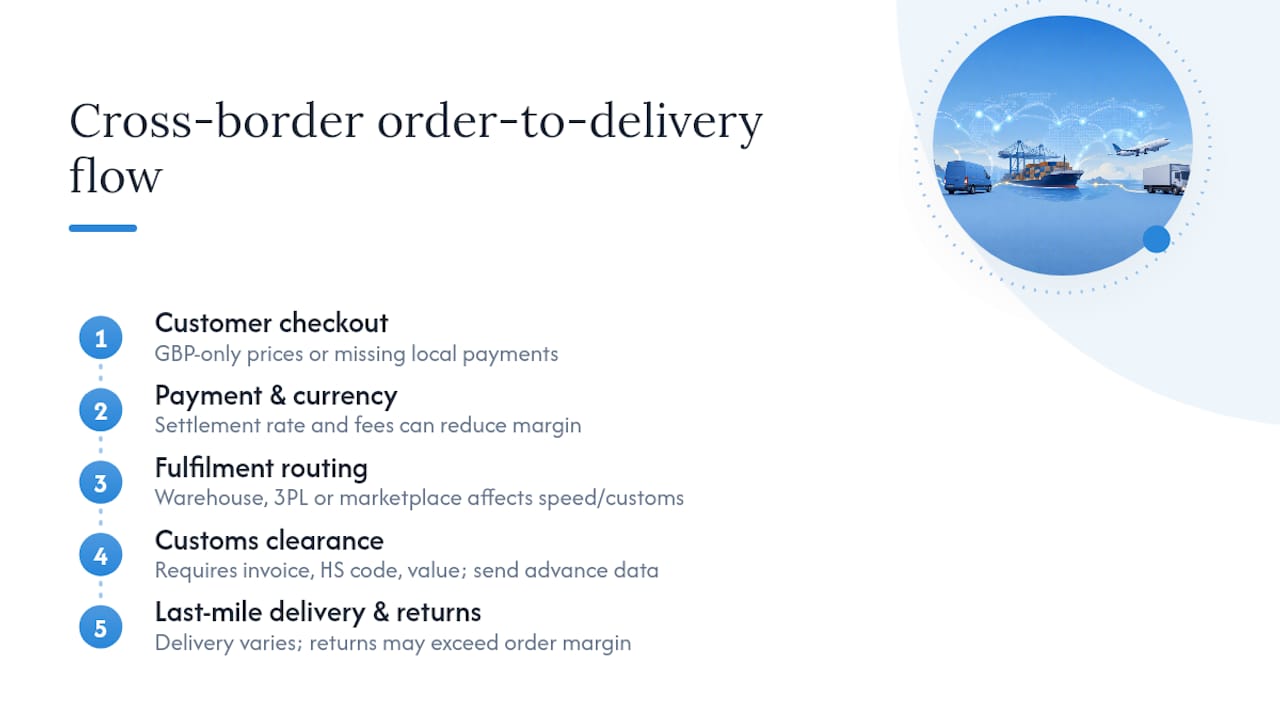
2. Payment authorisation and currency handling. Payment providers such as Stripe and PayPal handle multi-currency authorisation, but settlement back to your GBP account involves a conversion rate and, often, a fee. The rate applied at settlement can differ from the rate shown at checkout, so your margin on an international order is not always what it appears.
3. Fulfilment trigger and inventory routing. Once payment clears, the order routes to your fulfilment operation, whether that is a central UK warehouse, a third-party logistics (3PL) partner, or a marketplace fulfilment service. The choice of fulfilment model determines your delivery speed and customs exposure.
4. Customs clearance. Every commercial shipment crossing a border requires a customs declaration. That means a commercial invoice, a Harmonised System (HS) code for the product, and an accurate declared value. Customs authorities and carriers increasingly expect Advance Electronic Data before a parcel arrives, not after. Missing or incorrect data is the single most common cause of clearance delays and unexpected charges.
5. Last-mile delivery and returns. Carriers such as Royal Mail and DHL handle the final leg, but delivery promises vary significantly by destination. Returns are where many businesses underestimate cost: a cross-border return can cost more to process than the original order’s margin.
Pro Tip: Calculate the full landed cost — product price, shipping, import duty, and destination VAT — before the customer pays, not after. Showing a transparent total at checkout reduces delivery refusals and post-purchase disputes, which are disproportionately expensive on international orders.
What business models drive cross-border online sales?
International ecommerce is not one model. The four most common approaches each carry different operational demands.
B2C (business-to-consumer) is the most familiar: a UK brand sells directly to individual shoppers abroad via its own website or a marketplace. Shopify is the dominant hosted platform for this model, offering multi-currency pricing, localised checkout, and integrations with international payment providers out of the box. The volumes tend to be high, the order values lower, and the customs exposure is parcel-by-parcel.
B2B (business-to-business) cross-border selling involves selling to overseas companies, distributors, or trade buyers. Order values are larger, shipments are often palletised freight rather than small parcels, and payment terms (net 30, letters of credit) replace instant card transactions. The customs documentation burden is heavier, and VAT treatment differs from B2C in most markets.
D2C (direct-to-consumer) is a subset of B2C where a brand bypasses retailers entirely and ships to end customers. The margin opportunity is higher, but so is the operational complexity: you own the entire customer experience, including returns, in every market you enter.
Marketplace-driven cross-border uses platforms like Amazon’s Global Selling programme to reach international buyers without building your own international storefront. Amazon’s fulfilment network can handle customs, delivery, and returns in many markets, which reduces operational lift significantly. The trade-off is margin: marketplace fees and fulfilment costs compress what you keep per order.
According to Stripe, marketplaces and D2C websites are the two most common conduits for cross-border ecommerce, and most growing businesses eventually run both in parallel.
Why sell cross-border? The commercial opportunity for UK sellers
That demand is not hypothetical. The Avalara State of Global Cross-Border E-Commerce Report 2023–24 found that many manufacturers, retailers, and logistics service providers currently conduct or plan cross-border ecommerce, with a notable portion of their sales coming from cross-border transactions.
For UK businesses specifically, the commercial case rests on four pillars:
- Market expansion. Domestic demand has a ceiling. Cross-border access to markets in Europe, North America, and Asia-Pacific removes it.
- Seasonal smoothing. A product with a UK peak in November may peak in Australia in March. International sales can flatten revenue curves that would otherwise spike and trough.
- Product-market fit testing. Selling a small volume to a new market before committing to local warehousing or a local entity is a low-cost way to validate demand.
- Margin diversification. Some markets carry higher average order values or lower competitive intensity than the UK, which can improve blended margins.
The KPIs worth tracking from day one: percentage of orders from international customers, average order value by market, return rate by destination, landed-cost accuracy (estimated vs. actual duty and VAT), and delivery lead time against your stated promise.
What are the main risks and challenges in cross-border selling?
The challenges are real, but they are also well-mapped. Knowing where they cluster makes them manageable.
Logistics and customs. Small parcels and freight move through different customs regimes. A missing HS code or an incorrect declared value can hold a shipment for days and generate a clearance charge the customer was not expecting. The World Customs Organization recommends Advance Electronic Data submission as the standard for efficient low-value parcel clearance. Carriers like DHL and Royal Mail both support AED filing, but you need to provide the structured data.

Tax and duties. Post-Brexit, UK businesses exporting to the EU face import VAT and customs duties on every shipment. VAT registration thresholds vary by country: the EU’s One Stop Shop (OSS) scheme simplifies multi-country VAT filing for B2C sales above €10,000 in annual EU sales. For UK imports, HMRC’s guidance on customs declarations and import VAT is the authoritative starting point. Your EORI number is required for all commercial exports.
Payments and fraud. Card fraud rates are higher on cross-border transactions. Stripe and PayPal both offer fraud detection tools, but you also need to consider local payment preferences: iDEAL in the Netherlands, Klarna across Scandinavia, Alipay in China. A checkout that only accepts Visa and Mastercard will underperform in markets where those are not the default.
Customer experience and trust. DHL’s research shows that trust and transparent delivery matter more to cross-border shoppers than price. Showing prices in local currency, offering a clear returns policy, and displaying buyer protection signals are not optional extras.
Data privacy. Customer data collected from EU shoppers is subject to GDPR, even post-Brexit. If personal data leaves the UK for processing by a third-party service, you need a data processing agreement and, in some cases, a transfer mechanism. Consent tooling on your site helps with cookie compliance but does not replace the underlying contracts.
A practical checklist for UK businesses starting cross-border sales
Work through these in order. Skipping steps two or three creates problems that are expensive to fix later.
- Register for an EORI number via GOV.UK. This is your Economic Operators Registration and Identification number, required for all UK commercial exports.
- Assess your VAT position. Check whether you need to register for VAT in destination markets. For EU B2C sales above €10,000 annually, consider registering for the EU OSS scheme. Consult HMRC’s guidance and, for complex multi-market situations, a specialist customs adviser.
- Classify your products with HS codes. Every product needs a Harmonised System code for customs declarations. Incorrect codes cause delays and potential penalties. Use HMRC’s Trade Tariff tool to find the correct classification.
- Set up multi-currency pricing. Configure your platform (Shopify, for example, handles this natively) to display prices in the buyer’s local currency. Decide whether you will fix prices per market or use dynamic conversion.
- Calculate and display landed cost at checkout. Include estimated duty and destination VAT in the price the customer sees. Stripe’s guidance is clear that landed-cost errors are among the most common causes of delivery refusals and unexpected refund costs.
- Add local payment methods. Beyond card payments via Stripe or PayPal, identify the preferred payment rails in your target markets and integrate them.
- Prepare customs documentation templates. Commercial invoice, packing list, and HS code declaration should be templated and auto-populated from your order management system where possible.
- Choose a fulfilment model. Central UK warehouse with international shipping (lower upfront cost, slower delivery), 3PL with in-market fulfilment centres (faster delivery, higher fixed cost), or marketplace fulfilment (Amazon FBA for eligible products). Royal Mail and DHL both offer tracked international services with customs data integration.
- Write a clear international returns policy. State who pays return shipping, how refunds are processed, and the timeline. Post-purchase automation can handle returns notifications and status updates without manual intervention.
- Test before you launch. Place test orders to your target markets using test payment credentials. Verify that customs documentation generates correctly. Run a small pilot batch of real orders before scaling spend.
Pro Tip: Pick one market for your pilot, not five. A single-market pilot lets you identify documentation gaps, landed-cost errors, and customer experience issues without multiplying the variables. Germany, Ireland, and the United States are common first choices for UK sellers because of English-language compatibility or existing trade relationships.
Which platforms, payment providers, and carriers do UK sellers use?
The right combination depends on your model, order volume, and how much technical lift you want to own.
Ecommerce platforms
Shopify is the most widely used hosted platform for cross-border B2C and D2C. It supports multi-currency checkout, localised storefronts (Shopify Markets), and integrates with most international payment providers and fulfilment services. Setup is relatively fast, and the app ecosystem covers most localisation needs.
Amazon Global Selling gives UK sellers access to Amazon’s international marketplaces (US, EU, Japan, and others) without building separate storefronts. Amazon’s FBA network can handle fulfilment, customs, and returns in many markets. The trade-off is margin compression from fees and limited brand control.
Headless and enterprise platforms suit businesses with complex product catalogues or existing ERP systems. They offer more flexibility but require significant development resource and longer integration timelines.
Payment providers
Stripe handles multi-currency payment acceptance, fraud detection, and settlement in over 135 currencies. Its Radar fraud tooling is particularly relevant for cross-border transactions, where fraud rates tend to be higher. Stripe also supports local payment methods in many markets.
PayPal remains one of the most recognised payment options globally and carries strong buyer-trust signals in cross-border transactions. PayPal’s own research highlights that localising payment options is often the differentiator between stalled international sales and scalable growth.
Both providers integrate with Shopify and most other major platforms. For markets where card penetration is lower, you will need additional local payment method integrations.
Fulfilment and carriers
| Carrier / Model | Best suited to | Key consideration |
|---|---|---|
| Royal Mail International Tracked | Low-to-mid value small parcels | Cost-effective; AED support available |
| DHL Express / DHL eCommerce | Time-sensitive or higher-value shipments | Strong customs data integration; global network |
| Amazon FBA (international) | Marketplace sellers | Handles customs and returns; fee-heavy |
| 3PL with in-market warehousing | High-volume D2C or B2B | Faster delivery; requires inventory commitment |
When do integrated systems make the difference for cross-border operations?
Cross-border ecommerce generates data across more systems than domestic selling: payment platforms, customs software, inventory management, CRM, and finance all need to talk to each other. When they do not, the result is manual reconciliation, landed-cost disputes, and reporting that is always a week behind.

The integration checklist for a functioning cross-border operation covers: payment settlement reconciled to your accounting system (Xero, Sage, or QuickBooks), landed-cost calculations automated and fed back into pricing, order routing logic that selects the correct fulfilment centre and generates the right customs documents, returns management connected to inventory and finance, and KPI reporting that pulls from all of the above into a single view.
Ecommerce automation handles the repeatable parts of this, but the underlying system architecture needs to be right first. A business running Shopify for orders, Stripe for payments, a separate 3PL portal for fulfilment, and a standalone accounting package has four data silos. Every manual step between them is a potential error.
The signals that you have outgrown a manual approach: landed-cost disputes appearing regularly, customs documentation generated outside your order management system, finance reconciliation taking more than a day per week, and KPI reports built in spreadsheets rather than pulled automatically.
Cloud9’s managed services and CRM and marketing automation are designed specifically for established UK businesses at this inflection point: where the cross-border operation is generating revenue but the back-end is not keeping pace. A digital ecosystem integration approach connects payments, fulfilment, CRM, and reporting into a coherent system rather than a collection of disconnected tools.
Pro Tip: Before engaging any integration partner, map every data flow that currently requires a manual step. That map is your integration brief. It tells you exactly where automation will save time and where errors are most likely to occur.

If your cross-border operation is generating revenue but your systems are not keeping pace, Cloud9 can help you connect the pieces. From managed cloud services to CRM automation and ecommerce integration, we work with established UK businesses to build digital infrastructure that scales without adding operational overhead. Explore Cloud9’s services to see where we can reduce your cross-border friction.
The part most guides get wrong about cross-border ecommerce
Most articles about international ecommerce treat it as a logistics problem. Get the shipping right, sort the customs paperwork, and you are done. That framing misses the bigger issue.
The businesses that struggle with cross-border selling are not usually failing at shipping. They are failing at systems. Payment data sits in Stripe, order data in Shopify, customs data in a carrier portal, and finance data in Xero. Nobody has connected them. So every landed-cost dispute becomes a manual investigation. Every customs delay requires someone to chase a carrier by phone. Every month-end reconciliation takes a day longer than it should.
The conventional advice also overweights the compliance burden. Yes, EORI registration and VAT assessment matter, and you should do them first. But the businesses that scale cross-border profitably are the ones that automate the repeatable steps early: landed-cost calculation, customs document generation, returns processing, KPI reporting. The compliance steps are a one-time setup. The operational friction is ongoing, and it compounds.
There is also a persistent myth that cross-border ecommerce is primarily for large businesses. The platforms, payment rails, and carrier networks available to a UK SME today are the same ones available to a multinational. The difference is not access. It is whether the back-end systems are integrated well enough to handle the volume without breaking.
One more thing the standard guides understate: the customer experience gap. DHL’s research is unambiguous that cross-border shoppers prioritise trust and transparent delivery over price. A UK business that shows prices in GBP to a German customer, offers no local payment method, and provides no clear returns policy is not competing on price. It is just losing.
Sources
The following resources are worth bookmarking for ongoing compliance and market research:
- Cross-border ecommerce businesses explained | Stripe
- 2025 Cross-border buying behaviour trends | DHL eCommerce
- THE STATE OF GLOBAL CROSS-BORDER E-COMMERCE REPORT 2023-24
Always verify regulatory details against current GOV.UK and HMRC guidance before taking compliance action, as thresholds and requirements change.
FAQ
What is cross-border ecommerce?
Cross-border ecommerce is the online sale of goods or services between a business and a customer located in different countries. It includes both B2C and B2B transactions conducted through brand websites, marketplaces, or other digital channels.
What is an example of cross-border ecommerce?
A UK clothing brand selling through its Shopify store to customers in Germany, with payment processed via Stripe, goods shipped by DHL, and import VAT collected at checkout, is a straightforward example of cross-border ecommerce.
What does cross-border mean in business?
In a business context, cross-border refers to any commercial transaction, shipment, or financial flow that crosses a national border, triggering customs, tax, and regulatory requirements in both the origin and destination countries.
What is Amazon cross-border ecommerce?
Amazon’s Global Selling programme allows UK sellers to list products on Amazon’s international marketplaces (including the US, Germany, France, and Japan) and optionally use Amazon’s FBA network to handle fulfilment, customs clearance, and returns in those markets.
Do UK businesses need an EORI number for cross-border sales?
Yes. An Economic Operators Registration and Identification (EORI) number is required for all commercial exports from the UK. You can register for one via GOV.UK, and it is the first compliance step before shipping internationally.